Showing posts with label Philosophy. Show all posts

What Would Nietzsche Do?: How the Greatest Philosophers Would Solve Your Everyday Problems


Buy What Would Nietzsche Do? here. - Free delivery worldwide

Ever wondered if Schopenhauer could fix your broken heart? How Heraclitus might help you if you lost your phone? Given the chance, would Foucault leave the toilet seat up?

With sections on Relationships, Self and Identity, How to Live, Art and Aesthetics, and Politics, there is an answer to each of modern life's questions here. Each section is comprised of a collection of questions, from 'Is Shakespeare better than the Simpsons?' to 'Should I get a takeaway tonight?'; from little niggling questions, to the great mysteries of human existence. With Marcus Weeks's illuminating commentary on each philosopher's answer to the question at hand, you'll be spouting Socrates and discussing Descartes before you know it.

A guide to life, of sorts, and also a fantastic introduction to philosophy for anyone looking to broaden their knowledge of the subject.

Buy What Would Nietzsche Do? here. - Free delivery worldwide


http://freudquotes.blogspot.com/2016/04/freud-nietzsche-and-marx-rick-rodericks.html

The Anti-Oedipus Complex: Lacan, Critical Theory and Postmodernism


The Anti-Oedipus Complex critically explores the post-‘68 dramatic developments in Freudo-Lacanian psychoanalysis and cultural theory. Beginning with the decline of patriarchy and the master, exemplified by Freud’s paean for the Father, the revolutionary path was blown wide open by anti-psychiatry, schizoanalysis and radical politics, the complex antinomies of which are traced here in detail with the help of philosophers such as Nietzsche, Baudrillard, Levinas, Steiner, Žižek, Badiou, Derrida and Girard, as well as theologians, analysts, writers, musicians and film makers.

In this book, Rob Weatherill, starting from the clinic, considers the end of hierarchies, the loss of the Other, new subjectivities, so-called ‘creative destruction’, the power of negative thinking, revolutionary action, divine violence and new forms of extreme control. Where does this leave the psychoanalytic clinic – adrift in postmodern indifference? Does the engagement of the Radical Orthodoxy movement offer some hope? Or should we re-situate psychoanalysis within a ‘genealogy of responsibility’ (Patočka / Derrida) as it emerges out of the sacred demonic, via Plato and Christianity?

The Anti-Oedipus Complex will be of interest to psychoanalysts, psychotherapists, counsellors, social workers and scholars in critical theory, philosophy, cultural theory, literary theory and theology.

Nietzsche and the Clinic: Psychoanalysis, Philosophy, Metaphysics


Buy Nietzsche and the Clinic here. - Free delivery worldwide

Nietzsche and the Clinic reimagines what a sustained engagement with Nietzsche's thinking has to offer psychoanalysis today. Beyond the headlines that continue to misrepresent Nietzsche's project, this book portrays Nietzsche as a thinker of tremendous practical import for those treating the emergent pathologies of the twenty-first century with an interpretive approach.

The more pressing wager of the book is that, by introducing Nietzsche's thinking into contemporary debates about the nature and function of the psychoanalytic clinic, the future of that clinic can be better secured against attempts to discredit its claims to therapeutic efficacy and to scientific legitimacy.

Combining a close textual reading with examples drawn from concrete clinical practice, Nietzsche and the Clinic integrates philosophy and psychoanalysis in ways that move past a merely theoretical attitude, demonstrating how the relationship between philosophy and psychoanalysis can be expanded in ways that are both clinically specific and post-Freudian in orientation. Chapters include extended meditations on Nietzsche's relation to key themes in the work of Helene Deutsch, Wilfred Bion, Melanie Klein, Donald Winnicott, and Jacques Lacan.
 

The Unconscious Abyss: Hegel's Anticipation of Psychoanalysis


The first extended treatment of Hegel’s theory of the unconscious and his anticipation of Freud.

Offering the first comprehensive examination of Hegel’s theory of the unconscious abyss, Jon Mills rectifies a much neglected area of Hegel scholarship. Mills shows that the unconscious is the foundation for conscious and self-conscious life and is responsible for the normative and pathological forces that fuel psychic development. In addition, Mills illustrates how Hegel’s idea of the unconscious abyss transcends his time and is a pivotal concept to his entire philosophical system—one that advances the current understanding of the psychoanalytic mind.

Slavoj Žižek – Masterclass: Between Philosophy and Psychoanalysis

Masterclass 1: Lacan’s Hypothesis: Psychoanalysis as the Ex-Timate Core of Philosophy 
(31 October 2016)


"In the entire span of his teaching, Lacan was engaged in an intense debate with philosophy and philosophers, from ancient Greek materialists to Plato, from Stoics to Thomas Acquinas, from Descartes to Spinoza, from Kant to Hegel, from Marx to Kierkegaard, from Heidegger to Kripke. It is through the reference to philosophers that Lacan deploys his fundamental concepts: transference through Plato, the Freudian subject through Descartes’s cogito, surplus-enjoyment through Marx’s surplus-value, anxiety and repetition through Kierkegaard, the ethics of psychoanalysis through Kant, etc. Through this continuous engagement, Lacan is of course distancing himself from philosophy; however, all his desperate attempts to draw the line of separation again and again re-assert his commitment to philosophy – as if the only way for him to delineate the basic concepts of psychoanalysis is through a philosophical detour. Although psychoanalysis is not philosophy, its subversive dimension is grounded in the fact that it is not simply a particular science or practice but has radical consequences for philosophy: psychoanalysis is a “no” to philosophy that is internal to it, i.e., psychoanalytic theory refers to a gap/antagonism which philosophy blurs but which simultaneously grounds philosophy (Heidegger called this gap ontological difference). Without this link to philosophy – more precisely, to the blind spot of philosophy, to what is “primordially repressed” in philosophy – psychoanalysis loses its subversive dimension and becomes just another ontic practice."


Masterclass 2: Is it Possible to Move Beyond the Transcendental?
(1 November 2016)


Masterclass 3: The Prospect of the Post-Human
(2 November 2016)


Thanks mariborchan.si for uploading the videos!


See also:


Lacan and Philosophy: The New Generation ~ Free Ebook

The primary aim of this collection is to show that the topicality of Lacan’s legacy to contemporary philosophy is particularly evident with regard to current debates which, in attempting to overcome the spurious divide between continental and analytic traditions, as well as between the human, social and natural sciences, have been thoroughly rethinking the notions of realism and materialism, along with their implications for aesthetics, ethics, politics, and theology. More or less explicitly, all the essays included in the present volume tackle such a complex speculative articulation by focusing on the way in which a Lacanian approach can shed new light on traditional concepts of Western philosophy, if not rehabilitate them.

The ‘new’ in the ‘new generation’ that gives the title to the present collection of articles is far from rhetorical. All the authors included are under fifty years of age, and several are under forty. Without exception, they have, however, already secured a prominent position in debates concerning the relation between philosophy and psychoanalysis, or are in the process of doing so. The other contiguous novelty of this volume that marks a major shift from previous attempts at presenting Lacan in dialogue avec les philosophes is its markedly international dimension. Contributors reside and work in seven different countries, which are, moreover, not always their countries of origin. As the reader will be able to confirm by taking into consideration the respectful intensity of the many cross-references present in these essays – which should be taken as a very partial sedimentation of exchanges of ideas and collaborative projects that, in some cases, have been ongoing for more than a decade – geographical distance appears to have been beneficial to the overcoming of Lacan’s confinement to the supposed orthodoxy of specific – provincial – schools and their pathetic fratricidal wars, whilst in parallel enhancing intellectual rigour. These pieces rethink philosophically through Lacan, with as little jargon as possible, in this order, realism, god, history, genesis and structure, writing, logic, freedom, the master and slave dialectic, the act, and the subject.


Contents

Lorenzo Chiesa, ‘Editorial Introduction. Towards a New Philosophical-Psychoanalytic Materialism and Realism’

Alenka Zupan?i?, ‘Realism in Psychoanalysis’

Felix Ensslin, ‘Accesses to the Real: Lacan, Monotheism, and Predestination’

Adrian Johnston, ‘On Deep History and Lacan’

Michael Lewis, ‘Structure and Genesis in Derrida and Lacan: Animality and the Empirical Sciences’

Matteo Bonazzi, ‘Jacques Lacan’s Onto-graphy’

Guillaume Collett, ‘The Subject of Logic: The Object (Lacan with Kant and Frege)’

Raoul Moati, ‘Metapsychology of Freedom: Symptom and Subjectivity in Lacan’

Lorenzo Chiesa, ‘Wounds of Testimony and Martyrs of the Unconscious: Lacan and Pasolini contra the Discourse of Freedom’

Justin Clemens, ‘The Field and Function of the Slave in the Écrits’

Oliver Feltham, ‘The School and the Act’

Alvise Sforza Tarabochia, ‘Lacan with Basaglia: Psychoanalysis and Anti-Psychiatry’

About the Author

Lorenzo Chiesa is Professor of Modern European Thought at the University of Kent (UK), where he also serves as Co-Director of the Centre for Critical Thought. His research interests are in the area of Lacanian psychoanalysis; 20th century French thought; contemporary Italian philosophy and culture; Marxist theory.

Nietzsche and Psychoanalysis


This book presents a reading of the Nietzschean thought of the eternal return of all things and relates it to Freud's psychoanalysis of the repetition compulsion. Nietzsche's eternal return and Freud's repetition compulsion have never before been so seriously compared. The manner in which this study is executed is drastically different from usual Nietzsche scholarship and Freud studies. Chapelle works with his material until it acquires archetypal levels of significance, even while the level of everyday life experience is never abandoned. He returns the theory and practice of psychologizing and philosophizing to the old ground of imaginative poetic and ultimately mythic thought.

Freud and Nietzsche


Many of the leading Freudian analysts, including in the early days, Jung, Adler, Reich and Rank, attempted to link the writings of Nietzsche with the clinical work of Freud. But what was Nietzsche to Freud-an intuitive anticipation, a precursor, a rival psychologist? Assoun moves beyond the seduction of these attractive analogues to a deeper analysis of the relation between these two figures.

An Animated Introduction to Michel Foucault, “Philosopher of Power”


“Michel Foucault (1926-1984) was a French 20th-century philosopher and historian who spent his career forensically critiquing the power of the modern bourgeois capitalist state, including its police, law courts, prisons, doctors and psychiatrists. His goal was to work out nothing less than how power worked and then to change it in the direction of a Marxist-anarchist utopia. Though he spent most of his life in libraries and seminar rooms, he was a committedly revolutionary figure, who met with enormous popularity in elite Parisian intellectual circles (Jean Paul Sartre admired him deeply) and still maintains a wide following among young people studying at university in the prosperous corners of the world…”

See also:


The Wisdom of Lived Experience: Views from Psychoanalysis, Neuroscience, Philosophy and Metaphysics


In our quest toward truth we often rely on the guidance and clarity of conscious thought, but in doing so we may bypass awareness of a more deeply informing resource, which is embodied in lived experience. This book highlights aspects of this deeper dialogue where neuroscience (McGilchrist's work on right- and left-brain dynamics) and psychoanalysis (Freud, Klein, Winnicott, Bion, and others) verify the Hegelian dialectics that seem to underlie all living processes and perhaps all of Nature. Hegel's concept of Aufhebung embraces the creative negating transformations that carry forward what has gone before in new and evolving forms and structures.

Becoming, as on-going lived experience, exemplifies this dialectic as it embodies the cycle in which the emergence of unconscious (implicit) intuition is externalized and clarified (made explicit) via conscious notation and thought to then be enfolded back (made implicit once again) into the newly enriched unconscious matrix that becomes the root for the next intuition. While it is often difficult to surrender the clarified products of conscious thought, the deepest sources of wisdom in Becoming are those that involve the implicit and the bodily because the deepest reaches of Reality are those that resonate with somato-sensory experience.

Lacan's Return to Antiquity: Between nature and the gods


Lacan’s Return to Antiquity is the first book devoted to the role of classical antiquity in Lacan’s work. Oliver Harris poses a question familiar from studies of Freud: what are Ancient Greece and Rome doing in a twentieth-century theory of psychology? In Lacan’s case, the issue has an additional edge, for he employs antiquity to demonstrate what is radically new about psychoanalysis. It is a tool with which to convey the revolutionary power of Freud’s ideas by digging down to the philosophical questions beneath them. It is through these questions that Lacan allies psychoanalysis with the pioneering intellectual developments of his time in anthropology, philosophy, art and literature.

Harris begins by considering the role of Plato and Socrates in Lacan’s conflicted thoughts on teaching, writing and the process of becoming an intellectual icon. In doing so, he provides a way into considering the uniquely challenging nature of the Lacanian texts themselves, and the live performances behind them. Two central chapters explore when and why myth is drawn upon in psychoanalysis, its threat to the discipline’s scientific aspirations, and Lacan’s embrace of its expressive potential. The final chapters explore Lacan’s defence of tragedy and his return to Ovidian themes. These include the unwitting voyeurism of Actaeon, and the fate of Narcissus, a figure of tragic metamorphosis that Freud places at the heart of infantile development.

Lacan’s Return to Antiquity brings to Lacan studies the close reading and cross-disciplinary research that has proved fruitful in understanding Freud’s invention of psychoanalysis. It will appeal to psychoanalysts and advanced students studying in the field, being of particular value to those interested in the roots of Lacanian concepts, the evolution of his thought, and the cultural context of his work. What emerges is a more nuanced, self-critical figure, a corrective to the reputation for dogmatism and obscurity that Lacan has attracted. In the process, new light is thrown on enduring controversies, from Lacan’s pronouncements on feminine sexuality to the opaque drama of the seminars themselves.

Deleuze and Psychology: Philosophical Provocations to Psychological Practices


An increasing number of scholars, students and practitioners of psychology are becoming intrigued by the ideas of Gilles Deleuze and of Felix Guattari. This book aims to be a critical introduction to these ideas, which have so much to offer psychology in terms of new directions as well as critique.

Deleuze was one of the most prominent philosophers of the 20th century and a figure whose ideas are increasingly influential throughout the humanities and social sciences. His work, particularly his collaborations with psychoanalyst Guattari, focused on the articulation of a philosophy of difference. Rejecting mainstream continental philosophy just as much as the orthodox analytical metaphysics of the English-speaking world, Deleuze proposed a positive and passionate alternative, bursting at the seams with new concepts and new transformations.

This book overviews the philosophical contribution of Deleuze including the project he developed with Guattari. It goes on to explore the application of these ideas in three major dimensions of psychology: its unit of analysis, its method and its applications to the clinic.

Deleuze and Psychology will be of interest to students and scholars of psychology and those interested in continental philosophy, as well as psychological practitioners and therapists.

See also:


 Is pleasure a rotten idea, mired in negativity and lack, which should be abandoned in favor of a new concept of desire? Or is desire itself fundamentally a matter of lack, absence, and loss? This is one of the crucial issues dividing the work of Gilles Deleuze and Jacques Lacan, two of the most formidable figures of postwar French thought. Though the encounter with psychoanalysis deeply marked Deleuze’s work, we are yet to have a critical account of the very different postures he adopted toward psychoanalysis, and especially Lacanian theory, throughout his career. In The Trouble with Pleasure, Aaron Schuster tackles this tangled relationship head on. The result is neither a Lacanian reading of Deleuze nor a Deleuzian reading of Lacan but rather a systematic and comparative analysis that identifies concerns common to both thinkers and their ultimately incompatible ways of addressing them. Schuster focuses on drive and desire—the strange, convoluted relationship of human beings to the forces that move them from within—“the trouble with pleasure."


Inventing God: Psychology of Belief and the Rise of Secular Spirituality


In this controversial book, philosopher and psychoanalyst Jon Mills argues that God does not exist; and more provocatively, that God cannot exist as anything but an idea. Put concisely, God is a psychological creation signifying ultimate ideality. Mills argues that the idea or conception of God is the manifestation of humanity’s denial and response to natural deprivation; a self-relation to an internalized idealized object, the idealization of imagined value.

After demonstrating the lack of any empirical evidence and the logical impossibility of God, Mills explains the psychological motivations underlying humanity’s need to invent a supreme being. In a highly nuanced analysis of unconscious processes informing the psychology of belief and institutionalized social ideology, he concludes that belief in God is the failure to accept our impending death and mourn natural absence for the delusion of divine presence. As an alternative to theistic faith, he offers a secular spirituality that emphasizes the quality of lived experience, the primacy of feeling and value inquiry, ethical self-consciousness, aesthetic and ecological sensibility, and authentic relationality toward self, other, and world as the pursuit of a beautiful soul in search of the numinous.

Inventing God will be of interest to academics, scholars, lay audiences and students of religious studies, the humanities, philosophy, and psychoanalysis, among other disciplines. It will also appeal to psychotherapists, psychoanalysts and mental health professionals focusing on the integration of humanities and psychoanalysis.

Sex and Nothing: Bridges from Psychoanalysis to Philosophy


From its etymological roots, sex is related to a scission, Latin for sectus, secare, meaning “to divide or cut.” Therefore, regardless of the various studies applied to defining sex as inscribed by discursive acts, i.e. merely a ‘performatively enacted signification,’ there is something more to sex than just a social construction or an aprioristic substance. Sex is irreducible to meaning or knowledge.

This is why psychoanalysis cannot be formulated as an erotology nor a science of sex (scientia sexualis). Following this argumentation, in the final class of his eleventh seminar, Lacan asserts that psychoanalysis has proven to be uncreative in the realm of sexuality. Henceforth, sex does not engrave itself within the symbolic: only the failure of its inscription is marked in the symbolic. In this matter, sex escapes the symbolic restraints of language; however, it is through its failure that it manifests itself through the symbolic, e.g. symptoms or dream life. So, what is sex? Sex and Nothing embarks upon a dialogue between colleagues and friends interested in bridging psychoanalysis and philosophy, linking sex and thought, where what emerges is a greater awareness of the irreducucibility of sex to the discourse of knowledge and meaning: in other words, sex and nothing.

With contributions by Joan Copjec, Mladen Dolar, Sigi Jöttkandt, Cristina Soto van der Plas, Jelica Šumic, Samo Tomšic, Gabriel Tupinambá, Daniel Tutt, Slavoj Žižek, and Alenka Zupancic.

'Speech Is Blind' - Jacques Derrida On 'Echo And Narcissus'


Here, Derrida discusses the Greek myth of Echo and Narcissus, linking ideas such as Echo's repeating of Narcissus' last words (in whatever he spoke), to the non-transparency, the 'blindness' that he feels characterizes all speech ... however, Derrida maintains that Echo is able to 'appropriate' Narcissus' language in such a way that it becomes hers, in a sense, subverting Hera's punishment... he finally asks how two such 'blind' persons can love one another...

See also:


A photo posted by Freud Quotes (@freud.quotes) on

Catastrophe and Survival: Walter Benjamin and Psychoanalysis


Catastrophe and Survival addresses a blind spot in Benjamin scholarship: namely the way that Benjamin s thoughts regarding mental space, the mind-body problem, and the individual s experience of the material object world make significant contact with post-Freudian psychoanalytic confrontations with similar issues. Recent work on Benjamin s representations of the individual subjected to modern shock draws basic correlations between Benjamin and Freud. Still lacking is a discussion of a possible dialogue between Benjamin and Lacan and an account of the historical connections between Benjamin s work and contemporaneous post-Freudian psychoanalytic trends. This book supplies both. Elizabeth Stewart shows that all of these theories were deeply preoccupied with the mutual embeddedness of subject and object, with materiality, and with power. At stake are new ways of envisioning the ethical and political subject in and for the twenty-first century.

Psychoanalysis and Ecology at the Edge of Chaos: Complexity Theory, Deleuze|Guattari and Psychoanalysis for a Climate in Crisis


This book argues that psychoanalysis has a unique role to play in the climate change debate through its placing emphasis on the unconscious dimensions of our mental and social lives. Exploring contributions from Freudian, Kleinian, Object Relations, Self Psychology, Jungian, and Lacanian traditions, the book discusses how psychoanalysis can help to unmask the anxieties, deficits, conflicts, phantasies and defences crucial in understanding the human dimension of the ecological crisis.

Yet despite being essential to studying environmentalism and its discontents, psychoanalysis still remains largely a 'psychology without ecology.' The philosophy of Deleuze and Guattari, combined with new developments in the sciences of complexity, help us to build upon the best of these perspectives, providing a framework able to integrate Guattari's 'three ecologies' of mind, nature and society. This book thus constitutes a timely attempt to contribute towards a critical dialogue between psychoanalysis and ecology.

Further topics of discussion include:
  • ecopsychology and the greening of psychotherapy
  • our ambivalent relationship to nature and the non-human
  • complexity theory in psychoanalysis and ecology
  • defence mechanisms against eco-anxiety and eco-grief
  • Deleuze|Guattari and the three ecologies
  • becoming-animal in horror and eco-apocalypse in science fiction films
  • nonlinear ecopsychoanalysis.

In our era of anxiety, denial, paranoia, apathy, guilt, hope, and despair in the face of climate change, this book offers a fresh and insightful psychoanalytic perspective on the ecological crisis. As such this book will be of great interest to all those in the fields of psychoanalysis, psychology, philosophy, and ecology, as well as all who are concerned with the global environmental challenges affecting our planet's future.

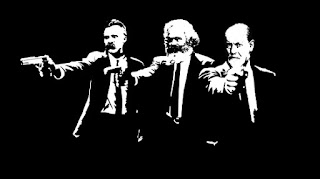
Freud, Nietzsche and Marx: Rick Roderick's Lecture on The Masters of Suspicion

Roderick on Freud's garrison metaphor from a Civilization and Its Discontents


"Freud compares the conscious mind, in the book I have – I am talking about now, he compares the conscious mind to a garrison. A captured, tiny garrison in an immense city. The city of Rome. With all its layers of history. All its archaic barbarisms. All its hidden avenues. Covered over by civilization after civilization. That’s our mind. That whole thing. But the conscious part of it is that one garrison that’s clear, that holds out in this captured city.

A magnificent metaphor for all the surrounding motives, motivations, motifs, desires, that drive us… that are not philosophical… that cannot, even if we talk to our therapist a long time, all be brought up at once."

Watch full lecture here:

Rick Roderick on The Masters of Suspicion


Marx, Freud, and Nietzsche (the figures named the "masters of suspicion" by the French Philosopher Paul Ricoeur)

This video is 1st in the 8-part series:

The Self Under Siege: Philosophy in the Twentieth Century (1993)

II. Heidegger - The Rejection of Humanism [full length]

III. Sartre - The Road to Freedom [full length]

IV. Marcuse - One-Dimensional Man [full length]

V. Habermas - The Fragile Dignity of Humanity [full length]

VI. Foucault - The Disappearance of the Human [full length]

VII. Derrida - The Ends of Man [full length]

VIII. Baudrillard - Fatal Strategies


Marx, Freud, and Nietzsche: The Masters of Suspicion

New 8-bit Philosophy video on "Mandatory Enjoyment"

"What we are dealing with is a particular type of ideology—an ideology of consumer capitalism that mandates enjoyment."


"There isn’t a pure, correct, or optimal object to enjoy—just that one ought to seek out and find pleasurable experiences… and this works perfectly with our society of advertising—where there is always a newer and shinier object promising pleasure—capitalism promotes and demands that we find happiness and that, most importantly, we enjoy that happiness.

Alfie Bown finds a ray of hope in a special kind of Lacanian enjoyment: Jouissance.


Jouissance is an irrational form of pleasure that borders on suffering —it is a sort of pleasure and pain wrapped in one. A sort of enjoyment that there’s no explanation for- Like watching The Room, picking at scabs, or playing Flappy Bird or any of the Dark Souls games.

With Jouissance there’s an opportunity, not to destroy our ideology that mandates enjoyment—but to reflect on the how unnatural our feelings of enjoyment are—that we aren’t beautiful individuals who are fighting the good fight against the corporate machine—that what we enjoy is predictable, sellable, and taught to us. That no matter how much people try not to be sell outs—they’re just sad hipster pseudo revolutionaries in Che t-shirts and Berets."

8-Bit Philosophy, where classic video games introduce famous thinkers, problems, and concepts with quotes, teachings, and more.

See also:

Worldwide Shipping: 🖤 T-Shirts / Hoodies / Mugs / Stickers >>       I WOULD PREFER NOT TO.  
https://www.teepublic.com/t-shirt/1759107-i-would-prefer-not-to-bartleby-zizek
Bartleby, the Scrivener: “I would prefer not to.
https://www.teepublic.com/t-shirt/1759107-i-would-prefer-not-to-bartleby-zizek
Related Posts Plugin for WordPress, Blogger...