Showing posts with label Christopher Bollas. Show all posts

The Shadow of the Object: Psychoanalysis of the Unthought Known - 30th Anniversary Edition


Buy The Shadow of the Object here. - Free delivery worldwide

In The Shadow of the Object, Christopher Bollas integrates aspects of Freud’s theory of unconscious thinking with elements from the British Object Relations School. In doing so, he offers radical new visions of the scope of psychoanalysis and expands our understanding of the creativity of the unconscious mind and the aesthetics of human character. 

During our formative years, we are continually "impressed" by the object world. Most of this experience will never be consciously thought, and but it resides within us as assumed knowledge. Bollas has termed this "the unthought known", a phrase that has ramified through many realms of human exploration, including the worlds of letters, psychology and the arts.

Aspects of the unthought known --the primary repressed unconscious --will emerge during a psychoanalysis, as a mood, the aesthetic of a dream, or in our relation to the self as other. Within the unique analytic relationship, it becomes possible, at least in part, to think the unthought -- an experience that has enormous transformative potential.

Published here with a new preface by Christopher Bollas, The Shadow of the Object remains a classic of the psychoanalytic literature, written by a truly original thinker.

When the Sun Bursts: The Enigma of Schizophrenia


Many schizophrenics experience their condition as one of radical incarceration, mind-altering medications, isolation, and dehumanization. At a time when the treatment of choice is anti-psychotic medication, world-renowned psychoanalyst Christopher Bollas asserts that schizophrenics can be helped by much more humane treatments, and that they have a chance to survive and even reverse the process if they have someone to talk to them regularly and for a sustained period, soon after their first breakdown.

In this sensitive and evocative narrative, he draws on his personal experiences working with schizophrenics since the 1960’s. He offers his interpretation of how schizophrenia develops, typically in the teens, as an adaptation in the difficult transition to adulthood.

With tenderness, Bollas depicts schizophrenia as an understandable way of responding to our precariousness in a highly unpredictable world. He celebrates the courage of the children he has worked with and reminds us that the wisdom inherent in human beings—to turn to conversation with others when in distress—is the fundamental foundation of any cure for human conflict.


The Infinite Question


In his latest book Christopher Bollas uses detailed studies of real clinical practice to illuminate a theory of psychoanalysis which privileges the human impulse to question. From earliest childhood to the end of our lives, we are driven by this impulse in its varying forms, and The Infinite Question illustrates how Freud's free associative method provides both patient and analyst with answers and, in turn, with an ongoing interplay of further questions.

At the book's core are transcripts of real analytical sessions, accompanied by parallel commentaries which highlight key aspects of the free associative method in practice. These transcripts are contextualised by further discussion of the cases themselves, as well as a wider theoretical framework which places its emphasis on Freud's theory of the logic of sequence: by learning to listen to this free associative logic, Bollas argues, we can discover a richer and more complex unconscious voice than if we rely solely on Freud's theory of repressed ideas.

Bollas demonstrates, in an eloquent and persuasive manner, how the Freudian position of evenly suspended attentiveness enables the analyst's unconscious to catch the drift of the patient's own unconscious. He also shows that to stimulate further questioning is often of more benefit to the analytical process than to jump to an interpretation. Yet whatever fascinating course a session may take, neither the patient nor the analyst can halt the progress of the self-propelling interrogative drive.

The Infinite Question will be invaluable to both the new student and the experienced psychoanalyst, read either on its own or as a practice-based extension of the theoretical ideas elaborated in its companion volume, The Evocative Object World (also published by Routledge).


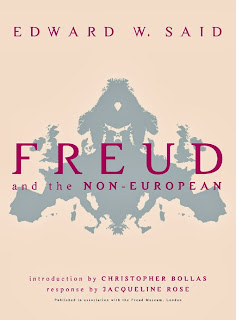
Freud and the Non-European


http://www.amazon.com/gp/product/1844675114/ref=as_li_ss_tl?ie=UTF8&camp=1789&creative=390957&creativeASIN=1844675114&linkCode=as2&tag=permacmedia-20
Banned by the Freud Institute in Vienna, this controversial lecture became Edward Said's final book. Using an impressive array of material from literature, archaeology and social theory, Edward Said explores the profound implications of Freuds Moses and Monotheism for Middle-East politics today.

The resulting book reveals Said's abiding interest in Freud's work and its important influence on his own. He proposes that Freud's assumption that Moses was an Egyptian undermines any simple ascription of a pure identity, and further that identity itself cannot be thought or worked through without the recognition of the limits inherent in it. Said suggests that such an unresolved, nuanced sense of identity might, if embodied in political reality, have formed, or might still form, the basis for a new understanding between Jews and Palestinians. Instead, Israel's relentless march towards an exclusively Jewish state denies any sense of a more complex, inclusive past.

Introduction by Christopher Bollas

With contributions by Jacqueline Rose


Edward Wadie Said
Worldwide Shipping: 🖤 T-Shirts / Hoodies / Mugs / Stickers >>       I WOULD PREFER NOT TO.  
https://www.teepublic.com/t-shirt/1759107-i-would-prefer-not-to-bartleby-zizek
Bartleby, the Scrivener: “I would prefer not to.
https://www.teepublic.com/t-shirt/1759107-i-would-prefer-not-to-bartleby-zizek
Related Posts Plugin for WordPress, Blogger...