Showing posts with label G.W.F. Hegel. Show all posts

The Unconscious Abyss: Hegel's Anticipation of Psychoanalysis


The first extended treatment of Hegel’s theory of the unconscious and his anticipation of Freud.

Offering the first comprehensive examination of Hegel’s theory of the unconscious abyss, Jon Mills rectifies a much neglected area of Hegel scholarship. Mills shows that the unconscious is the foundation for conscious and self-conscious life and is responsible for the normative and pathological forces that fuel psychic development. In addition, Mills illustrates how Hegel’s idea of the unconscious abyss transcends his time and is a pivotal concept to his entire philosophical system—one that advances the current understanding of the psychoanalytic mind.

Your money or your life!


Your money or your life! If I choose the money, I lose both. If I choose life, I have life without the money, namely, a life deprived of something. I think I have made myself clear.

It is in Hegel that I have found a legitimate justification for the term alienating vel. What does Hegel mean by it? To cut a long story short, it concerns the production of the primary alienation, that by which man enters into the way of slavery. Your freedom or your life! If he chooses freedom, he loses both immediately — if he chooses life, he has life deprived of freedom.

― Jacques Lacan, Seminar 11: Four Fundamental Concepts of Psychoanalysis, page 212

The Wisdom of Lived Experience: Views from Psychoanalysis, Neuroscience, Philosophy and Metaphysics


In our quest toward truth we often rely on the guidance and clarity of conscious thought, but in doing so we may bypass awareness of a more deeply informing resource, which is embodied in lived experience. This book highlights aspects of this deeper dialogue where neuroscience (McGilchrist's work on right- and left-brain dynamics) and psychoanalysis (Freud, Klein, Winnicott, Bion, and others) verify the Hegelian dialectics that seem to underlie all living processes and perhaps all of Nature. Hegel's concept of Aufhebung embraces the creative negating transformations that carry forward what has gone before in new and evolving forms and structures.

Becoming, as on-going lived experience, exemplifies this dialectic as it embodies the cycle in which the emergence of unconscious (implicit) intuition is externalized and clarified (made explicit) via conscious notation and thought to then be enfolded back (made implicit once again) into the newly enriched unconscious matrix that becomes the root for the next intuition. While it is often difficult to surrender the clarified products of conscious thought, the deepest sources of wisdom in Becoming are those that involve the implicit and the bodily because the deepest reaches of Reality are those that resonate with somato-sensory experience.

Introduction to the Reading of Hegel: Lectures on the "Phenomenology of Spirit" by Alexandre Kojeve


"This collection of Kojeve's thoughts about Hegel constitutes one of the few important philosophical books of the twentieth century―a book, knowledge of which is requisite to the full awareness of our situation and to the grasp of the most modern perspective on the eternal questions of philosophy."―Allan Bloom (from the Introduction)

http://www.amazon.co.uk/gp/product/0801492033/ref=as_li_tl?ie=UTF8&camp=1634&creative=19450&creativeASIN=0801492033&linkCode=as2&tag=freuquot-21
During the years 1933–1939, the Russian-born and German-educated Marxist political philosopher Alexandre Kojève (1902–1968) brilliantly explicated―through a series of lectures―the philosophy of Hegel as it was developed in the Phenomenology of Spirit. This collection of lectures―originally compiled by Raymond Queneau and edited for its English-language translation by Allan Bloom―shows the intensity of Kojève's study and thought and the depth of his insight into Hegel's Phenomenology. More important―for Kojève was above all a philosopher and not an ideologue―this profound and venturesome work on Hegel will expose the readers to the excitement of discovering a great mind in all its force and power.


Kojève: Consciousness and Desire

This short text is quoted from Kojève, Alexandre: Introduction to the Reading of Hegel. Basic Books, New York, 1969. Beginning and End.

Man is Self-Consciousness. He is conscious of himself, conscious of his human reality and dignity; and it is in this that he is essentially different from animals, which do not go beyond the level of simple Sentiment of self. Man becomes conscious of himself at the moment when – for the “first” time – he says “I.” To understand man by understanding his “origin” is, therefore, to understand the origin of the I revealed by speech.

Now, the analysis of “thought,” “reason,” “understanding,” and so on – in general, of the cognitive, contemplative, passive behavior of a being or a “knowing subject” – never reveals the why or the how of the birth of the word “I,” and consequently of self-consciousness – that is, of the human reality. The man who contemplates is “absorbed” by what he contemplates; the “knowing subject” “loses” himself in the object that is known. Contemplation reveals the object, not the subject. The object, and not the subject, is what shows itself to him in and by – or better, as – the act of knowing. The man who is “absorbed” by the object that he is contemplating can be “brought back to himself” only by a Desire; by the desire to eat, for example.The (conscious) Desire of a being is what constitutes that being as I and reveals it as such by moving it to say “I….” Desire is what transforms being, revealed to itself by itself in (true) knowledge, into an “object” revealed to a “subject” by a subject different from the object and “opposed” to it. It is in and by-or better still, as “his” Desire that man is formed and is revealed-to himself and to others – as an I, as the I that is essentially different from, and radically opposed to, the non-I. The (human) I is the I of a Desire or of Desire.

The very being of man, the self-conscious being, therefore, implies and presupposes Desire. Consequently, the human reality can be formed and maintained only within a biological reality, an animal life. But, if animal Desire is the necessary condition of Self-Consciousness, it is not the sufficient condition. By itself, this Desire constitutes only the Sentiment of self.

In contrast to the knowledge that keeps man in a passive quietude, Desire disquiets him and moves him to action. Born of Desire, action tends to satisfy it, and can do so only by the “negation”, the destruction, or at least the transformation, of the desired object: to satisfy hunger, for example, the food must be destroyed or, in any case, transformed. Thus, all action is “negating.” Far from leaving the given as it is, action destroys it; if not in its being, at least in its given form. And all “negating-negativity” with respect to the given is necessarily active. But negating action is not purely destructive, for if action destroys an objective reality, for the sake of satisfying the Desire from which it is born, it creates in its place, in and by that very destruction, a subjective reality. The being that eats, for example, creates and preserves its own reality by the overcoming of a reality other than its own by the “transformation” of an alien reality into its own reality, by the “assimilation,” the “internalization” of a “foreign,” “external” reality. Generally speaking, the I of Desire is an emptiness that receives a real positive content only by negating action that satisfies Desire in destroying, transforming, and “assimilating” the desired non-I. And the positive content of the I, constituted by negation, is a function of the positive content of the negated non-I.

If, then, the Desire is directed toward a “natural” non-I, the I, too, will be “natural.” The I created by the active satisfaction of such a Desire will have the same nature as the things toward which that Desire is directed: it will be a “thingish” I, a merely living I, an animal I. And this natural I, a function of the natural object, can be revealed to itself and to others only as Sentiment of self. It will never attain Self-Consciousness.

For there to be Self-Consciousness, Desire must therefore be directed toward a non-natural object, toward something that goes beyond the given reality. Now, the only thing that goes beyond the given reality is Desire itself. For Desire taken as Desire – i.e., before its satisfaction – is but a revealed nothingness, an unreal emptiness. Desire, being the revelation of an emptiness, the presence of the absence of a reality, is something essentially different from the desired thing, something other than a thing, than a static and given real being that stays eternally identical to itself. Therefore, Desire directed toward another Desire, taken as Desire, will create, by the negating and assimilating action that satisfies it, an I essentially different from the animal “I.” This I, which “feeds” on Desires, will itself be Desire in its very being, created in and by the satisfaction of its Desire. And since Desire is realized as action negating the given, the very being of this I will be action. This I will not, like the animal “I,” be “identity” or equality to itself, but “negating negativity.” In other words, the very being of this I will be becoming, and the universal form of this being will not be space, but time. Therefore, its continuation in existence will signify for this I: “not to be what it is (as static and given being, as natural being, as `innate character’) and to be (that is, to become) what it is not.” Thus, this I will be its own product: it will be (in the future) what it has become by negation (in the present) of what it was (in the past), this negation being accomplished with a view to what it will become. In its very being this I is intentional becoming, deliberate evolution, conscious and voluntary progress; it is the act of transcending the given that is given to it and that it itself is. This I is a (human) individual, free (with respect to the given real) and historical (in relation to itself ). And it is this I, and only this I, that reveals itself to itself and to others as Self-Consciousness.

Human Desire must be directed toward another Desire. For there to be human Desire, then, there must first be a multiplicity of (animal) Desires. In other words, in order that Self-Consciousness be born from the Sentiment of self, in order that the human reality come into being within the animal reality, this reality must be essentially manifold. Therefore, man can appear on earth only within a herd. That is why the human reality can only be social. But for the herd to become a society, multiplicity of Desires is not sufficient by itself; in addition, the Desires of each member of the herd must be directed – or potentially directed – toward the Desires of the other members. If the human reality is a social reality, society is human only as a set of Desires mutually desiring one another as Desires. Human Desire, or better still, anthropogenetic Desire, produces a free and historical individual, conscious of his individuality, his freedom, his history, and finally, his historicity. Hence, anthropogenetic Desire is different from animal Desire (which produces a natural being, merely living and having only a sentiment of its life) in that it is directed, not toward a real, “positive,” given object, but toward another Desire. Thus, in the relationship between man and woman, for example, Desire is human only if the one desires, not the body, but the Desire of the other; if he wants “to possess” or “to assimilate” the Desire taken as Desire – that is to say, if he wants to be “desired” or “loved,” or, rather, “recognized” in his human value, in his reality as a human individual. Likewise, Desire directed toward a natural object is human only to the extent that it is “mediated” by the Desire of another directed toward the same object: it is human to desire what others desire, because they desire it. Thus, an object perfectly useless from the biological point of view (such as a medal, or the enemy’s flag), can be desired because it is the object of other desires. Such a Desire can only be a human Desire, and human reality, as distinguished from animal reality, is created only by action that satisfies such Desires: human history is the history of desired Desires.

The Most Sublime Hysteric: Hegel with Lacan by Slavoj Zizek


http://www.amazon.co.uk/gp/product/0745663753/ref=as_li_tl?ie=UTF8&camp=1634&creative=19450&creativeASIN=0745663753&linkCode=as2&tag=freuquot-21
What do we know about Hegel? What do we know about Marx? What do we know about democracy and totalitarianism? Communism and psychoanalysis? What do we know that isn′t a platitude that we′ve heard a thousand times – or a self–satisfied certainty? Through his brilliant reading of Hegel, Slavoj Zizek – one of the most provocative and widely–read thinkers of our time – upends our traditional understanding, dynamites every cliché and undermines every conviction in order to clear the ground for new ways of answering these questions.

When Lacan described Hegel as the most sublime hysteric , he was referring to the way that the hysteric asks questions because he experiences his own desire as if it were the Other′s desire. In the dialectical process, the question asked of the Other is resolved through a reflexive turn in which the question begins to function as its own answer. We had made Hegel into the theorist of abstraction and reaction, but by reading Hegel with Lacan, Zizek unveils a Hegel of the concrete and of revolution – his own, and the one to come.

This early and dazzlingly original work by Zizek offers a unique insight into the ideas which have since become hallmarks of his mature thought. It will be of great interest to anyone interested in critical theory, philosophy and contemporary social thought.

The Vestal and the Fasces: Hegel, Lacan, Property, and the Feminine


http://www.amazon.co.uk/gp/product/0520211456/ref=as_li_tl?ie=UTF8&camp=1634&creative=19450&creativeASIN=0520211456&linkCode=as2&tag=freuquot-21
In this feminist exploration of the erotics of the marketplace, Hegel's notion of property and Lacan's idea of the phallus serve parallel functions in creating the subjectivity necessary for self-actualization. Subjectivity requires intersubjective relationships mediated through a regime of possessing, enjoying, and exchanging an object of desire. For Hegel, this regime is property; for Lacan, it is sexuality, symbolized by the Phallus, which we conflate with the male organ and the female body. Property law, in Jeanne Schroeder's account, is implicitly figured by similar anatomical metaphors for that which men wish to possess and that which women try to be and enjoy. This is reflected in imagery taken from ancient Rome - the ax and bundle of sticks known as the Fasces and the virgin priestess called the Vestal. Schroeder traces the persistence of phallic metaphors in modern jurisprudence. Feminist scholars, social theorists, political scientists, philosophers, and lawyers will find in Schroeder's analysis new perspectives on property theory and the feminine within the market and the law.

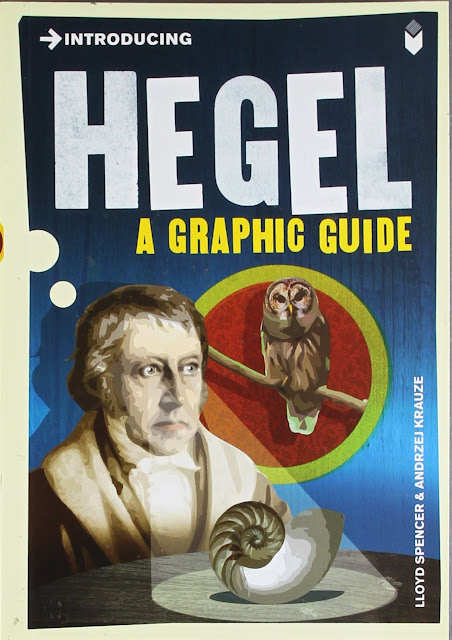
Introducing Hegel: A Graphic Guide

http://www.amazon.co.uk/gp/product/1848312083/ref=as_li_tl?ie=UTF8&camp=1634&creative=19450&creativeASIN=1848312083&linkCode=as2&tag=freuquot-21&linkId=MW3Q7DHECU2B5OCW

INTRODUCING guide to the hugely influential German thinker. Georg Wilhelm Friedrich Hegel is one of the greatest thinkers of all time. No other philosopher has had such a profound impact on the ideas and political events of the 20th century. Hegel’s influential writings on philosophy, politics, history and art are parts of a larger systematic whole. They are also among the most difficult in the entire literature of philosophy. Introducing Hegel guides us through a spectacular system of thought which aimed to make sense of history. The book also provides new perspectives on contemporary postmodern debates about ‘metanarratives’ (Lyotard) and the ‘end of history’ (Fukuyama). It is an ideal introduction to this crucial figure in the history of philosophy, and is indispensable for anyone trying to understand such key modern thinkers as Marx, Lacan, Satre and Adorno.


Introducing Continental Philosophy: A Graphic Guide


What makes philosophy on the continent of Europe so different and exciting? And why does it have such a reputation for being ‘difficult’?

Continental philosophy was initiated amid the revolutionary ferment of the 18th century, philosophers such as Kant and Hegel confronting the extremism of the time with theories that challenged the very formation of individual and social consciousness.

Covering the great philosophers of the modern and postmodern eras – from Nietzsche, Heidegger, Derrida and Deleuze right to up Agamben and Žižek – and philosophical movements from German idealism to deconstruction and feminism – Christopher Kul-Want and Piero brilliantly elucidate some of the most thrilling and powerful ideas ever to have been discussed.


Goethe, Kant, and Hegel: Discovering the Mind


Buy Goethe, Kant, and Hegel here. - Free delivery worldwide

http://www.amazon.com/gp/product/088738370X/ref=as_li_ss_tl?ie=UTF8&camp=1789&creative=390957&creativeASIN=088738370X&linkCode=as2&tag=permacmedia-20
This immensely readable and absorbing book - the first of a three-volume series on understanding the human mind - concentrates on three major figures who have changed our image of human beings. Kaufmann drastically revises traditional conceptions of Goethe, Kant, and Hegel, showing how their ideas about the mind were shaped by their own distinctive mentalities.

Kaufmann's version of psychohistory stays clear of gossip and is carefully documented. He offers us a radically new understanding of two centuries of intellectual history, but his primary focus is on self-knowledge. He is in a unique position to perform this task by virtue of being, according to Stephen Spender, "the best translator of Faust"; and in Sidney Hook's view, "unquestionably the most interesting and informative writer of Hegel in English."

The foremost interpreter of Kant, Lewis White Beck, has called this book on Goethe, Kant, and.Hegel "fascinating" - a work which "will stir up a good many people by telling them things they have never heard, and providing an alternative to what is the accepted reading of that part of the history of philosophy. The story of how personality affects philosophy has never been better told." We are shown how Goethe advanced the discovery of the mind more than anyone before him, while Kant was in many ways a disaster. Hegel, like others between 1790 to 1990, tried to reconcile Kant and Goethe.

Kaufmann shows this is impossible He paints a large picture, but he is always highly specific and details the major contributions of Goethe and Hegel as well as the ways in which Kant's immense influence proved catastrophic.


http://www.amazon.co.uk/gp/product/1848312091/ref=as_li_tl?ie=UTF8&camp=1634&creative=19450&creativeASIN=1848312091&linkCode=as2&tag=freuquot-21&linkId=YENMBLAUYXPNHDGT

The Indivisible Remainder: On Schelling and Related Matters by Slavoj Zizek


Confronts Schelling with Hegel, and illuminates popular culture and modern subjectivity.

The feature which distinguishes the great works of materialist thought, from Lucretius’ De rerum natura through Capital to the writings of Lacan, is their unfinished character: again and again they tackle their chosen problem. Schelling’s Weltalter drafts belong to this same series, with their repeated attempt at the formulation of the ‘beginning of the world,’ of the passage from the pre-symbolic pulsation of the Real to the universe of logos.

http://www.amazon.co.uk/gp/product/1844675815/ref=as_li_tl?ie=UTF8&camp=1634&creative=19450&creativeASIN=1844675815&linkCode=as2&tag=freuquot-21
F.W.J. Schelling, the German idealist who for too long dwelled in the shadow of Kant and Hegel, was the first to formulate the post-idealist motifs of finitude, contingency and temporality. His unique work announces Marx's critique of speculative idealism, as well as the properly Freudian notion of drive, of a blind compulsion to repeat which can never be sublated in the ideal medium of language.

The Indivisible Remainder begins with a detailed examination of the two works in which Schelling's speculative audacity reached its peak: his essay on human freedom and his drafts on the “Ages of the World.” After reconstituting their line of argumentation, Slavoj Žižek confronts Schelling with Hegel, and concludes by throwing a Schellingian light on some “related matters”: the consequences of the computerization of daily life for sexual experience; cynicism as today's predominant form of ideology; the epistemological deadlocks of quantum physics.

Although the book is packed with examples from politics and popular culture — the unmistakable token of Žižek’s style — from Speed and Groundhog Day to Forrest Gump, it signals a major shift towards a systematic concern with the basic questions of philosophy and the roots of the crisis of our late-capitalist universe, centred around the enigma of modern subjectivity.

Tarrying with the Negative: Kant, Hegel, and the Critique of Ideology


Buy Tarrying with the Negative here. - Free delivery worldwide

In the space of barely more than five years, with the publication of four pathbreaking books, Slavoj Zizek has earned the reputation of being one of the most arresting, insightful, and scandalous thinkers in recent memory. Perhaps more than any other single author, his writings have constituted the most compelling evidence available for recognizing Jacques Lacan as the preemient philosopher of our time.

http://www.amazon.co.uk/gp/product/0822313952/ref=as_li_tl?ie=UTF8&camp=1634&creative=19450&creativeASIN=0822313952&linkCode=as2&tag=freuquot-21
In Tarrying with the Negative, Zizek challenges the contemporary critique of ideology, and in doing so opens the way for a new understanding of social conflict, particularly the recent outbursts of nationalism and ethnic struggle. Are we, Zizek asks, confined to a postmodern universe in which truth is reduced to the contingent effect of various discursive practices and where our subjectivity is dispersed through a multitude of ideological positions? No is his answer, and the way out is a return to philosophy. This revisit to German Idealism allows Zizek to recast the critique of ideology as a tool for disclosing the dynamic of our society, a crucial aspect of which is the debate over nationalism, particularly as it has developed in the Balkans--Zizek's home. He brings the debate over nationalism into the sphere of contemporary cultural politics, breaking the impasse centered on nationalisms simultaneously fascistic and anticolonial aspirations. Provocatively, Zizek argues that what drives nationalistic and ethnic antagonism is a collectively driven refusal of our own enjoyment.

Using examples from popular culture and high theory to illuminate each other--opera, film noir, capitalist universalism, religious and ethnic fundamentalism--this work testifies to the fact that, far more radically than the postmodern sophists, Kant and Hegel are our contemporaries.


Reading Žižek – Where to Start?


Hegel and the Infinite: Religion, Politics, and Dialectic

(Insurrections: Critical Studies in Religion, Politics, and Culture)


http://www.amazon.co.uk/gp/product/0231143354/ref=as_li_tl?ie=UTF8&camp=1634&creative=19450&creativeASIN=0231143354&linkCode=as2&tag=freuquot-21Catherine Malabou, Antonio Negri, John D. Caputo, Bruno Bosteels, Mark C. Taylor, and Slavoj Zizek join seven others—including William Desmond, Katrin Pahl, Adrian Johnston, Edith Wyschogrod, and Thomas A. Lewis—to apply Hegel's thought to twenty-first-century philosophy, politics, and religion. Doing away with claims that the evolution of thought and history is at an end, these thinkers safeguard Hegel's innovations against irrelevance and, importantly, reset the distinction of secular and sacred.

These original contributions focus on Hegelian analysis and the transformative value of the philosopher's thought in relation to our current "turn to religion." Malabou develops Hegel's motif of confession in relation to forgiveness; Negri writes of Hegel's philosophy of right; Caputo reaffirms the radical theology made possible by Hegel; and Bosteels critiques fashionable readings of the philosopher and argues against the reducibility of his dialectic. Taylor reclaims Hegel's absolute as a process of infinite restlessness, and Zizek revisits the religious implications of Hegel's concept of letting go. Mirroring the philosopher's own trajectory, these essays progress dialectically through politics, theology, art, literature, philosophy, and science, traversing cutting-edge theoretical discourse and illuminating the ways in which Hegel inhabits them.

Less Than Nothing: Hegel and the Shadow of Dialectical Materialism by Slavoj Zizek


Slavoj Žižek's masterwork on the Hegelian Legacy

http://www.amazon.co.uk/gp/product/1781681279/ref=as_li_tl?ie=UTF8&camp=1634&creative=19450&creativeASIN=1781681279&linkCode=as2&tag=freuquot-21
For the last two centuries, Western philosophy has developed in the shadow of Hegel, an influence each new thinker struggles to escape. As a consequence, Hegel's absolute idealism has become the bogeyman of philosophy, obscuring the fact that he is the defining philosopher of the historical transition to modernity, a period with which our own times share startling similarities.

Today, as global capitalism comes apart at the seams, we are entering a new period of transition. In Less Than Nothing, the product of a career-long focus on the part of its author, Slavoj Žižek argues it is imperative we not simply return to Hegel but that we repeat and exceed his triumphs, overcoming his limitations by being even more Hegelian than the master himself. Such an approach not only enables Žižek to diagnose our present condition, but also to engage in a critical dialogue with the key strands of contemporary thought—Heidegger, Badiou, speculative realism, quantum physics, and cognitive sciences. Modernity will begin and end with Hegel.

Worldwide Shipping: 🖤 T-Shirts / Hoodies / Mugs / Stickers >>       I WOULD PREFER NOT TO.  
https://www.teepublic.com/t-shirt/1759107-i-would-prefer-not-to-bartleby-zizek
Bartleby, the Scrivener: “I would prefer not to.
https://www.teepublic.com/t-shirt/1759107-i-would-prefer-not-to-bartleby-zizek
Related Posts Plugin for WordPress, Blogger...