Showing posts with label Philosophy of Science. Show all posts

Copernicus, Darwin and Freud: Revolutions in the History and Philosophy of Science


Using Copernicanism, Darwinism, and Freudianism as examples of scientific traditions, Copernicus, Darwin and Freud takes a philosophical look at these three revolutions in thought to illustrate the connections between science and philosophy.

  • Shows how these revolutions in thought lead to philosophical consequences
  • Provides extended case studies of Copernicanism, Darwinism, and Freudianism
  • Integrates the history of science and the philosophy of science like no other text
  • Covers both the philosophy of natural and social science in one volume

The Scientific Status of Psychoanalysis: Evidence and Confirmation


In his Foundations of Psychoanalysis: A Philosophical Critique, Adolf Grünbaum claimed that the arguments supporting psychoanalytic hypotheses are both logically invalid and unsound. They are invalid because they violate the cannons of inductive elimination, and unsound because the clinical data is contaminated by the suggestive influence of the analyst.

In a spirited defence of psychoanalysis, Pushpa Misra asserts that Grünbaum's argument over suggestibility is not supported by textual evidence and gives her own formulation of Freud's argument to show how the problem of suggestibility can be dealt with. To counter the charge of the invalidity of the repression argument, the author addresses the two specific objections of Grünbaum: first, that repression can be a maintaining rather than an originating cause of neurotic symptoms, and, second, that by eliminating rival candidates it is possible to formulate a valid argument for repression aetiology.

This book is a must-read for all those interested in the stature and reputation of psychoanalysis in the scientific world


Philosophy, Science, and Psychoanalysis: A Critical Meeting


The perennial interest in psychoanalysis shows no signs of abating and the longevity of psychoanalytic theory is seen in the varied extensions and elaborations of Freudian thinking in the fields of neuroscience and cognitive theory. Nevertheless, the scientific standing of psychoanalysis has long been questioned and developments in the fields of the philosophy of science and psychology require a fresh assessment of the scientific standing of psychoanalysis. While there are a range of views on the topic of whether psychoanalysis is in fact scientific, any satisfactory approach to understanding mind and behaviour requires an approach that is at once both philosophic and scientific. Accordingly, to even approach the question regarding the scientific nature of psychoanalysis, a foundation comprising a sophisticated conceptual and philosophical framework is required.

This volume represents the junction where philosophy, science, and psychoanalysis meet and presents arguments critical and supportive of the scientific standing of psychoanalysis, including debates between Adolf Grünbaum, Edward Erwin, Linda. A. W. Brakel and Vesa Talvitie, as well as fresh approaches from Anna Ursula Dreher, Agnes Petocz, Thomas Wallgren, and Simon Boag. While mainstream psychology is largely dismissive of psychoanalysis, the themes covered within this volume have important implications for science as a whole, including the nature of scientific explanation, philosophy of science, as well as the psychology of science.

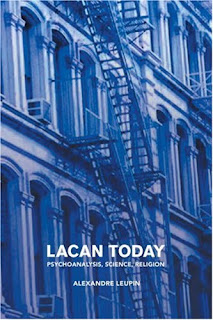
Lacan Today: Psychoanalysis, Science, Religion


Buy Lacan Today: Psychoanalysis, Science, Religion here.

Lacan Today: Psychoanalysis, Science, Religion offers a lucid overview of the French psychoanalyst's work. In five sections--"The Structure of the Subject," "Epistemology," "Four Discourses," "There is No Sexual Rapport," and "God is Real,"--the book maps out Lacan's thought for the lay reader with unmatched clarity. It does this by building from Lacan's graph and formulas, which are often misunderstood. This formalization acts as a pedagogical tool of wonderful economy, offering a broad overview without neglecting the essential details. The chapters are summarized by a general graph that visually demonstrates Lacan's rigor and coherence.
http://www.amazon.co.uk/gp/product/1892746905/ref=as_li_tl?ie=UTF8&camp=1634&creative=19450&creativeASIN=1892746905&linkCode=as2&tag=freuquot-21
The book examines often-neglected aspects of Lacan's work, like problems in the history of science, epistemology, and religion, in order to show Lacan's relevance to today's world. It makes the case for Lacan as one of the most important thinkers of the twentieth century, whose reach extends beyond the discipline of psychoanalysis. Indeed, Lacan's thought should lead readers into a reexamination of philosophy, literature, art, politics, economy, and desire.

In his introduction, Alexandre Leupin writes: "If the unconscious exists, then Lacan is the only twentieth-century thinker who has drawn the consequences of Freud's discovery to their ultimate limits. I propose here what some will take as bombastic hyperbole: Lacan's radical reevaluation of human thinking is comparable to Einstein's."

Though Lacan's thought is making tremendous inroads in countries of Latin culture, it has been slowly fading from public awareness in the English-speaking world. Often Lacan has been nothing more than a pawn in the bundling of contradictory doctrines labeled as "French thought"; or he has been reduced to a means of exchange between psychoanalysts or specialists in the humanities. Leupin's contention is that what Lacan said or wrote is of interest to the general public and that his consignment to oblivion is reversible. This book demonstrates that Lacan's thinking has vast implications, not only for college professors or practicing psychoanalysts, but also for scientists, epistemologists, and every man and woman.

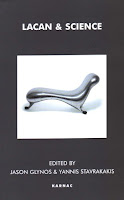
Lacan and Science


http://www.amazon.co.uk/gp/product/1855759217/ref=as_li_tl?ie=UTF8&camp=1634&creative=19450&creativeASIN=1855759217&linkCode=as2&tag=freuquot-21
The current volume represents an exciting collection of essays critically examining the relation between modern science and Lacanian psychoanalysis in approaching the question of mental suffering. Lacan & Science also tackles more widely the role and logic of scientific practice in general, taking as its focus psychic processes. Central themes that are explored from a variety of perspectives include the use of mathematics in Lacanian psychoalanysis, the importance of linguistics and Freud's text in Lacan's approach, and the central significance attached to ethics and the role of the subject. Constituting an invaluable addition to existing literature, this comprehensive volume offers a fresh insight into Lacan's conception of the subject and its implications to scientific practice and evidence.

Introducing Philosophy of Science: A Graphic Guide

http://www.amazon.co.uk/gp/product/1848312962/ref=as_li_tl?ie=UTF8&camp=1634&creative=19450&creativeASIN=1848312962&linkCode=as2&tag=freuquot-21&linkId=66OV27TACBYZCULU


What do scientists actually do? Is science “value-free”? How has science evolved through history? Where is science leading us? “Introducing Philosophy of Science” is a clear and incisively illustrated map of the big questions underpinning science. It is essential reading for students, the general public, and even scientists themselves.
 
Worldwide Shipping: 🖤 T-Shirts / Hoodies / Mugs / Stickers >>       I WOULD PREFER NOT TO.  
https://www.teepublic.com/t-shirt/1759107-i-would-prefer-not-to-bartleby-zizek
Bartleby, the Scrivener: “I would prefer not to.
https://www.teepublic.com/t-shirt/1759107-i-would-prefer-not-to-bartleby-zizek
Related Posts Plugin for WordPress, Blogger...