“Your practice of psycho-analysis was a mistake. It has, for the time at least, made the work of purification more complicated, not easier. The psycho-analysis of Freud is the last thing that one should associate with yoga. It takes up a certain part, the darkest, the most perilous, the unhealthiest part of the nature, the lower vital subconscious layer, isolates some of its most morbid phenomena and attributes to it and them an action out of all proportion to its true role in the nature. Modern psychology is an infant science, at once rash, fumbling and crude. As in all infant sciences, the universal habit of the human mind—to take a partial or local truth, generalise it unduly and try to explain a whole field of Nature in its narrow terms—runs riot here. Moreover, the exaggeration of the importance of suppressed sexual complexes is a dangerous falsehood and it can have a nasty influence and tend to make the mind and vital more and not less fundamentally impure than before.”
― Sri Aurobindo, Bases of Yoga
Showing posts with label Yoga. Show all posts
Freud and Yoga: Two Philosophies of Mind Compared
Lessons from a great yoga master and an eminent psychoanalyst that explore what psychotherapy and yoga philosophy have in common
Yoga philosophy and Freud's revolutionary approach to psychology could not have been developed in more different times, places, or cultural conditions. And yet these two profound and dynamic systems of understanding human behavior, emotions, perception, and what's essential in our existence have an astonishing amount to share. What we learn by comparing their similarities as well as their differences can enhance how we comprehend our lives and our potential for change.
In "Freud and Yoga," the great yoga master T.K.V. Desikachar and the eminent psychoanalyst Hellfried Krusche examine forty classic sayings, or "sutras," from the vantage point of their respective disciplines. Through clear, candid conversations that draw on long experience and are illustrated by case studies from the clinic and the "shala," these two experts explain the concepts, terms, forces, and processes in their traditions.
Therapists and patients, yoga adepts and professionals, and readers interested in psychology and spirituality will find this unique investigation fascinating, enriching, and useful. In a time when Western and Eastern modalities have ever more to offer each other, "Freud and Yoga" is a watershed work one that draws us closer to understanding our own nature and the deep workings of the human psyche."
Freud on Yoga
I can imagine that the oceanic feeling became connected: with religion later on. The ‘oneness with the universe’ which constitutes its ideational content sounds like a first attempt at a religious consolation, as though it were another way of dis claiming the danger which the ego recognizes as threatening it from the external world. Let me admit once more that it is very difficult for me to work with these almost intangible quantities. Another friend of mine, whose insatiable craving for knowledge has fed him to make the most unusual experiments and has ended by giving him encyclopaedic knowledge, has assured me that through the practices of Yoga, by withdrawing from the world, by fixing the attention on bodily functions and by peculiar methods of breathing, one can in fact evoke new sensations and coenaesthesias in oneself, which he regards as regressions to primordial states of mind which have long ago been overlaid. He sees in them a physiological basis, as it were, of much of the wisdom of mysticism. It would not be hard to find connections here with a number of obscure m odifications of mental life, such as trances and ecstasies. But I am moved to exclaim in the words of Schiller’s diver: —
... Es freue sich,
Wer da atmet im rosigten Licht.
[‘Let him rejoice who breathes up here in the roseate light!’
Schiller,‘Der Taucher’.]
― Sigmund Freud, Civilization and Its Discontents
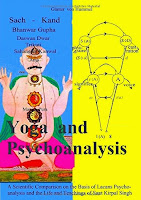
Yoga and Psychoanalysis
This book offers a brief overview of the different types of Yoga and then provides a comparison with the modern science of psychology. Laya-Yoga, as it was taught by Kirpal Singh (1894 - 1974) is a comprehensiv physical and mental method and widely known in India and abroad. A comparison is made with psychoanalysis especially in its form teached by J. Lacan. This study of western and eastern "spiritual" ways centers around so called FORMULA-WORDS. They each bear several meanings in one formulation and so correspond to the scientific term "unconscious" as well as to the exercises of Yoga. This comparative study culminates in a independent and new method which can connect East and West in an ideal way.
Download Free Ebook - The Seminar of Jacques Lacan: The Four Fundamental Concepts of Psychoanalysis
See also:
Subscribe to:
Posts (Atom)
![]() |
| Bartleby, the Scrivener: “I would prefer not to.” |