Showing posts with label Dictionary. Show all posts

Brief Dictionary of Psychoanalysis

by Jorge Alemán

Ten concepts for debate. Ten proposals to understand, explain and update the legacy of a revolution and its impact on language. Psychoanalyst Jorge Alemán chose ten ideas on Freud, ten threads from which to pull and unravel the most burning topics in current psychoanalysis. From the “response” of Love to the “split” of the Subject. 


LOVE. Love is not the common ground that reunites two beings. It is the response built -between two beings- to veil the impossible relation which, at the level of the drive, remains. By concealing the impossible, true love reveals it.

SCIENCE. Psychoanalysis is not a science, but not because of an epistemological deficit whatsoever, since it deals with that which science must exclude in order to constitute itself as such. It is a reform of the limits of reason, “a frontier reason” open to what escapes meaning: the unconscious, slips, dreams, the subjective symtpm, the phantasy.

TREATMENT. In the analytic cure it is not about adaptation, or about re-establishing a balance, or increasing “self-esteem”. Freud would have conceived of these as narcissistic operations and therefore impoverishing of subjective experience. It is rather, once morbid symptoms and inhibitions have been dealt with, about “knowing-how” to do with the incurable that inhabits each one of us. It is elevating the incurable symptom to the dignity of a style of life.

DISCOURSE. Rather than saying it all, a push the market knows well how to realise, psychoanalysis is the invitation to realise, via speech, the experience of the impossible to say. The analytic cure is the discovery of a different silence.

OEDIPUS. The Oedipus is not the “blah, blah” that narrates the love and misfortunes of the child and his or her parents. It is the singular myth that in each one of us narrates the impact of language (which always precedes us) on this life emerging in the world. It is the torrent of statements, proper names, wishes, promises, expectations, grievances, debts, guilt, ideals, awaiting the living being even before s/he is born. Thanks to the Oedipus, the speaking being will not feel the product of an anonymous desire, but neither will s/he find, in the auspices of his or her birth, a foundation able to give meaning, to make sense of his or her existence.

THE REAL. Whereas reality puts us to sleep, the real, which lacks a name, wakes us up. It may erupt at any instant as a figure of trauma, anxiety or the uncanny, and the subject defends itself against it through rituals, fantasies of control, obsessions, delusions. However, the subject may face the real with a different kind of dignity, if s/he assumes his or her relation with the unconscious.

MODERNITY. A man of science, Freud was a modern enlightened. But it was in the experience of the cure called psychoanalytic, that he encountered a series of problems which questioned the ideals of his time. Thus, to the ideals of progress and improvement he opposed the idea of a “drive residue” to which we remain fixated and which is never overcome; the idea of a “repetition compulsion”, which returns at different stages in various disguises. Likewise, to the utopias of realisation and fulfilment, he opposed the irreducible discontent in Civilization.

WOMAN. It was through women that Freud got news about unconscious truth, that truth emerging by surprise, which is half-said and which objects any universal definition. Psychoanalysis is the attempt to theorise the way in which “it speaks” in the feminine voice. From there, “phallocentrism” was de-centred and sexuality was “de-hierarchized”; heterosexuality became one practice among others, and no longer the ultimate value of sexuality.

DRIVE. Drive is not instinct. It is the “accursed part of the instinct”, the one made ill by language and forever altered by it. While instinct knows what its object is (hunger-food), the drive aims at erratic and contingent objects, which confirm its autistic and headless satisfaction.

SUBJECT. The subject is neither consciousness, nor reflection, nor the ego. It is an incurable split, an originary and structural fracture which must choose itself through its desires. Consciousness, reflection, the ego, are fictions attempting to suture an inaugural wound, that of the subject of the unconscious. Attacked as “Jewish science” by the Nazis, as “bourgeois science” among the Stalinists, maligned by the Anglo-Saxon schools, the duty to think about this split subject returns to Europe and Latin America thanks to Jacques Lacan.


Published originally in Spanish (terms in alphabetical order) in EL CULTURAL. Revista de Actualidad Cultural, on 04/05/2006

Translated by Florencia F.C. Shanahan.

via Irish Circle Lacanian Orientation

See also:


http://freudquotes.blogspot.com/2015/09/the-language-of-psychoanalysis-by-jean.html

An Introductory Dictionary of Lacanian Psychoanalysis


http://www.amazon.co.uk/gp/product/0415135230/ref=as_li_tl?ie=UTF8&camp=1634&creative=19450&creativeASIN=0415135230&linkCode=as2&tag=freuquot-21
Jacques Lacan's thinking revolutionised the theory and practice of psychoanalysis and had a major impact in fields as diverse as film studies, literary criticism, feminist theory and philosophy. Yet his writings are notorious for their complexity and idiosyncratic style. Emphasising the clinical basis of Lacan's work, An Introductory Dictionary of Lacanian Psychoanalysis is an ideal companion to his ideas for readers in every discipline where his influence is felt.

The First Dictionary of Psychoanalysis: A Gift for Sigmund Freud's 80th Birthday


This is a new translation of the classic 1932 Dictionary by Dr Richard Sterba, for which Freud wrote a Preface praising the "precision and correctness" of Sterba's work and calling it a "fine achievement".

The dictionary is not only an important source of information about psychoanalysis in Vienna in the 1930s but is also an insight into its author, as movingly attested by the 'Epilogue' to this edition written by his daughter Verena Sterba Michels, son-in-law Robert Michels, and grand-daughter Katherine J. Michels.

This new edition also includes a transcript of an interview with Dr Sterba by Dr William Langford, Chairman of the Department of Child Psychiatry at the Columbia College of Physicians and Surgeons.

Dictionary of Untranslatables: A Philosophical Lexicon


http://www.amazon.co.uk/gp/product/0691138702/ref=as_li_tl?ie=UTF8&camp=1634&creative=19450&creativeASIN=0691138702&linkCode=as2&tag=freuquot-21&linkId=W4T3PEJXZAYHJKNR
This is an encyclopedic dictionary of close to 400 important philosophical, literary, and political terms and concepts that defy easy--or any--translation from one language and culture to another. Drawn from more than a dozen languages, terms such as Dasein (German), pravda (Russian), saudade (Portuguese), and stato (Italian) are thoroughly examined in all their cross-linguistic and cross-cultural complexities. Spanning the classical, medieval, early modern, modern, and contemporary periods, these are terms that influence thinking across the humanities. The entries, written by more than 150 distinguished scholars, describe the origins and meanings of each term, the history and context of its usage, its translations into other languages, and its use in notable texts. The dictionary also includes essays on the special characteristics of particular languages--English, French, German, Greek, Italian, Portuguese, Russian, and Spanish.

Originally published in French, this one-of-a-kind reference work is now available in English for the first time, with new contributions from Judith Butler, Daniel Heller-Roazen, Ben Kafka, Kevin McLaughlin, Kenneth Reinhard, Stella Sandford, Gayatri Chakravorty Spivak, Jane Tylus, Anthony Vidler, Susan Wolfson, Robert J. C. Young, and many more.The result is an invaluable reference for students, scholars, and general readers interested in the multilingual lives of some of our most influential words and ideas.

  • Covers close to 400 important philosophical, literary, and political terms that defy easy translation between languages and cultures
  • Includes terms from more than a dozen languages
  • Entries written by more than 150 distinguished thinkers
  • Available in English for the first time, with new contributions by Judith Butler, Daniel Heller-Roazen, Ben Kafka, Kevin McLaughlin, Kenneth Reinhard, Stella Sandford, Gayatri Chakravorty Spivak, Jane Tylus, Anthony Vidler, Susan Wolfson, Robert J. C. Young, and many more
  • Contains extensive cross-references and bibliographies
  • An invaluable resource for students and scholars across the humanities


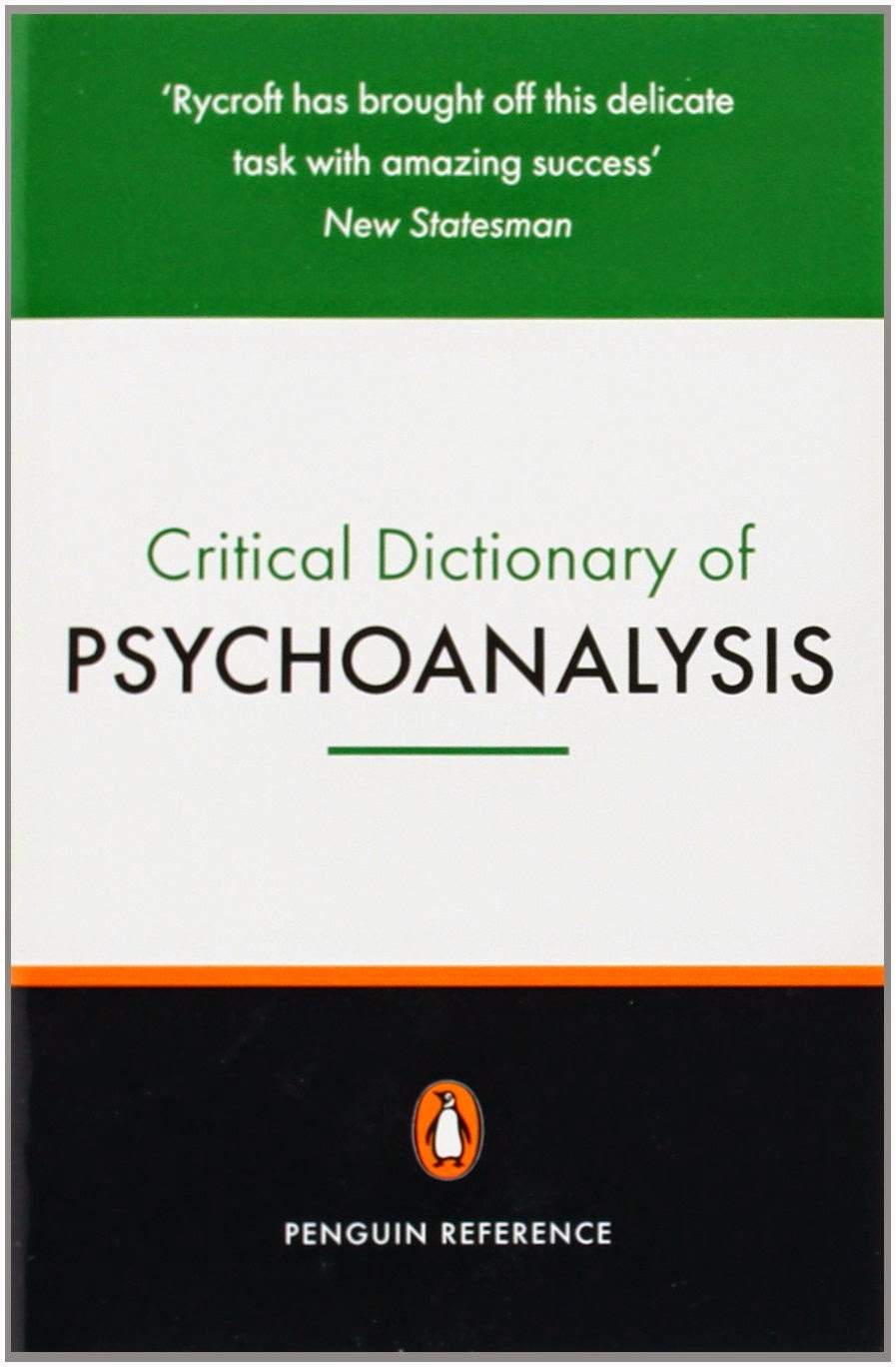
A Critical Dictionary of Psychoanalysis

http://www.amazon.co.uk/gp/product/0140513108/ref=as_li_ss_tl?ie=UTF8&camp=1634&creative=19450&creativeASIN=0140513108&linkCode=as2&tag=freuquot-21


Charles Rycroft's 'Critical Dictionary of Psychoanalysis' is an established reference work providing clear definitions and critical discussions of the technical terms used in psychoanalysis. "An accurate and witty guide to the meaning of psychoanalytic terms ... [it] also explains the various controversies which have disfigured the psychoanalytic movement and which are such a puzzle to those outside it. For anyone concerned with psychoanalysis and its offshoots this is an indispensable book" Anthony Storr

Some sample entries:


EGO BOUNDARY

Topographical concept by which the distinction between self and not-self is imagined to be delineated. A patient is said to lack ego boundaries if he identifies readily with others and does so at the expense of his own sense of identity. Analysts who hold that the infant lives in a state of primary identification with his mother, postulate the gradual development of an ego boundary, i.e. the discovery that objects are not parts of itself.


IDENTITY v. ROLE DIFFUSION

The fifth of Erikson's eight stages of man. It corresponds to adolescence and early manhood, during which, according to Erikson, the individual has to redefine his identity, particularly in relation to the parents he is growing away from and the society he is growing into. `Role diffusion' refers to the adolescent tendency to `over-identify, to the point of apparent complete loss of identity, with the heroes of cliques and crowds' - Erikson (1953).


REALITY PRINCIPLE

According to Freud, mental activity is governed by two principles: the pleasure principle and the reality principle, the former leading to relief of instinctual tension by hallucinatory wish-fulfilment (see also hallucination), the latter to instinctual gratification by accommodation to the facts of , and the objects existing within, the external world. According to Freud's original formulations, the reality principle is acquired and learned during development, whereas the pleasure principle is innate and primitive.


Worldwide Shipping: 🖤 T-Shirts / Hoodies / Mugs / Stickers >>       I WOULD PREFER NOT TO.  
https://www.teepublic.com/t-shirt/1759107-i-would-prefer-not-to-bartleby-zizek
Bartleby, the Scrivener: “I would prefer not to.
https://www.teepublic.com/t-shirt/1759107-i-would-prefer-not-to-bartleby-zizek
Related Posts Plugin for WordPress, Blogger...