Showing posts with label Ideology. Show all posts

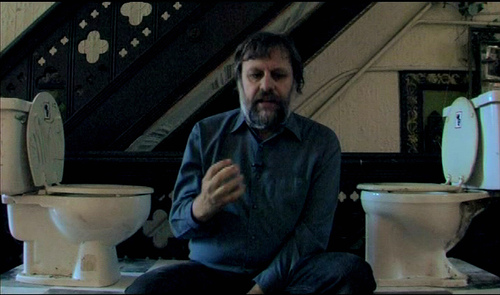
“Obviously, I have some anal fixation here” Žižek, Ideology and Toilets


“In a traditional German toilet, the hole into which shit disappears after we flush is right at the front, so that shit is first laid out for us to sniff and inspect for traces of illness. In the typical French toilet, on the contrary, the hole is at the back, i.e. shit is supposed to disappear as quickly as possible. Finally, the American (Anglo-Saxon) toilet presents a synthesis, a mediation between these opposites: the toilet basin is full of water, so that the shit floats in it, visible, but not to be inspected. [...] It is clear that none of these versions can be accounted for in purely utilitarian terms: each involves a certain ideological perception of how the subject should relate to excrement. Hegel was among the first to see in the geographical triad of Germany, France and England an expression of three different existential attitudes: reflective thoroughness (German), revolutionary hastiness (French), utilitarian pragmatism (English). In political terms, this triad can be read as German conservatism, French revolutionary radicalism and English liberalism. [...] The point about toilets is that they enable us not only to discern this triad in the most intimate domain, but also to identify its underlying mechanism in the three different attitudes towards excremental excess: an ambiguous contemplative fascination; a wish to get rid of it as fast as possible; a pragmatic decision to treat it as ordinary and dispose of it in an appropriate way. It is easy for an academic at a round table to claim that we live in a post-ideological universe, but the moment he visits the lavatory after the heated discussion, he is again knee-deep in ideology.”

― Slavoj Žižek, The Plague of Fantasies


Slavoj Zizek | Post-Modern Architecture

The following is the full version of a lecture delivered by Slavoj Zizek on Architecture and Aesthetics in which he talks about a range of issues including, but not limited to, the meanings and implications of public spaces (what he says is the ‘privatized public spaces’), the invisible space (i.e., canalization referring to sewage system), the sanitatization of the city, ideology embedded in our everyday architecture (i.e., toilet), the notions of ‘more’ imbedded in ‘less’, etc.


See also:


Reading Žižek – Where to Start?


ZIZEK BOOKS

Ideologies of Experience: Trauma, Failure, Deprivation, and the Abandonment of the Self


Matthew H. Bowker offers a novel analysis of "experience": the vast and influential concept that has shaped Western social theory and political practice for the past half-millennium.

While it is difficult to find a branch of modern thought, science, industry, or art that has not relied in some way on the notion of "experience" in defining its assumptions or aims, no study has yet applied a politically-conscious and psychologically-sensitive critique to the construct of experience. Doing so reveals that most of the qualities that have been attributed to experience over the centuries ― particularly its unthinkability, its correspondence with suffering, and its occlusion of the self ― are part of unlikely fantasies or ideologies. By analyzing a series of related cases, including the experiential education movement, the ascendency of trauma theory, the philosophy of the social contract, and the psychological study of social isolation, the book builds a convincing case that ideologies of experience are invoked not to keep us close to lived realities and ‘things-in-themselves,’ but, rather, to distort and destroy true knowledge of ourselves and others.

In spite of enduring admiration for those who may be called champions of experience, such as Michel de Montaigne, Ralph Waldo Emerson, and others treated throughout the work, the ideologies of experience ultimately discourage individuals and groups from creating, resisting, and changing our experience, urging us instead to embrace trauma, failure, deprivation, and self-abandonment.

New 8-bit Philosophy video on "Mandatory Enjoyment"

"What we are dealing with is a particular type of ideology—an ideology of consumer capitalism that mandates enjoyment."


"There isn’t a pure, correct, or optimal object to enjoy—just that one ought to seek out and find pleasurable experiences… and this works perfectly with our society of advertising—where there is always a newer and shinier object promising pleasure—capitalism promotes and demands that we find happiness and that, most importantly, we enjoy that happiness.

Alfie Bown finds a ray of hope in a special kind of Lacanian enjoyment: Jouissance.


Jouissance is an irrational form of pleasure that borders on suffering —it is a sort of pleasure and pain wrapped in one. A sort of enjoyment that there’s no explanation for- Like watching The Room, picking at scabs, or playing Flappy Bird or any of the Dark Souls games.

With Jouissance there’s an opportunity, not to destroy our ideology that mandates enjoyment—but to reflect on the how unnatural our feelings of enjoyment are—that we aren’t beautiful individuals who are fighting the good fight against the corporate machine—that what we enjoy is predictable, sellable, and taught to us. That no matter how much people try not to be sell outs—they’re just sad hipster pseudo revolutionaries in Che t-shirts and Berets."

8-Bit Philosophy, where classic video games introduce famous thinkers, problems, and concepts with quotes, teachings, and more.

See also:

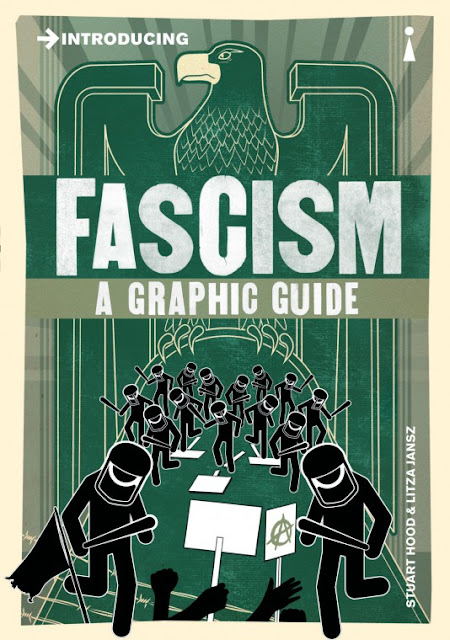
Introducing Fascism: A Graphic Guide

http://www.amazon.co.uk/gp/product/1848316127/ref=as_li_tl?ie=UTF8&camp=1634&creative=19450&creativeASIN=1848316127&linkCode=as2&tag=freuquot-21&linkId=5TGFVFBWFMYR5C4J


Did Fascism end with the Allied victory over the Axis powers in 1945, or has it been lying dormant and is now re-awakening as we move into the 21st century? Introducing Fascism trace the origins of Fascism in 19th-century traditions of ultra-conservatism, the ideas of Nietzsche, Wagner and other intellectuals which helped to make racist doctrines respectable and which led to the ultimate horrifying ‘logic’ of the Holocaust.

Introducing Fascism investigates the four types of Fascism that emerged after the First World War in Italy, Germany, Spain and Japan. It also looks beyond the current headlines of neo-Nazi hooliganism and examines the increasing political success of the far right in Western Europe and the explosion of ultra-nationalisms in Eastern Europe and the former Soviet Union.


Mapping Subaltern Studies and the Postcolonial


http://www.amazon.co.uk/gp/product/1844676374/ref=as_li_tl?ie=UTF8&camp=1634&creative=19450&creativeASIN=1844676374&linkCode=as2&tag=freuquot-21&linkId=ZVJEVGTQI7AJNZHN
Inspired by Antonio Gramsci's writings on the history of subaltern classes, the authors in Mapping Subaltern Studies and the Postcolonial sought to contest the elite histories of Indian nationalists by adopting the paradigm of 'history from below.' Later on, the project shifted from its social history origins by drawing upon an eclectic group of thinkers that included Edward Said, Roland Barthes, Michel Foucault and Jacques Derrida. This book provides a comprehensive balance sheet of the project and its developments, including Ranajit Guha's original subaltern studies manifesto, Partha Chatterjee, Dipesh Chakrabarty and Gayatri Spivak.


See also:


http://www.amazon.co.uk/gp/product/1844675548/ref=as_li_tl?ie=UTF8&camp=1634&creative=19450&creativeASIN=1844675548&linkCode=as2&tag=freuquot-21&linkId=RLANCSMZYQMJB6W5

Tarrying with the Negative: Kant, Hegel, and the Critique of Ideology


Buy Tarrying with the Negative here. - Free delivery worldwide

In the space of barely more than five years, with the publication of four pathbreaking books, Slavoj Zizek has earned the reputation of being one of the most arresting, insightful, and scandalous thinkers in recent memory. Perhaps more than any other single author, his writings have constituted the most compelling evidence available for recognizing Jacques Lacan as the preemient philosopher of our time.

http://www.amazon.co.uk/gp/product/0822313952/ref=as_li_tl?ie=UTF8&camp=1634&creative=19450&creativeASIN=0822313952&linkCode=as2&tag=freuquot-21
In Tarrying with the Negative, Zizek challenges the contemporary critique of ideology, and in doing so opens the way for a new understanding of social conflict, particularly the recent outbursts of nationalism and ethnic struggle. Are we, Zizek asks, confined to a postmodern universe in which truth is reduced to the contingent effect of various discursive practices and where our subjectivity is dispersed through a multitude of ideological positions? No is his answer, and the way out is a return to philosophy. This revisit to German Idealism allows Zizek to recast the critique of ideology as a tool for disclosing the dynamic of our society, a crucial aspect of which is the debate over nationalism, particularly as it has developed in the Balkans--Zizek's home. He brings the debate over nationalism into the sphere of contemporary cultural politics, breaking the impasse centered on nationalisms simultaneously fascistic and anticolonial aspirations. Provocatively, Zizek argues that what drives nationalistic and ethnic antagonism is a collectively driven refusal of our own enjoyment.

Using examples from popular culture and high theory to illuminate each other--opera, film noir, capitalist universalism, religious and ethnic fundamentalism--this work testifies to the fact that, far more radically than the postmodern sophists, Kant and Hegel are our contemporaries.


Reading Žižek – Where to Start?


Mapping Ideology


http://www.amazon.co.uk/gp/product/1844675548/ref=as_li_tl?ie=UTF8&camp=1634&creative=19450&creativeASIN=1844675548&linkCode=as2&tag=freuquot-21&linkId=RLANCSMZYQMJB6W5
For a long time, the term ‘ideology’ was in disrepute, having become associated with such unfashionable notions as fundamental truth and the eternal verities. The tide has turned, and recent years have seen a revival of interest in the questions that ideology poses to social and cultural theory, and to political practice.

Mapping Ideology is a comprehensive reader covering the most important contemporary writing on the subject. Including Slavoj Žižek’s study of the development of the concept from Marx to the present, assessments of the contributions of Lukács and the Frankfurt School by Terry Eagleton, Peter Dews and Seyla Benhabib, and essays by Adorno, Lacan and Althusser, Mapping Ideology is an invaluable guide to the most dynamic field in cultural theory.


With contributions by Nicholas Abercrombie, Theodor Adorno, Louis Althusser, Michèle Barrett, Seyla Benhabib, Pierre Bourdieu, Peter Dews, Terry Eagleton, Stephen Hill, Fredric Jameson, Jacques Lacan, Michel Pécheux, Richard Rorty, Göran Therborn, and Bryan Turner


See also


http://www.amazon.co.uk/gp/product/1844676501/ref=as_li_tl?ie=UTF8&camp=1634&creative=19450&creativeASIN=1844676501&linkCode=as2&tag=freuquot-21&linkId=RGHKHNFVOJRSO73D


http://www.amazon.co.uk/gp/product/1844676374/ref=as_li_tl?ie=UTF8&camp=1634&creative=19450&creativeASIN=1844676374&linkCode=as2&tag=freuquot-21&linkId=ZVJEVGTQI7AJNZHNhttp://freudquotes.blogspot.co.uk/2015/06/mapping-subaltern-studies-and.html


Did Somebody Say Totalitarianism?: Five Interventions in the (Mis)Use of a Notion by Slavoj Zizek


Undermining the liberal-democratic consensus that enables the designation of totalitarianism.

http://www.amazon.co.uk/gp/product/1844677133/ref=as_li_tl?ie=UTF8&camp=1634&creative=19450&creativeASIN=1844677133&linkCode=as2&tag=freuquot-21
In some circles, a nod towards totalitarianism is enough to dismiss any critique of the status quo. Such is the insidiousness of the neo-liberal ideology, argues Slavoj Žižek. Did Somebody Say Totalitarianism? turns a specious rhetorical strategy on its head to identify a network of family resemblances between totalitarianism and modern liberal democracy. Žižek argues that totalitarianism is invariably defined in terms of four things: the Holocaust as the ultimate, diabolical evil; the Stalinist gulag as the alleged truth of the socialist revolutionary project; ethnic and religious fundamentalisms, which are to be fought through multiculturalist tolerance; and the deconstructionist idea that the ultimate root of totalitarianism is the ontological closure of thought. Žižek concludes that the devil lies not so much in the detail but in what enables the very designation totalitarian: the liberal-democratic consensus itself.

The Sublime Object of Ideology by Slavoj Zizek


Exploring the ideologies fantasies of wholeness and exclusion which make up human society.

http://www.amazon.co.uk/gp/product/1844673006/ref=as_li_tl?ie=UTF8&camp=1634&creative=19450&creativeASIN=1844673006&linkCode=as2&tag=freuquot-21Slavoj Zizek, the maverick philosopher, author of over 30 books, acclaimed as the “Elvis of cultural theory”, and today's most controversial public intellectual. His work traverses the fields of philosophy, psychoanalysis, theology, history and political theory, taking in film, popular culture, literature and jokes—all to provide acute analyses of the complexities of contemporary ideology as well as a serious and sophisticated philosophy. His recent films The Pervert's Guide to the Cinema and Zizek! reveal a theorist at the peak of his powers and a skilled communicator. Now Verso is making his classic titles, each of which stand as a core of his ever-expanding life's work, available as new editions. Each is beautifully re-packaged, including new introductions from Zizek himself. Simply put, they are the essential texts for understanding Zizek's thought and thus cornerstones of contemporary philosophy.

The Sublime Object of Ideology: Slavoj Zizek's first book is a provocative and original work looking at the question of human agency in a postmodern world. In a thrilling tour de force that made his name, he explores the ideological fantasies of wholeness and exclusion which make up human society.


Cynicism as a Form of Ideology by Slavoj Zizek

Cynicism as a Form of Ideology

Slavoj Zizek.
The Sublime Object of Ideology (London; New York: Verso, 1989), pp. 28-30.


http://www.amazon.co.uk/gp/product/1844673006/ref=as_li_tl?ie=UTF8&camp=1634&creative=19450&creativeASIN=1844673006&linkCode=as2&tag=freuquot-21
The most elementary definition of ideology is probably the well-known phrase from Marx's Capital: "Sie wissen das nicht, aber sie tun es" ("they do not know it, but they are doing it"). The very concept of ideology implies a kind of basic, constitutive naïveté: the misrecognition of its own presuppositions, of its own effective conditions, a distance, a divergence between so-called social reality and our distorted representation, our false consciousness of it. That is why such a 'naive consciousness' can be submitted to a critical-ideological procedure. The aim of this procedure is to lead the naïve ideological consciousness to a point at which it can recognize its own effective conditions, the social reality that it is distorting, and through this very act dissolve itself. In the more sophisticated versions of the critics of ideology -that developed by the Frankfurt School, for example — it is not just a question of seeing things (that is, social reality) as they 'really are', of throwing away the distorting spectacles of ideology; the main point is to see how the reality itself cannot reproduce itself without this so-called ideological mystification. The mask is not simply hiding the real state of things; the ideological distortion is written into its very essence.

We find, then, the paradox of a being which can reproduce itself only in so far as it is misrecognized and overlooked: the moment we see it 'as it really is', this being dissolves itself into nothingness or, more precisely, it changes into another kind of reality. That is why we must avoid the simple metaphors of demasking, of throwing away the veils which are supposed to hide the naked reality. We can see why Lacan, in his Seminar on The Ethic of Psychoanalysis, distances himself from the liberating gesture of saying finally that "the emperor has no clothes". The point is, as Lacan puts it, that the emperor is naked only beneath his clothes, so if there is an unmasking gesture of psychoanalysis, it is closer to Alphonse Allais's well-known joke, quoted by Lacan: somebody points at a woman and utters a horrified cry, "Look at her, what a shame, under her clothes, she is totally naked" (Lacan, 1986, p.231).

But all this is already well known: it is the classic concept of ideology as 'false consciousness', misrecognition of the social reality which is part of this reality itself. Our question is: Does this concept of ideology as a naive consciousness still apply to today's world? Is it still operating today? In the Critique of Cynical Reason, a great bestseller in Germany (Sloterdijk, 1983), Peter Sloterdijk puts forward the thesis that ideology's dominant mode of functioning is cynical, which renders impossible- or, more precisely, vain — the classic critical-ideological procedure. The cynical subject is quite aware of the distance between the ideological mask and the social reality, but he none the less still insists upon the mask. The formula, as proposed by Sloterdijk, would then be: "they know very well what they are doing, but still, they are doing it". Cynical reason is no longer naïve, but is a paradox of an enlightened false consciousness: one knows the falsehood very well, one is well aware of a particular interest hidden behind an ideological universality, but still one does not renounce it.

We must distinguish this cynical position strictly from what Sloterdijk calls kynicism. Kynicism represents the popular, plebeian rejection of the official culture by means of irony and sarcasm: the classical kynical procedure is to confront the pathetic phrases of the ruling official ideology — its solemn, grave tonality — with everyday banality and to hold them up to ridicule, thus exposing behind the sublime noblesse of the ideological phrases the egotistical interests, the violence, the brutal claims to power. This procedure, then, is more pragmatic than argumentative: it subverts the official proposition by confronting it with the situation of its enunciation; it proceeds ad hominem (for example when a politician preaches the duty of patriotic sacrifice, kynicism exposes the personal gain he is making from the sacrifice of others).

Cynicism is the answer of the ruling culture to this kynical subversion: it recognizes, it takes into account, the particular interest behind the ideological universality, the distance between the ideological mask and the reality, but it still finds reasons to retain the mask. This cynicism is not a direct position of immorality, it is more like morality itself put in the service of immorality — the model of cynical wisdom is to conceive probity, integrity, as a supreme form of dishonesty, and morals as a supreme form of profligacy, the truth as the most effective form of a lie. This cynicism is therefore a kind of perverted 'negation of the negation' of the official ideology: confronted with illegal enrichment, with robbery, the cynical reaction consists in saying that legal enrichment is a lot more effective and, moreover, protected by the law. As Bertolt Brecht puts it in his Threepenny Opera: "what is the robbery of a bank compared to the founding of a new bank?"

It is clear, therefore, that confronted with such cynical reason, the traditional critique of ideology no longer works. We can no longer subject the ideological text to 'symptomatic reading', confronting it with its blank spots, with what it must repress to organize itself, to preserve its consistency — cynical reason takes this distance into account in advance. Is then the only issue left to us to affirm that, with the reign of cynical reason, we find ourselves in the so-called post-ideological world? Even Adorno came to this conclusion, starting from the premiss that ideology is, strictly speaking, only a system which makes a claim to the truth — that is, which is not simply a lie but a lie experienced as truth, a lie which pretends to be taken seriously. Totalitarian ideology no longer has this pretension. It is no longer meant, even by its authors, to be taken seriously — its status is just that of a means of manipulation, purely external and instrumental; its rule is secured not by its truth-value but by simple extra-ideological violence and promise of gain.

It is here, at this point, that the distinction between symptom and fantasy must be introduced in order to show how the idea that we live in a post-ideological society proceeds a little too quickly: cynical reason, with all its ironic detachment, leaves untouched the fundamental level of ideological fantasy, the level on which ideology structures the social reality itself.

From: Zizek, Slavoj. The Sublime Object of Ideology (London; New York: Verso, 1989), pp. 28-30.
Available: http://www.autodidactproject.org/other/cynzizek.html

Worldwide Shipping: 🖤 T-Shirts / Hoodies / Mugs / Stickers >>       I WOULD PREFER NOT TO.  
https://www.teepublic.com/t-shirt/1759107-i-would-prefer-not-to-bartleby-zizek
Bartleby, the Scrivener: “I would prefer not to.
https://www.teepublic.com/t-shirt/1759107-i-would-prefer-not-to-bartleby-zizek
Related Posts Plugin for WordPress, Blogger...