Showing posts with label Carl Gustav Jung. Show all posts

“A sadist is always at the same time a masochist.”

The idea of a connection between the sadistic and masochistic perversions had already been noted by Krafft-Ebing. Freud stresses it as early as the Three Essays on the Theory of Sexuality (1905), treating sadism and masochism as the two faces of a single perversion whose active and passive forms are to be found in variable proportions in the same individual:

‘A sadist is always at the same time a masochist, although the active or the passive aspect of the perversion may be the more strongly developed in him and may represent his predominant sexual activity.’
 ― Sigmund Freud, Three Essays on the Theory of Sexuality (1905)


Excerpted from The Language of Psychoanalysis


Carl Jung spanks Sabina Spielrein in Cronenberg's drama, A Dangerous Method (2011)

Labyrinths: Emma Jung, Her Marriage to Carl and the Early Years of Psychoanalysis


The story of Emma and Carl Jung's highly unconventional marriage, their relationship with Freud, and their part in the early years of Psychoanalysis.

Emma Jung was clever, ambitious and immensely wealthy, one of the richest heiresses in Switzerland when, aged seventeen, she met and fell in love with Carl Jung, a handsome, penniless medical student. Determined to share his adventurous life, and to continue her own studies, she was too young to understand Carl’s complex personality or conceive the dramas that lay ahead.

Labyrinths tells the story of the Jungs’ unconventional marriage, their friendship and, following publication of Jung’s The Psychology of the Unconscious, subsequent rift with Freud. It traces Jung’s development of word association, notions of the archetype, the collective unconscious, the concepts of extraversion and introversion and the role played by both Carl and Emma in the early development of the scandalous new Psychoanalysis movement.

In its many twists and turns, the Jung marriage was indeed labyrinthine and Emma was forced to fight with everything she had to come to terms with Carl’s brilliant, complex character and to keep her husband close to her. His belief in polygamy led to many extra-marital affairs including a menage a trois with a former patient Toni Wolff that lasted some thirty years. But the marriage endured and Emma realised her ambition to become a noted analyst in her own right.

The Red Book of C.G. Jung: A Journey into Unknown Depths


Jung's The Red Book has an enormous complexity of meaning deriving from Jung's intimate experiences, which are still being discussed and elaborated on by the Jungian community all over the world. The present volume focuses on some of its main aspects and its importance for the understanding of the work of Jung.

The Red Book is often mistakenly seen as a product of a midlife crisis of Jung's, caused by his break with Freud. However, although this crisis was present, the work is better understood as a manifestation of unconscious symbolism of Jung's individuation process that started in his childhood. Certain symbols of The Red Book can be traced back to Jung's earliest years, reaching their peak during the period of writing the book and continuing throughout his creative life.

Jung's work is therefore understood as having a Janus face: like the old Roman god of the gates it has two faces, one looking back to the past, the other looking to the future. If the past appears in the various figures with which Jung interacts throughout the book, such as the desert anchorite Ammonius, and the prophets and heroes of ancient times, it also looks to the future, pointing to new developments in analytical psychology and the practice of psychotherapy. Both aspects of the The Red Book are here discussed at length.

The writing of Jung's book and its appearance to the general public almost a century afterwards is studied in relation to the paradigm crisis in science and the phantasy of millenarianism. Jung wrote this work when Europe was entering the strong cultural crisis of World War One, which threw up profound cultural changes. Jung's family and estate gave their final authorization for the publication of the book in the year 2000, a year full of symbolic meaning, impregnated with phantasies of millenarianism. Jung's work is considered here as a book therefore pertaining to large cultural changes, one in the past and one in the present, and both equally transformative of society and the perception of man himself.

Freud's 'Outstanding' Colleague/Jung's 'Twin Brother': The suppressed psychoanalytic and political significance of Otto Gross


Otto Gross was the first analyst to link his work with radical politics, connecting inner, personal transformation with outer, collective change. Since his death in 1920 his work has been suppressed, despite his seminal influence on the developing analytic discipline and on the fields of sociology, philosophy and literature. Here Gottfried M. Heuer introduces Gross’ life and ideas, using an innovative, historiographic methodology he terms trans-historical: a psychoanalytic, intersubjective, and trans-temporal approach to the past, aimed at ‘healing wounded history’ in the present.

Heuer considers several previously unpublished sources to explore Gross’s ideas and legacy as well as his unusually bohemian life. His use of the anarchist concept of mutuality to develop a relational and intersubjective approach in his own analytic theory and clinical practice was unique, and his work had a lasting, yet unacknowledged, influence on Freud, Jung (with whom he had the first recorded mutual analysis) and many other analysts. His ideas were appropriated by Max Weber, the founder of sociology, and by the philosopher Martin Buber, playing a pivotal role in what we now call ‘modernity’. Heuer also explores Gross’s paradigmatic father/son battle with his father Hans, who established the science of criminology, and touches upon Gross’s links to the literary field of the early 20th century via Kafka, Werfel, et al., German expressionism and the Dada-movement, as well as the Anglo-American world through the work of D. H. Lawrence.

This innovative, multi-faceted approach to Gross’s work and its influence marks a turning point, putting him firmly on the map of the historiography of analysis as well as linking this field with the neighbouring disciplines of the history of law and criminology, literature, sociology and philosophy. In addition, Gross continuing relevance for leading edge clinical and political ideas is addressed. This book will be essential reading for Jungian and Freudian analysts, psychotherapists and counsellors, academics and students of analysis, politics, history, criminology and sociology.

‘the aim of all life is death’

“If we are to take it as a truth that knows no exception that everything dies for internal reasons – becomes inorganic once again – then we shall be compelled to say that ‘the aim of all life is death’ and, looking backwards, that ‘inanimate things existed before living ones’.”

― Sigmund Freud, Beyond the Pleasure Principle


Jung-Lacan Dialogues: The Psychoid and the Real

This is the second in a series of Jung-Lacan Dialogues aimed at fostering an engagement between two important and creative schools of psychoanalysis. What is the common ground between them? What are the intractable differences? Is it possible to find a common language or achieve mutual understandings? And what are the implications for clinical practice?


The Psychoid and the Real

Is there any commonality between Jung’s idea of the Psychoid and Lacan’s conceptualisation of the Real? And what are the specifics of the differences between these two important clinical concepts? Alistair Black and David Henderson will elaborate the history and development of the terms and reflect on the implications for clinical work.


Dr Alistair Black is a psychoanalyst in the Lacanian tradition in private practice in south London. He is a member of the Centre for Freudian Analysis and Research (CFAR). Recent publications include 'Lacan's encounter with a Buddhist statue and the gaze as objet a ' in Psychoanalytische Perspectieven.

David Henderson, PhD is a psychoanalytic psychotherapist in private practice and senior lecturer in psychoanalysis at the Centre for Psychoanalysis, Middlesex University. He is a member of the Association of Independent Psychotherapists (AIP) Recent publications include, Apophatic Elements in the Theory and Practice of Psychoanalysis, published by Routledge and ‘Freud and Jung: The creation of the psychoanalytic universe,’ published in Psychodynamic Practice.
 

The Quotable Jung


Buy The Quotable Jung here. - Free delivery worldwide

C. G. Jung (1875–1961) was a preeminent thinker of the modern era. In seeking to establish an interdisciplinary science of analytical psychology, he studied psychiatry, religion, mysticism, literature, physics, biology, education, and criminology. He introduced the concepts of extraversion and introversion, and terms such as complex, archetype, individuation, and the collective unconscious. He stressed the primacy of finding meaning in our lives.

The Quotable Jung is the single most comprehensive collection of Jung quotations ever assembled. It is the essential introduction for anyone new to Jung and the Jungian tradition. It will also inspire those familiar with Jung to view him in an entirely new way. The Quotable Jung presents hundreds of the most representative selections from the vast array of Jung’s books, essays, correspondence, lectures, seminars, and interviews, as well as the celebrated Red Book, in which Jung describes his own fearsome confrontation with the unconscious. Organized thematically, this collection covers such topics as the psyche, the symbolic life, dreams, the analytic process, good and evil, creativity, alchemical transformation, death and rebirth, the problem of the opposites, and more. The quotations are arranged so that the reader can follow the thread of Jung’s thought on these topics while gaining an invaluable perspective on his writings as a whole.

Succinct and accessible, The Quotable Jung also features a preface by Judith Harris and a detailed chronology of Jung’s life and work.
  • The single most comprehensive collection of Jung quotations ever assembled
  • Features hundreds of quotes
  • Covers such topics as the psyche, dreams, good and evil, death and rebirth, and more
  • Includes a detailed chronology of Jung’s life and work
  • Serves as the ideal introduction to Jung and the Jungian tradition
Judith Harris is President of the Philemon Foundation and a Jungian analyst in private practice. She is a supervising and training analyst at ISAPZURICH and a senior analyst at the Ontario Association of Jungian Analysts. She is the author of Jung and Yoga: The Psyche-Body Connection. She lives in Zürich and Toronto.

Buy The Quotable Jung here. - Free delivery worldwide
 

Carl Jung’s 1957 Letter on UFOs

For his final act, Jung cast an analytical eye on UFOs.


In 1957, with Flying Saucers to appear the following year, New Republic editor Gilbert A. Harrison wanted to get this Jungian perspective on UFOs in his magazine. At the top of this post, you can see (via The Awl) a scan of Jung’s response to Harrison’s query, the text of which follows:

the problem of the Ufos is, as you rightly say, a very fascinating one, but it is as puzzling as it is fascinating; since, in spite of all observations I know of, there is no certainty about their very nature. On the other side, there is an overwhelming material pointing to their legendary or mythological aspect. As a matter of fact the psychological aspect is so impressive, that one almost must regret that the Ufos seem to be real after all. I have followed up the literature as much as possible and it looks to me as if something were seen and even confirmed by radar, but nobody knows exactly what is seen. In consideration of the psychological aspect of the phenomenon I have written a booklet about it, which is soon to appear. It is also in the process of being translated into English. Unfortunately being occupied with other tasks I am unable to meet your proposition. Being rather old, I have to economize my energies.

Serious enthusiasts of both Jung and UFOs might consider bidding on the original letter, now up for auction. Estimated sale price: $2,000 to 3,000.


See also


http://www.amazon.co.uk/gp/product/0415278376/ref=as_li_tl?ie=UTF8&camp=1634&creative=19450&creativeASIN=0415278376&linkCode=as2&tag=freuquot-21

Flying Saucers: A Modern Myth of Things Seen in the Skies by C.G. Jung


http://www.amazon.co.uk/gp/product/0415278376/ref=as_li_tl?ie=UTF8&camp=1634&creative=19450&creativeASIN=0415278376&linkCode=as2&tag=freuquot-21
Written in the late 1950s at the height of popular fascination with UFO's, Flying Saucers is the great psychologist's brilliantly prescient meditation on the phenomenon that gripped the world. A self-confessed sceptic in such matters, Jung was nevertheless intrigued, not so much by their reality or unreality, but by their psychic aspect. He saw flying saucers as a modern myth in the making, to be passed down the generations just as we have received such myths from our ancestors. In this wonderful and enlightening book Jung sees UFO's as 'visionary rumours', the centre of a quasi-religious cult and carriers of our technological and salvationist fantasies. 40 years later, with entire religions based on the writings of science fiction authors, it is remarkable to see just how right he has proved to be.

The Cambridge Companion to Jung


http://www.amazon.co.uk/gp/product/0521685001/ref=as_li_tl?ie=UTF8&camp=1634&creative=19450&creativeASIN=0521685001&linkCode=as2&tag=freuquot-21
This second edition represents a wide-ranging critical introduction to the psychology of Carl Jung, one of the founders of psychoanalysis. Including two new essays and thorough revisions of most of the original chapters, it constitutes a radical assessment of his legacy. Andrew Samuels' introduction succinctly articulates the challenges facing the Jungian community. The fifteen essays set Jung in the context of his own time, outline the current practice and theory of Jungian psychology and show how Jungians continue to question and evolve his thinking and apply it to aspects of modern culture and psychoanalysis. The volume includes a full chronology of Jung's life and work, extensively revised and up to date bibliographies, a case study and a glossary. It is an indispensable reference tool for both students and specialists, written by an international team of Jungian analysts and scholars from various disciplines.

See also


&

How to Deal With Frenemies: The Well-Documented Friendship of Jung & Freud - 8 Steps (with Pictures)

Would you even know if you had frenemies?


1# Spot the frenemy in your life.

 Freud & Jung celebrating Jung's birthday at his home in Zurich, ca. 1906.


2# Listen to your own instincts.

 Freud & Jung fishing halibut off the coast of the Rhine near Düsseldorf, ca. 1909.


3# Make changes.

Freud & Jung relaxing with freinds at a Turkish banya during a psychoanalysts' retreat , ca. 1907.


4# Talk to the frenemy outright.

Freud & Jung taking a break from their lecture tour to enjoy an American billiards hall, 1908.


5# Expect your frenemy to be surprised or in denial.

Influenced by America's burgeoning bohemian culture, Freud & Jung spent a short portion of their trip travelling the rails. Photo ca. 1908.


6# Be realistic about the chances of staying friends with the frenemy.

Freud & Jung with their sweethearts during a brief furlough, ca. 1907


7# Look to yourself.

Although a political passifist, Freud was well-known for his fascination with rifles and other firearms. This photo, which features a more-than reluctant Jung, was taken during a big-game safari in Sub-Saharan Africa, ca. 1909.


8# Make the break.

Freud & Jung posing for a photo during an ill-fated arctic expedition ca. 1912. One man and three dogs met their deaths during this endeavor. This traumatic episode put a great deal of strain on the two mens' relationship.


Happy Birthday, Carl Jung!

Swiss psychotherapist and founder of analytical psychology Carl Jung was born today in 1875. He died in 1961 at the age of 85.

A photo posted by Freud Quotes (@freud.quotes) on


A Swiss-born psychologist, Carl Jung  (26 July 1875 – 6 June 1961) is best known for his identification of synchronicity, the Collective Unconscious and the concept of archetypes that dictate human behavior. The advances Jung made in the field of psychology have since spawned Jungian schools and centers and inspired analysts worldwide. Jung’s work had an indelible impact on the theories of Sigmund Freud, arguably the most influential doctor in modern psychology.


“We cannot change anything unless we accept it.”
― C.G. Jung, Modern Man in Search of a Soul

Answer to Job by C.G. Jung


http://www.amazon.co.uk/gp/product/0415289971/ref=as_li_tl?ie=UTF8&camp=1634&creative=19450&creativeASIN=0415289971&linkCode=as2&tag=freuquot-21&linkId=B5YTWML4VZ2LHXA3
Of all the books of the Bible few have had more resonance for modern readers than the Book of Job. For a world that has witnessed great horrors, Job's cries of despair and incomprehension are all too recognizable. The visionary psychotherapist Carl Gustav Jung understood this and responded with this remarkable book, in which he set himself face-to-face with 'the unvarnished spectacle of divine savagery and ruthlessness'. Jung perceived in the hidden recesses of the human psyche the cause of a crisis that plagues modern humanity and leaves the individual, like Job, isolated and bewildered in the face of impenetrable fortune. By correlating the transcendental with the unconscious, Jung, writing not as a biblical scholar but 'as a layman and physician who has been privileged to see deeply into the psychic life of many people', offers a way for every reader to come to terms with the divine darkness which confronts each individual.


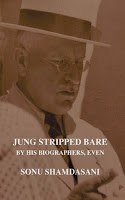
Jung Stripped Bare: By His Biographers, Even


http://www.amazon.co.uk/gp/product/1855753170/ref=as_li_tl?ie=UTF8&camp=1634&creative=19450&creativeASIN=1855753170&linkCode=as2&tag=freuquot-21&linkId=U7P6K3I4ICB3XAE2
How many "posthumous" lives does a man have to live? Nearly half a century after his death, C. G. Jung is a subject of continual controversies. Every few years, a new life of Jung appears, each promising to provide the missing master key to the mysteries of his life and work, and to lay bare their secrets. However, with every successive "life", Jung becomes shrouded in an ever-increasing web of rumour, gossip, innuendo and fantasy. We may ask why Jung biographies are so filled with shortcomings? How did Jung become a fiction?This book addresses these issues. It demonstrates the pitfalls and fallacies of such works, and sets out how his life and work should be approached on a historical basis, drawing on decades of archival investigation and new documentation. It surveys attempts to write Jung's biography from during his own lifetime until the present; shows how Memories, Dreams, Reflections came to be falsely perceived as his autobiography; and why his Collected Works was never completed. Thus this work lays out an agenda for future studies and discussions of Jung, the reception of his work and its impact on contemporary culture.


Jung and the Making of Modern Psychology: The Dream of a Science


http://www.amazon.co.uk/gp/product/0521539099/ref=as_li_tl?ie=UTF8&camp=1634&creative=19450&creativeASIN=0521539099&linkCode=as2&tag=freuquot-21&linkId=2U27UUFIXVZSR4J7
Occultist, Scientist, Prophet, Charlatan - C. G. Jung has been called all these things and after decades of myth making, is one of the most misunderstood figures in Western intellectual history. This book is the first comprehensive study of the origins of his psychology, as well as providing a new account of the rise of modern psychology and psychotherapy. Based on a wealth of hitherto unknown archival materials it reconstructs the reception of Jung's work in the human sciences, and its impact on the social and intellectual history of the twentieth century. The book creates a basis for all future discussion of Jung, and opens new vistas on psychology today.


Dream Interpretation Ancient and Modern: Notes from the Seminar Given in 1936-1941


http://www.amazon.co.uk/gp/product/0691159459/ref=as_li_tl?ie=UTF8&camp=1634&creative=19450&creativeASIN=0691159459&linkCode=as2&tag=freuquot-21&linkId=MDECKIPYDYKYHRHO
From 1936 to 1941, C. G. Jung gave a four-part seminar series in Zurich on children’s dreams and the historical literature on dream interpretation. This book completes the two-part publication of this landmark seminar, presenting the sessions devoted to dream interpretation and its history. Here we witness Jung as both clinician and teacher: impatient and sometimes authoritarian but also witty, wise, and intellectually daring, a man who, though brilliant, could be vulnerable, uncertain, and humbled by life’s mysteries. These sessions open a window on Jungian dream interpretation in practice, as Jung examines a long dream series from the Renaissance physician Girolamo Cardano. They also provide the best example of group supervision by Jung the educator. Presented here in an inspired English translation commissioned by the Philemon Foundation, these sessions reveal Jung as an impassioned teacher in dialogue with his students as he developed and refined the discipline of analytical psychology.

An invaluable document of perhaps the most important psychologist of the twentieth century at work, this splendid book is the fullest representation of Jung’s interpretations of dream literatures, filling a critical gap in his collected works.


The Question of Psychological Types: The Correspondence of C. G. Jung and Hans Schmid-Guisan, 1915-1916


http://www.amazon.co.uk/gp/product/0691155615/ref=as_li_tl?ie=UTF8&camp=1634&creative=19450&creativeASIN=0691155615&linkCode=as2&tag=freuquot-21&linkId=6WHDTWU7SPLRCVAD
In 1915, C. G. Jung and his psychiatrist colleague, Hans Schmid-Guisan, began a correspondence through which they hoped to codify fundamental individual differences of attention and consciousness. Their ambitious dialogue, focused on the opposition of extraversion and introversion, demonstrated the difficulty of reaching a shared awareness of differences even as it introduced concepts that would eventually enable Jung to create his landmark 1921 statement of the theory of psychological types. That theory, the basis of the widely used Myers-Briggs Type Indicator and similar personality assessment tools, continues to inform not only personality psychology but also such diverse fields as marriage and career counseling and human resource management.

This correspondence reveals Jung fielding keen theoretical challenges from one of his most sensitive and perceptive colleagues, and provides a useful historical grounding for all those who work with, or are interested in, Jungian psychology and psychological typology.


Synchronicity: An Acausal Connecting Principle by C.G. Jung


http://www.amazon.co.uk/gp/product/0415136490/ref=as_li_tl?ie=UTF8&camp=1634&creative=19450&creativeASIN=0415136490&linkCode=as2&tag=freuquot-21&linkId=FRXHWX4VK575B25Q
To Jung, synchonicity is a meaningful coincidence in time, a psychic factor which is independant of space and time. This revolutionary concept of synchronicity both challenges and complements the physicist's classical view of casualty. It also forces is to a basic reconsideration of the meaning of chance, probability, coincidence and the singular events in our lives.


Analytical Psychology in Exile: The Correspondence of C. G. Jung and Erich Neumann


http://www.amazon.co.uk/gp/product/069116617X/ref=as_li_tl?ie=UTF8&camp=1634&creative=19450&creativeASIN=069116617X&linkCode=as2&tag=freuquot-21&linkId=JI22RKGPUC22STWH
C. G. Jung and Erich Neumann first met in 1933, at a seminar Jung was conducting in Berlin. Jung was fifty-seven years old and internationally acclaimed for his own brand of psychotherapy. Neumann, twenty-eight, had just finished his studies in medicine. The two men struck up a correspondence that would continue until Neumann’s death in 1960. A lifelong Zionist, Neumann fled Nazi Germany with his family and settled in Palestine in 1934, where he would become the founding father of analytical psychology in the future state of Israel.

Presented here in English for the first time are letters that provide a rare look at the development of Jung’s psychological theories from the 1930s onward as well as the emerging self-confidence of another towering twentieth-century intellectual who was often described as Jung’s most talented student. Neumann was one of the few correspondence partners of Jung’s who was able to challenge him intellectually and personally. These letters shed light on not only Jung’s political attitude toward Nazi Germany, his alleged anti-Semitism, and his psychological theory of fascism, but also his understanding of Jewish psychology and mysticism. They affirm Neumann’s importance as a leading psychologist of his time and paint a fascinating picture of the psychological impact of immigration on the German Jewish intellectuals who settled in Palestine and helped to create the state of Israel.

Featuring Martin Liebscher’s authoritative introduction and annotations, this volume documents one of the most important intellectual relationships in the history of analytical psychology.


Children's Dreams: Notes from the Seminar Given in 1936-1940 (Jung Seminars)


http://www.amazon.co.uk/gp/product/0691148074/ref=as_li_tl?ie=UTF8&camp=1634&creative=19450&creativeASIN=0691148074&linkCode=as2&tag=freuquot-21&linkId=S5D6CFVTNVFUHLX7
In the 1930s C. G. Jung embarked upon a bold investigation into childhood dreams as remembered by adults to better understand their significance to the lives of the dreamers. Jung presented his findings in a four-year seminar series at the Swiss Federal Institute of Technology in Zurich. Children's Dreams marks their first publication in English, and fills a critical gap in Jung's collected works.

Here we witness Jung the clinician more vividly than ever before--and he is witty, impatient, sometimes authoritarian, always wise and intellectually daring, but also a teacher who, though brilliant, could be vulnerable, uncertain, and humbled by life's great mysteries. These seminars represent the most penetrating account of Jung's insights into children's dreams and the psychology of childhood. At the same time they offer the best example of group supervision by Jung, presenting his most detailed and thorough exposition of Jungian dream analysis and providing a picture of how he taught others to interpret dreams. Presented here in an inspired English translation commissioned by the Philemon Foundation, these seminars reveal Jung as an impassioned educator in dialogue with his students and developing the practice of analytical psychology.

An invaluable document of perhaps the most important psychologist of the twentieth century at work, this splendid volume is the fullest representation of Jung's views on the interpretation of children's dreams, and signals a new wave in the publication of Jung's collected works as well as a renaissance in contemporary Jung studies.


Worldwide Shipping: 🖤 T-Shirts / Hoodies / Mugs / Stickers >>       I WOULD PREFER NOT TO.  
https://www.teepublic.com/t-shirt/1759107-i-would-prefer-not-to-bartleby-zizek
Bartleby, the Scrivener: “I would prefer not to.
https://www.teepublic.com/t-shirt/1759107-i-would-prefer-not-to-bartleby-zizek
Related Posts Plugin for WordPress, Blogger...