Showing posts with label Mladen Dolar. Show all posts

Sex and Nothing: Bridges from Psychoanalysis to Philosophy


From its etymological roots, sex is related to a scission, Latin for sectus, secare, meaning “to divide or cut.” Therefore, regardless of the various studies applied to defining sex as inscribed by discursive acts, i.e. merely a ‘performatively enacted signification,’ there is something more to sex than just a social construction or an aprioristic substance. Sex is irreducible to meaning or knowledge.

This is why psychoanalysis cannot be formulated as an erotology nor a science of sex (scientia sexualis). Following this argumentation, in the final class of his eleventh seminar, Lacan asserts that psychoanalysis has proven to be uncreative in the realm of sexuality. Henceforth, sex does not engrave itself within the symbolic: only the failure of its inscription is marked in the symbolic. In this matter, sex escapes the symbolic restraints of language; however, it is through its failure that it manifests itself through the symbolic, e.g. symptoms or dream life. So, what is sex? Sex and Nothing embarks upon a dialogue between colleagues and friends interested in bridging psychoanalysis and philosophy, linking sex and thought, where what emerges is a greater awareness of the irreducucibility of sex to the discourse of knowledge and meaning: in other words, sex and nothing.

With contributions by Joan Copjec, Mladen Dolar, Sigi Jöttkandt, Cristina Soto van der Plas, Jelica Šumic, Samo Tomšic, Gabriel Tupinambá, Daniel Tutt, Slavoj Žižek, and Alenka Zupancic.

A Voice and Nothing More by Mladen Dolar


http://www.amazon.co.uk/gp/product/0262541874/ref=as_li_tl?ie=UTF8&camp=1634&creative=19450&creativeASIN=0262541874&linkCode=as2&tag=freuquot-21
Plutarch tells the story of a man who plucked a nightingale and finding but little to eat exclaimed: "You are just a voice and nothing more." Plucking the feathers of meaning that cover the voice, dismantling the body from which the voice seems to emanate, resisting the Sirens' song of fascination with the voice, concentrating on "the voice and nothing more": this is the difficult task that philosopher Mladen Dolar relentlessly pursues in this seminal work. The voice did not figure as a major philosophical topic until the 1960s, when Derrida and Lacan separately proposed it as a central theoretical concern. In A Voice and Nothing More Dolar goes beyond Derrida's idea of "phonocentrism" and revives and develops Lacan's claim that the voice is one of the paramount embodiments of the psychoanalytic object (objet a). Dolar proposes that, apart from the two commonly understood uses of the voice as a vehicle of meaning and as a source of aesthetic admiration, there is a third level of understanding: the voice as an object that can be seen as the lever of thought. He investigates the object voice on a number of different levels -- the linguistics of the voice, the metaphysics of the voice, the ethics of the voice (with the voice of conscience), the paradoxical relation between the voice and the body, the politics of the voice -- and he scrutinizes the uses of the voice in Freud and Kafka. With this foundational work, Dolar gives us a philosophically grounded theory of the voice as a Lacanian object-cause.

Opera's Second Death


http://www.amazon.co.uk/gp/product/0415930170/ref=as_li_tl?ie=UTF8&camp=1634&creative=19450&creativeASIN=0415930170&linkCode=as2&tag=freuquot-21
Opera's Second Death is a passionate exploration of opera - the genre, its masterpieces, and the nature of death. Using a dazzling array of tools, Slavoj Zizek and coauthor Mladen Dolar explore the strange compulsions that overpower characters in Mozart and Wagner, as well as our own desires to die and to go to the opera.


Everything You Always Wanted to Know About Lacan (But Were Afraid to Ask Hitchcock)


Hitchcock gets onto the analyst’s couch in this extraordinary volume of case studies.

https://www.bookdepository.com/Everything-You-Wanted-Know-About-Lacan-But-Were-Afraid-Ask-Hitchcock-Slavoj-Zizek/9781844676217?a_aid=dbclub
The contributors bring to bear an unrivaled enthusiasm and theoretical sweep on the entire Hitchcock oeuvre, analyzing movies such as Rear Window and Psycho. Starting from the premise that ‘everything has meaning,’ the authors examine the films’ ostensible narrative content and formal procedures to discover a rich proliferation of hidden ideological and psychic mechanisms. But Hitchcock is also a bait to lure the reader into a serious Marxist and Lacanian exploration of the construction of meaning.

An extraordinary landmark in Hitchcock studies, this new edition features a brand-new essay by philosopher Slavoj Žižek, presenter of Sophie Fiennes’s three-part documentary The Pervert’s Guide to Cinema.

With contributions by Pascal Bonitzer, Miran Božovič, Michel Chion, Mladen Dolar, Fredric Jameson, Stojan Pelko, Renata Salecl, and Alenka Zupančič

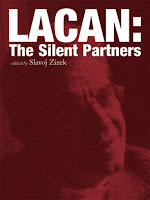
Lacan: The Silent Partners


Buy Lacan: The Silent Partners here. - Free delivery worldwide

A dazzling re-evaluation of Jacques Lacan, uncovering his hidden inspirations.

Jacques Lacan is the foremost psychoanalytic theorist after Freud. Revolutionising the study of social relations, his work has been a major influence on political theory, philosophy, literature and the arts, but his thought has so far been studied without a serious investigation of its foundations. Just what are the influences on his thinking, so crucial to its proper understanding?

http://www.amazon.co.uk/gp/product/1844675491/ref=as_li_tl?ie=UTF8&camp=1634&creative=19450&creativeASIN=1844675491&linkCode=as2&tag=freuquot-21In Lacan: The Silent Partners Slavoj Žižek, the maverick theorist and pre-eminent Lacan scholar, has marshalled some of the greatest thinkers of our age in support of a dazzling re-evaluation of Lacan's work. Focussing on Lacan's 'silent partners', those who are the hidden inspiration to Lacanian theory, they discuss his work in relation to the Pre-Socratics, Diderot, Hegel, Nietzsche, Schelling, Hölderlin, Wagner, Turgenev, Kafka, Henry James and Artaud.

This major collection, including three essays by Žižek, marks a new era in the study of this unsettling thinker, breathing new life into his classic work.
With contributions by Alain Badiou, Bruno Bosteels, Miran Božovič, Lorenzo Chiesa, Joan Copjec, Mladen Dolar, Timothy C. Huson, Fredric Jameson, Adrian Johnston, Sigi Jöttkandt, Sylvia Ons, Robert Pfaller, and Alenka Zupančič

Worldwide Shipping: 🖤 T-Shirts / Hoodies / Mugs / Stickers >>       I WOULD PREFER NOT TO.  
https://www.teepublic.com/t-shirt/1759107-i-would-prefer-not-to-bartleby-zizek
Bartleby, the Scrivener: “I would prefer not to.”
https://www.teepublic.com/t-shirt/1759107-i-would-prefer-not-to-bartleby-zizek
Related Posts Plugin for WordPress, Blogger...