Showing posts with label Architecture. Show all posts

“Obviously, I have some anal fixation here” Žižek, Ideology and Toilets


“In a traditional German toilet, the hole into which shit disappears after we flush is right at the front, so that shit is first laid out for us to sniff and inspect for traces of illness. In the typical French toilet, on the contrary, the hole is at the back, i.e. shit is supposed to disappear as quickly as possible. Finally, the American (Anglo-Saxon) toilet presents a synthesis, a mediation between these opposites: the toilet basin is full of water, so that the shit floats in it, visible, but not to be inspected. [...] It is clear that none of these versions can be accounted for in purely utilitarian terms: each involves a certain ideological perception of how the subject should relate to excrement. Hegel was among the first to see in the geographical triad of Germany, France and England an expression of three different existential attitudes: reflective thoroughness (German), revolutionary hastiness (French), utilitarian pragmatism (English). In political terms, this triad can be read as German conservatism, French revolutionary radicalism and English liberalism. [...] The point about toilets is that they enable us not only to discern this triad in the most intimate domain, but also to identify its underlying mechanism in the three different attitudes towards excremental excess: an ambiguous contemplative fascination; a wish to get rid of it as fast as possible; a pragmatic decision to treat it as ordinary and dispose of it in an appropriate way. It is easy for an academic at a round table to claim that we live in a post-ideological universe, but the moment he visits the lavatory after the heated discussion, he is again knee-deep in ideology.”

― Slavoj Žižek, The Plague of Fantasies
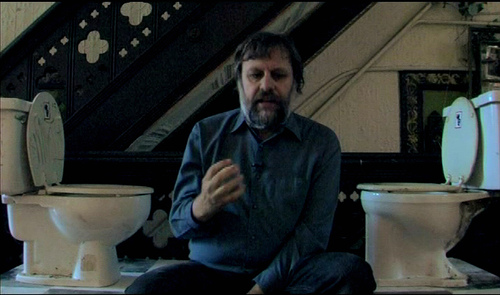

Slavoj Zizek | Post-Modern Architecture

The following is the full version of a lecture delivered by Slavoj Zizek on Architecture and Aesthetics in which he talks about a range of issues including, but not limited to, the meanings and implications of public spaces (what he says is the ‘privatized public spaces’), the invisible space (i.e., canalization referring to sewage system), the sanitatization of the city, ideology embedded in our everyday architecture (i.e., toilet), the notions of ‘more’ imbedded in ‘less’, etc.


See also:


Reading Žižek – Where to Start?


ZIZEK BOOKS

Architecture and the Unconscious


There are a number of recent texts that draw on psychoanalytic theory as an interpretative approach for understanding architecture, or that use the formal and social logics of architecture for understanding the psyche. But there remains work to be done in bringing what largely amounts to a series of independent voices, into a discourse that is greater than the sum of its parts, in the way that, say, the architect Peter Eisenman was able to do with the architecture of deconstruction or that the historian Manfredo Tafuri was able to do with the Marxist critique of architecture. The discourse of the present volume focuses specifically for the first time on the subject of the unconscious in relation to the design, perception, and understanding of architecture. It brings together an international group of contributors, who provide informed and varied points of view on the role of the unconscious in architectural design and theory and, in doing so, expand architectural theory to unexplored areas, enriching architecture in relation to the humanities.

The book explores how architecture engages dreams, desires, imagination, memory, and emotions, how architecture can appeal to a broader scope of human experience and identity. Beginning by examining the historical development of the engagement of the unconscious in architectural discourse, and the current and historical, theoretical and practical, intersections of architecture and psychoanalysis, the volume also analyses the city and the urban condition.

Psychoanalysis and Architecture: The Inside and the Outside


This book explores how psychoanalysis and architecture can enhance and increase the chances of mental 'containment', while also fostering exchange between inside and outside.

The way in which psychoanalysts take care of mental suffering, and the way in which architects and city planners assess the environment, are grounded in a shared concern with the notion of 'dwelling'. It is a matter of fact that dwelling exists in a complex context comprised of both biological need and symbolic function. Psychoanalysis and architecture can work together in both thinking about and designing not only our homes but also the analyst's consulting rooms and, more generally, our therapy places. However, this is possible only if they renounce the current limited and restrictive model of this interaction, and propose one more that is more in harmony with the questions and situations that clients themselves pose.

Creating sustainable and integrative relationships with the buildings in which we inhabit everyday - whether they are our houses, public buildings (such as schools and prisons), or therapeutic spaces (hospitals, clinics, and consulting rooms) - can be a measure both of the degree of the advancement of a society and of the quality of its institutions.
Worldwide Shipping: 🖤 T-Shirts / Hoodies / Mugs / Stickers >>       I WOULD PREFER NOT TO.  
https://www.teepublic.com/t-shirt/1759107-i-would-prefer-not-to-bartleby-zizek
Bartleby, the Scrivener: “I would prefer not to.”
https://www.teepublic.com/t-shirt/1759107-i-would-prefer-not-to-bartleby-zizek
Related Posts Plugin for WordPress, Blogger...