Showing posts with label Biography. Show all posts

Freud: An Intellectual Biography


The life and work of Sigmund Freud continue to fascinate general and professional readers alike. Joel Whitebook here presents the first major biography of Freud since the last century, taking into account recent developments in psychoanalytic theory and practice, gender studies, philosophy, cultural theory, and more. Offering a radically new portrait of the creator of psychoanalysis, this book explores the man in all his complexity alongside an interpretation of his theories that cuts through the stereotypes that surround him. The development of Freud's thinking is addressed not only in the context of his personal life, but also in that of society and culture at large, while the impact of his thinking on subsequent issues of psychoanalysis, philosophy, and social theory is fully examined. Whitebook demonstrates that declarations of Freud's obsolescence are premature, and, with his clear and engaging style, brings this vivid figure to life in compelling and readable fashion.

Freud: In His Time and Ours by Élisabeth Roudinesco


Buy Freud: In His Time and Ours here. - Free delivery worldwide

Elisabeth Roudinesco offers a bold and modern reinterpretation of the iconic founder of psychoanalysis. Based on new archival sources, this is Freud s biography for the twenty-first century a critical appraisal, at once sympathetic and impartial, of a genius greatly admired and yet greatly misunderstood in his own time and in ours.

http://amzn.to/2enihW0

Buy Freud: In His Time and Ours here. - Free delivery worldwide

Roudinesco traces Freud s life from his upbringing as the eldest of eight siblings in a prosperous Jewish-Austrian household to his final days in London, a refugee of the Nazis' annexation of his homeland. She recreates the milieu of fin de siécle Vienna in the waning days of the Habsburg Empire an era of extraordinary artistic innovation, given luster by such luminaries as Gustav Klimt, Stefan Zweig, and Gustav Mahler. In the midst of it all, at the modest residence of Berggasse 19, Freud pursued his clinical investigation of nervous disorders, blazing a path into the unplumbed recesses of human consciousness and desire.

Élisabeth Roudinesco and Sigmund Freud: en son temps et dans le nôtre

Yet this revolutionary who was overthrowing cherished notions of human rationality and sexuality was, in his politics and personal habits, in many ways conservative, Roudinesco shows. In his chauvinistic attitudes toward women, and in his stubborn refusal to acknowledge the growing threat of Hitler until it was nearly too late, even the analytically-minded Freud had his blind spots. Alert to his intellectual complexity the numerous tensions in his character and thought that remained unresolved Roudinesco ultimately views Freud less as a scientific thinker than as the master interpreter of civilization and culture.

Also by Élisabeth Roudinesco :


See also:


A Different Path: An Emotional Autobiography


'Our human task is to be lived by Life. Life as a transcendent principle. It seems to me that a reliable test of whether we have lived worthwhile lives is this: is the world a better place for my having lived in it?'

Neville Symington has written a dozen books about psychoanalysis but this one is different from all the others. It is an emotional autobiography that starts with his own birth and gives a character sketch of his mother and father and his upbringing in Portugal, with a two year period in Canada, and takes the reader through to the age of 45 by which time he was a qualified psychoanalyst, married with two sons and, at the time, living in London.

This sounds like the story of a peaceful journey from childhood through to his chosen career in adulthood. However, the author takes the reader through the period of his earlier career in the Church in a parish in the East End of London and the turbulent period of change that led him to take leave of this first career, seek psychoanalysis and finally to become a psychoanalyst himself.

This is an engaging book that charts the emotional storms and the ups and downs that beset the life's journey of a well-known psychoanalyst.

Freud: A Life for Our Time


Freud: A Life for Our Time is a 1988 biography of Sigmund Freud, the founder of psychoanalysis, by historian Peter Gay. The work is based partly on new material that has become available since the publication of Ernest Jones' The Life and Work of Sigmund Freud (1953). The book has been praised, but has also been criticized by several authors skeptical of psychoanalysis.

A magisterial contribution to the history of ideas (J. Anthony Lukas), this remarkable biography . . . briskly traces the story of Freud's life and education, deftly weaving the familiar narrative with a style that makes it seem fresh and lively (Chicago Tribune).

Erich Fromm: His Life and Ideas An Illustrated Biography


This beautifully designed volume contains 250 rare photographs of Fromm, his family, and associates. The literary executor of the Fromm estate has produced this all-new, lavishly illustrated biography to spearhead the spring 2000 international celebration of the centennial of Fromm's birth. The author of The Art of Loving, The Sane Society, To Have Or to Be?, and other classic works is as popular today as ever. His humanistic message endures as a rallying cry for a more merciful and responsive society. Fromm's entire life is here, from his traditional Jewish upbringing to the years associated with the Frankfurt School of philosophers through life with Trotsky in Mexico to Fromm's important work in America, from the 1950s to his death in 1980. Eschewing dry biographical facts, this fascinating volume will inspire older readers to return to the master's work as it will educate new readers of the seminal psychologist.


Growing Up?: A Journey with Laughter


http://www.amazon.co.uk/gp/product/178220315X/ref=as_li_tl?ie=UTF8&camp=1634&creative=19450&creativeASIN=178220315X&linkCode=as2&tag=freuquot-21
This book is written by a well established author, previously writing in a quite different genre, that of psychoanalysis, psychotherapy and counselling. But this book is written for an entirely different readership. Casement has put together a fascinating account of his strange journey from a privileged background, through schools and national service and through university, avoiding throughout the pull of his family for him to join the Royal Navy. Instead, he leaves university with a degree but heads straight into becoming a bricklayer's mate. From there, eventually, he gets through the vicissitudes of Probation and Social Work, and the hilarious experiences of trying to furnish his first flat. He thus moves into what he describes as the 'real' world - getting what his family would regard as a 'real job' (or two). But despite that, he continues on his unpredictable journey - into becoming a psychotherapist and then a psychoanalyst: what his mother thought was 'training to become a psychotic'. This book is filled with laughter, the author laughing at himself and inviting the reader to join with him in this.

War Memoirs 1917-1919: Second Edition


Bion's War Memoirs is perhaps the most exceptional piece of autobiography yet written by a psychoanalyst. The first section of the book is documentary, consisting of the entire text of the diaries which Bion wrote as a young man to record his experiences on the Western Front in 1917-1919, and this volume also includes the photographs and diagrams with which he illustrated his recollections. The diaries are followed by two later essays, in which he reflects upon his wartime experiences.

Wilfred Bion has long been renowned as one of the great psychoanalysts, his career spanning much of the twentieth century and making him one of the most influential names in the field.

Bion's war diary, which he kept with him during combat, covered his years fighting in France during the First World War. He was just twenty years old when he began writing it. War Memoirs constitutes the final part of Bion's autobiography. It comprised three hardbound notebooks written soon after he had been demobilized from the Army and had begun his studies at Queen's College, Oxford. He wrote it for his parents as compensation for having found it impossible to write to them during the war. It has been aptly described by Winship (1999) as a 'book about the blood and guts of a youth who cut his teeth in the most devastating of circumstances'.

The actions he describes in War Memoirs are terrifying and detailed. They form the basis for his later understanding, as a psychiatrist and psychoanalyst, of the inner torments faced by the patients he treated. In Band of Brigands: The First Men in Tanks (2009), Christy Campbell, referring to a segment of Bion's descriptions, wrote: 'Bion... looks repeatedly at how sentient human beings continue to operate when everything around them is dissolving into violent chaos'.

Many years later, Bion returned to his youth and penned two pieces reflecting upon his time at war, which make up the second part of this book. These meditations are influenced by his psychoanalytic training, and show how his approach to psychoanalysis was influenced by his wartime experiences. Together, these diaries and essays provide an extraordinarily vivid and moving picture of war and its long-term effects.

Karl Abraham: Life and Work, a Biography


Karl Abraham: Life and Work, a Biography is the first complete biography of Karl Abraham (1877-1925), a close colleague and friend of Sigmund Freud and one of the most important pioneers of psychoanalysis.

Abraham was the first psychoanalyst in Germany, where he brought about a great flourishing of psychoanalysis. His clinical-theoretical contributions quickly became classics that have powerfully influenced the development of psychoanalytic theory. He was the first to develop a psychoanalytic theory of depression, several years before the publication of Freud’s 'Mourning and Melancholia'. Abraham was both supervisor and analyst to Melanie Klein, on whose theoretical work he had a profound influence.

In the 1920s Abraham was the most important analyst of the psychoanalytic movement after Freud. He was president of the International Psychoanalytical Association, president of the Berlin Psychoanalytic Society, and a member of the "secret committee". He was involved in a number of major conflicts of the early years of psychoanalysis, and after his death he was quite often blamed for them. As a consequence, Abraham, so highly valued during his life, was frequently reviled after his death.

See also


The Life and Times of Franz Alexander: From Budapest To California


http://www.amazon.co.uk/gp/product/1782202501/ref=as_li_tl?ie=UTF8&camp=1634&creative=19450&creativeASIN=1782202501&linkCode=as2&tag=freuquot-21
Franz Alexander was the first graduate of the Berlin Psychoanalytic Institute, the man who turned down Freud's offer to enter into private practice in Vienna, and the man Freud told to go to America and spread the doctrine of psychoanalysis. He was also the grandfather of Ilonka Venier Alexander, the author of this remarkable account of one of the major figures of psychoanalysis in the twentieth century, set against the backdrop of the growth of analysis in America.

The book considers his personal and professional life, the role of family in his decisions, and how those decisions affected other family members. Themes touched on in this intimate and personal biography include family secrets and lies, the fear of discovery and the need to reinvent one's past in order to survive, the importance of giving to society, and family reunification after decades of deceit and betrayal. All of these themes help to create a stunning portrait of a man who, as the author's mother once told her, was 'as important to psychoanalysis as Elvis is to music'. Franz Alexander's story is finally told here by those who really knew him.

Hysteria: An illuminating visual guide to the birth of Psychoanalysis

Hysteria follows the early career of Sigmund Freud, from his training in neurological research to his establishment of a therapeutic practice in Vienna.


Taking in the psychoanalyst's earliest clinical experiences, his studies alongside Charcot at La Salpêtrière and his interest in the work of his friend and colleague Joseph Breuer, Richard Appignanesi and Oscar Zarate introduce the characters and case histories that inspired the development of a revolutionary new clinical therapy. Drawing on the case histories of "Anna O.", Fräulein Elisabeth von R. and others, Hysteria shows Freud and his contemporaries developing ideas that would transform the intellectual landscape of the Western world. This is a masterful visual guide to the strange and fascinating characters that populate Freud and Breuer's Studies in Hysteria, the founding text of psychoanalysis.

Buy  Hysteria (Graphic Freud) here. - Free delivery worldwide


Buy  Hysteria (Graphic Freud) here. - Free delivery worldwide

Free Ebook - Studies on Hysteria by Sigmund Freud and Josef Breuer

See also


Georges Bataille: An Intellectual Biography


An authoritative account of the life and work of Bataille.

http://www.amazon.co.uk/gp/product/1859841538/ref=as_li_tl?ie=UTF8&camp=1634&creative=19450&creativeASIN=1859841538&linkCode=as2&tag=freuquot-21
Georges Bataille was a philosopher, writer, librarian, pornographer and a founder of the influential journals Critique and Acéphale. He has had an enormous impact on contemporary thought, influencing such writers as Barthes, Baudrillard, Derrida, Foucault and Sontag. Many of his books, including the notorious Story of the Eye and the fascinating The Accursed Share, are modern classics.

In this acclaimed intellectual biography, Michel Surya gives a detailed and insightful account of Bataille’s work against the backdrop of his life – his troubled childhood, his difficult relationship with André Breton and the surrealists and his curious position as a thinker of excess, ‘potlatch’, sexual extremes and religious sacrifice, one who nonetheless remains at the heart of twentieth century French thought—all of it drawn here in rich and allusive prose. While exploring the source of the violent eroticism that laces Bataille’s novels, the book is also an acute guide to the development of Bataille’s philosophical thought. Enriched by testimonies from Bataille’s closest acquaintances and revealing the context in which he worked, Surya sheds light on a figure Foucault described as ‘one of the most important writers of the century’.

Frantz Fanon: A Biography


Comprehensive and eloquent account of Fanon’s personal, intellectual and political life.

http://www.amazon.co.uk/gp/product/1844677737/ref=as_li_tl?ie=UTF8&camp=1634&creative=19450&creativeASIN=1844677737&linkCode=as2&tag=freuquot-21
Born in Martinique, Frantz Fanon (1925–61) trained as a psychiatrist in Lyon before taking up a post in colonial Algeria. He had already experienced racism as a volunteer in the Free French Army, in which he saw combat at the end of the Second World War. In Algeria, Fanon came into contact with the Front de Libération Nationale, whose ruthless struggle for independence was met with exceptional violence from the French forces. He identified closely with the liberation movement, and his political sympathies eventually forced him out the country, whereupon he became a propagandist and ambassador for the FLN, as well as a seminal anticolonial theorist.

David Macey’s eloquent life of Fanon provides a comprehensive account of a complex individual’s personal, intellectual and political development. It is also a richly detailed depiction of postwar French culture. Fanon is revealed as a flawed and passionate humanist deeply committed to eradicating colonialism.

Now updated with new historical material, Frantz Fanon remains the definitive biography of a truly revolutionary thinker.

Disappearing and Reviving: Sandor Ferenczi in the History of Psychoanalysis


http://www.amazon.co.uk/gp/product/1855752549/ref=as_li_tl?ie=UTF8&camp=1634&creative=19450&creativeASIN=1855752549&linkCode=as2&tag=freuquot-21
This book is an indispensable work for anyone interested in the pioneering psychoanalyst Sandor Ferenczi. As the supervisor of the recently published correspondence between Freud and Ferenczi, Haynal brings to the present volume an elegant scholarship sensitive to Ferenczi's time and intellectual milieu. This is not solely a study in the history of psychoanalysis, in that Haynal sets himself the aim of entering into a 'dialogue' with Ferenzi, 'the founder of all relationship-based psychoanalysis and the explorer of traumatisms, counter transference and other problems present even in contemporary  psychoanalysis'. Expressed in a lucid and eloquent style, each chapter explores with an intimate incisiveness, not only Ferenczi's complex and difficult relationship with Freud, but the emergence and elaboration of original ideas anticipatory of subsequent developments within the psychoanalytic movement.

See also:


Mirrors of Memory: Freud, Photography, and the History of Art


http://www.amazon.co.uk/gp/product/0801448190/ref=as_li_tl?ie=UTF8&camp=1634&creative=19450&creativeASIN=0801448190&linkCode=as2&tag=freuquot-21
Photographs shaped the view of the world in turn-of-the-century Central Europe, bringing images of everything from natural and cultural history to masterpieces of Greek sculpture into homes and offices. Sigmund Freud's library―no exception to this trend―was filled with individual photographs and images in books. According to Mary Bergstein, these photographs also profoundly shaped Freud's thinking in ways that were no less important because they may have been involuntary and unconscious.

In Mirrors of Memory, lavishly illustrated with reproductions of the photos from Freud's voluminous collection, she argues that studying the man and his photographs uncovers a key to the origins of psychoanalysis. In Freud's era, photographs were viewed as transparent windows revealing objective truth but at the same time were highly subjective, resembling a kind of dream-memory. Thus, a photo of a ruined temple both depicted the particular place and conveyed a sense of loss, oblivion, of time passing and past, and provided entry into the language of the psychoanalytic project.

Bergstein seeks to understand how various kinds of photographs―of sculptures; archaeological sites in Greece, Rome, and Egypt; medical conditions; ethnographic scenes―fed into Freud's thinking as he elaborated the concepts of psychoanalysis. The result is a book that makes a significant contribution to our understanding of early twentieth century visual culture even as it shows that photography shaped the ways in which the great archaeologist of the human mind saw and thought about the world.

Excavations and Their Objects: Freud's Collection of Antiquity


http://www.amazon.co.uk/gp/product/0791422941/ref=as_li_tl?ie=UTF8&camp=1634&creative=19450&creativeASIN=0791422941&linkCode=as2&tag=freuquot-21
Sigmund Freud collected over two thousand pieces of art, ranging from statuary to jars to seal rings to painted mummy bandages. He prized this collection as much as anything else he owned, seeing these works as pivotal exempla of the great civilizations out of which the best of the contemporary world had been fashioned, with his collection as a personal "School of Athens" by which that great antiquity might be accessed. The essays in this book focus on various aspects of Freud as a collector and aesthete, and on the thematic and theoretical implications of his tastes and passions for art.

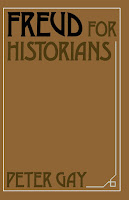
Freud for Historians by Peter Gay


http://www.amazon.co.uk/gp/product/019504228X/ref=as_li_tl?ie=UTF8&camp=1634&creative=19450&creativeASIN=019504228X&linkCode=as2&tag=freuquot-21
Is psychoanalysis a legitimate tool for helping us understand the past? Many traditional historians have answered with an emphatic no, greeting the introduction of Freud into historical study with responses ranging from condescending skepticism to outrage. Now Peter Gay, one of America's leading historians, builds an eloquent case for "history informed by psychoanalysis" and offers an impressive rebuttal to the charges of the profession's anti-Freudians.

In this book, Gay takes on the opposition's arguments, defending psychoanalysis as a discipline that can enhance social, economic, and literary studies. No mere polemic, Freud for Historians is a thoughtful and detailed contribution to a major intellectual debate.

Living in the Shadow of the Freud Family by Sophie Freud


http://www.amazon.co.uk/gp/product/0275994155/ref=as_li_tl?ie=UTF8&camp=1634&creative=19450&creativeASIN=0275994155&linkCode=as2&tag=freuquot-21
I had to do something to escape Hitler's clutches, writes Esti Freud. Yet she waits with her then-16-year-old daughter, Sophie in Paris until German canons can be heard in the distance before deciding to escape by bicycle across France, as Sophie keeps looking back to see whether German tanks will overtake them. Both women survive and, in their own ways, come to feel a need to keep a personal record of those tumultuous times. Thus, in a memoir written at age 79, Esti Fraud, daughter-in-law of Sigmund Freud and wife of his oldest son, Martin, looks back on her life starting before the 20th century, lived on three continents, and stretched through two world wars and the Holocaust. Twenty years after her mothers' death, daughter Sophie turned to Esti's memoir as the scaffold for this book, expanding it through family letters, archival material, and her own diary penned as a teenager. Out of these documents, Sophie Freud has created a many-voiced mosaic, including letters and insights from a wide cast of characters who tell the story of a famous family-and of a century. This work gives an insider's, in-law view of the family Freud, its foundations, and flaws. The relationship between Esti, daughter of a wealthy Vienna attorney and her husband Martin Freud is foreshadowed by the young lovers' fathers. At first meeting Esti, Sigmund told his son the glamorous woman was too beautiful for the clan, meaning her splendor belied a lifestyle not conducive to the frugal Freud ways. And Esti's father, on hearing of her love for Martin, expressed regret she was involved with a man who was not a financially favorable linkage, and that his family was not respectable since patriarch Sigmund was just another psychiatrist, and one who writes pornography books at that. Thus begins the ill-fated relationship that would rock two families and a generation of children to come. Sophie weaves into the text letters she inherited, including letters from Martin while he was a prisoner of war, and excerpts from her own diary, kept as an adolescent. The resulting mosaic will fascinate-and perhaps disturb-readers interested in Freud and psychoanalysis, as well as those intrigued by relationships and family.

Analyzing Freud: Letters of H.D., Bryher, and Their Circle


http://www.amazon.co.uk/gp/product/0811214990/ref=as_li_tl?ie=UTF8&camp=1634&creative=19450&creativeASIN=0811214990&linkCode=as2&tag=freuquot-21
A landmark book in the studies of Freud, H.D., modernism, gender, and sexuality. The poet H.D. (1886-1961) was in psychoanalysis with Sigmund Freud in Vienna during the spring of 1933 and again in the fall of 1934. She visited him daily at his study at 19 Berggasse, while outside Nazi thugs and militia bullied their way through the streets. Freud was old, and fragile. H.D. was forty-six and despairing of her writing life, which seemed to have reached a dead end, for all her success. Her sessions with Freud proved to be the point of transition, the funnel into which were poured her memories of the past and associations in the presentand from which she emerged reborn. H.D. came to Freud at the urging of her companion, the novelist Bryher (1884-1983), the daughter of a wealthy British shipping magnate. Freud welcomed H.D. as a creative spirit whose work he respected, but he did ask her not to prepare for their sessions, write about them in her journal, or talk about them with her friends, especially Bryher, who remained home in England. H.D.'s letters from Vienna filled the gap. Breezy, informal, irreverent, vibrant with detail, they revolve around her hours with Freud, making her correspondence unique in the spectrum of reminiscences, journals, memoirs, and biographies swirling around the legacy of the "Professor" and the movement he founded. The volume includes H.D. and Bryher's letters, as well as letters by Freud to H.D. and Bryher, most of them published for the first time. In addition, the book includes H.D. and Bryher's letters to and from Havelock Ellis, Kenneth MacPherson, Robert McAlmon, Ezra Pound, and Anna Freud, among others. Fully annotated with Index and Photographs

Helene Deutsch: A Psychoanalyst's Life


http://www.amazon.co.uk/gp/product/1560005521/ref=as_li_tl?ie=UTF8&camp=1634&creative=19450&creativeASIN=1560005521&linkCode=as2&tag=freuquot-21
Student and protege of Sigmund Freud, Helene Deutsch was one of the most influential psychoanalysts of her time. An early woman analyst, Deutsch was an ardent feminist and a leading proponent of Freud's controversial theories about the psychology of women. Deutsch was also one of the first prominent career women to combine a professional life with motherhood-even though she never resolved her own conflicts over those contradictory demands. At the time of her death in 1982 at the age of 97, Helene Deutsch was the last survivior of Freud's original circle from Vienna. This volume is a definitive account of the life and works of this remarkable-and enigmatic-woman. The author knew Deutsch personally and was given exclusive access to her papers after her death. The private life of Helene Deutsch was as unconventional as her professional life. While Felix Deutsch, a physician who specialized in psychosomatic medicine, was to remain her husband for fifty years and father her son, Martin, their relationship was highly eccentric. Roazen produces evidence that indicates Felix Deutsch may have been homosexual; also that their son was raised primarily by Felix, as Helene was more interested in her career than was Felix in his, and the Deutsches often lived continents apart. With the rise of Nazism, Helene Deutsch departed in 1935 for America She was welcomed in Cambridge, Massachusetts by the Boston Psychoanalytic Society and was made director of the Society's new institute for the training of analysts. Her two-volume "The Psychology of Women, "published in 1945, remains one of the foundations of modern analysis. Roazen's biography is an authoritative portrait of a pioneer of psychoanalysis, and one of the unique women of her day. It will be of interest to psychoanalysts, cultural historians, and specialists in women's studies.

Passion of Youth: An Autobiography, 1897-1922 by Wilhelm Reich


When he died in 1957, Wilhelm Reich had been the most revolutionary figure in psychoanalysis and the only student of Freud's to carry his libido theory into experimental science. Reich's legacy includes such essential volumes as Character Analysis, The Function of the Orgasm, and The Mass Psychology of Fascism.

Passion of Youth is the latest of Reich's writings to appear posthumously, and it reveals that Reich's life, no less than his work, was provocative and instructive.

In a reminiscence composed in 1919, "Childhood and Puberty," Reich tells of his earliest years, spent on a country estate in Bukovina. He describes his first conscious experiences of sexuality, and the further development of his sexual life; his schooling; and, above all, the catastrophic infidelity that led first to his mother's suicide in 1910 and then to his father's death in 1914.

With the outbreak of the Great War, Reich fled Bukovina and enlisted in the Austro-Hungarian Army, where he became a battalion commander. In an excerpt from his 1937 History of Sexpol, he recounts how his four years in the military impressed on him the masses' numb obedience to authority and the automatic quality of a ceaselessly operating "war machine."

Reich began his study of medicine at the University of Vienna in 1919 and graduated in the summer of 1922. His diaries from these years record his encounter with Freud; the growth of his conviction that sexuality is the core around which all social life, and the inner life, revolves; his first political stirrings; and his analysis of the woman who would become his first wife. These diaries abound in turbulent emotions and the passion of youth.
Worldwide Shipping: 🖤 T-Shirts / Hoodies / Mugs / Stickers >>       I WOULD PREFER NOT TO.  
https://www.teepublic.com/t-shirt/1759107-i-would-prefer-not-to-bartleby-zizek
Bartleby, the Scrivener: “I would prefer not to.”
https://www.teepublic.com/t-shirt/1759107-i-would-prefer-not-to-bartleby-zizek
Related Posts Plugin for WordPress, Blogger...