Showing posts with label Ethics. Show all posts

Talking about Evil: Psychoanalytic, Social, and Cultural Perspectives


How can we talk about evil? How can we make sense of its presence all around us? How can we come to terms with the sad fact that our involvement in doing or enabling evil is an interminable aspect of our lives in the world? This book is an attempt to engage these questions in a new way.

Written from within the complicated reality of Israel, the contributors to this book forge a collective effort to think about evil from multiple perspectives. A necessary effort, since psychoanalysis has been slow to account for the existence of evil, while philosophy and the social sciences have tended to neglect its psychological aspects.

The essays collected here join to form a wide canvas on which a portrait of evil gradually emerges, from the Bible, through the enlightenment to the Holocaust; from Kant, through Freud, Klein, Bromberg and Stein to Arendt, Agamben and Bauman; using literature, history, cinema, social theory and psychoanalysis.

Talking about Evil opens up a much needed space for thinking, in itself an antidote to evil. It will be of interest to psychoanalysts, psychotherapists, and scholars and students of philosophy, social theory and the humanities.

Climate Crisis, Psychoanalysis, and Radical Ethics


Psychoanalysis engages with the difficult subjects in life, but it has been slow to address climate change. Climate Crisis, Psychoanalysis, and Radical Ethics draws on the latest scientific evidence to set out the likely effects of climate change on politics, economics and society more generally, including impacts on psychoanalysts.

Despite a tendency to avoid the warnings, times of crisis summon clinicians to emerge from comfortable consulting rooms. Daily engaged with human suffering, they now face the inextricably bound together crises of global warming and massive social injustices. After considering historical and emotional causes of climate unconsciousness and of compulsive consumerism, this book argues that only a radical ethics of responsibility to be "my other’s keeper" will truly wake us up to climate change and bring psychoanalysts to actively take on responsibilities, such as demanding change from governments, living more simply, flying less, and caring for the earth and its inhabitants everywhere.

Linking climate justice to radical ethics by way of psychoanalysis, Donna Orange explores many relevant aspects of psychoanalytic expertise, referring to work on trauma, mourning, and the transformation of trouble into purpose. Orange makes practical suggestions for action in the psychoanalytic and psychotherapeutic communities: reducing air travel, consolidating organizations and conferences, better use of internet communication and education. This book includes both philosophical considerations of egoism (close to psychoanalytic narcissism) as problematic, together with work on shame and envy as motivating compulsive and conspicuous consumption.

The interweaving of climate emergency and massive social injustice presents psychoanalysts and organized psychoanalysis with a radical ethical demand and an extraordinary opportunity for leadership. Climate Crisis, Psychoanalysis, and Radical Ethics will provide accessible and thought-provoking reading for psychoanalysts and psychotherapists, as well as philosophers, environmental studies scholars and students studying across these fields.

The Ethical Turn: Otherness and Subjectivity in Contemporary Psychoanalysis


Buy The Ethical Turn here. - Free delivery worldwide

Levinas (1969) claims that "morality is not a branch of philosophy, but first philosophy" and if he is right about this, might ethics also serve as a first psychology? This possibility is explored by the authors in this volume who seek to bring the "ethical turn" into the world of psychoanalysis. This phenomenologically rich and socially conscious ethics has taken centre stage in a variety of academic disciplines, inspired by the work of philosophers and theologians concerned with the moral fabric of subjectivity, human relationship, and socio-political life. At the heart of this movement is a reconsideration of the other person, and the dangers created when the question of the "Other" is subsumed by grander themes.

The authors showcased here represent the exceptional work being done by both scholars and practitioners working at the crossroads between psychology and philosophy in order to rethink the foundations of their disciplines. The Ethical Turn: Otherness and subjectivity in contemporary psychoanalysis guides readers into the heart of this fresh and exciting movement and includes contributions from many leading thinkers, who provide fascinating new avenues for enriching our responses to suffering and understandings of human identity. It will be of use to psychoanalysts, professionals in psychology, postgraduate students, professors and other academics in the field.

Buy The Ethical Turn here. - Free delivery worldwide

Ethics of Evil: Psychoanalytic Investigations


In today's world where every form of transgression enjoys a psychological motive and rational justification, psychoanalysis stands alone in its ability to uncover the hidden motives that inform individual and social collective behaviour. Both in theory and practice, it bears witness to the impact of anonymity on the potential for perpetration, especially when others are experienced as faceless, disposable objects whose otherness is, at bottom, but a projection, displacement, and denial of our own interiority-in short, the evil within.

In keeping with this perspective, Ethics of Evil rejects facile rationalizations of violence; it also rejects the idea that evil, as a concept, is inscrutable or animated by demonic forces. Instead, it evaluates the moral framework in which evil is situated, providing a descriptive understanding of it as a plurality and a depth psychological perspective on the threat it poses for our well-being and ways of life. In so doing, it also fashions and articulates an ethical stance that recognizes the intrinsic link between human freedom and the potential for evil. The essays collected in Ethics of Evil argue that moralizing evil is one of the most important agendas of our time.


Ethics of the Real: Kant and Lacan


Fascinating study of the relationship between the philosopher and the psychoanalyst by major Slovenian scholar.

The idea of Kantian ethics is both simple and revolutionary: it proposes a moral law independent of any notion of a pre-established Good or any 'human inclination' such as love, sympathy or fear. In attempting to interpret such a revolutionary proposition in a more 'humane' light, and to turn Kant into our contemporary - someone who can help us with our own ethical dilemmas - many Kantian scholars have glossed over its apparent paradoxes and impossible claims.

This book is concerned with doing exactly the opposite. Kant, thank God, is not our contemporary; he stands against the grain of our times. Lacan on the face of it appears the very antithesis of Kant - the wild theorist of psychoanalysis compared to the sober Enlightenment thinker. His concept of the Real, however, provides perhaps the most useful backdrop to this new interpretation of Kantian ethics. Constantly juxtaposing her readings of the two philosophers. Alenka Zupancic summons up an 'ethics of the Real', and clears the ground for a radical restoration of the disruptive element in ethics.


What are Perversions?: Sexuality, Ethics, Psychoanalysis


Buy What are Perversions? here. - Free delivery worldwide

This book explores what we mean when we use the term “perversion.” Are we dealing with a sexological classification, a mental disturbance, an ethical deviation, a hedonistic style, or an historical-cultural artifact?

The book retraces some of the fundamental stages in the field of psychoanalytic thought—from Freud to Masud Khan, Stoller, and Lacan—and proposes an original approach: that “paraphilias” today are taken as an ethical failure of the sexual relationship with the other. The perversions signal a specific relationship with the other, who is treated not simply as a sexual object, but someone whose subjectivity is ably exploited precisely in order to get a perverse pleasure.

Acts, if considered perverse, are understood as a metaphorical re-edition of a trauma, above all sexual, in which the subject (as a child) suffered the bitter experience of exclusion or jealousy. The book articulates an heterodox hypothesis by drawing on clinical cases, from both the author’s own analytic practice and those of others; but it also draws on cinema, historical episodes, social psychology experiments (for example, Stanley Milgram’s experiment), stories and novels, and philosophical works. The final appendix delves more deeply into Freud’s theory of masochism.

Buy What are Perversions? here. - Free delivery worldwide

See also

Our Dark Side: A History of Perversion by Élisabeth Roudinesco

Nourishing the Inner Life of Clinicians and Humanitarians: The Ethical Turn in Psychoanalysis


Nourishing the Inner Life of Clinicians and Humanitarians: The Ethical Turn in Psychoanalysis, demonstrates the demanding, clinical and humanitarian work that psychotherapists often undertake with fragile and devastated people, those degraded by violence and discrimination. In spite of this, Donna M. Orange argues that there is more to human nature than a relentlessly negative view. Drawing on psychoanalytic and philosophical resources, as well as stories from history and literature, she explores ethical narratives that ground hope in human goodness and shows how these voices, personal to each analyst, can become sources of courage, warning and support, of prophetic challenge and humility which can inform and guide their work. Over the course of a lifetime, the sources change, with new ones emerging into importance, others receding into the background.

Donna Orange uses examples from ancient Rome (Marcus Aurelius), from twentieth century Europe (Primo Levi, Emmanuel Levinas, Dietrich Bonhoeffer), from South Africa (Nelson Mandela), and from nineteenth century Russia (Fyodor Dostoevsky). She shows how not only can their words and examples, like those of our personal mentors, inspire and warn us; but they also show us the daily discipline of spiritual self-care, although these examples rely heavily on the discipline of spiritual reading, other practitioners will find inspiration in music, visual arts, or elsewhere and replenish the resources regularly.

Nourishing the Inner Life of Clinicians and Humanitarians will help psychoanalysts to develop a language with which to converse about ethics and the responsibility of the therapist/analyst. This is an exceptional contribution highly suitable for practitioners and students of psychoanalysis and psychotherapy.

Donna M. Orange teaches, consults, and offers study groups for psychoanalysts and gestalt therapists. She seeks to integrate contemporary psychoanalysis with radically relational ethics. Recent books are Thinking for Clinicians: Philosophical Resources for Contemporary Psychoanalysis and the Humanistic Psychotherapies (2010), and The Suffering Stranger: Hermeneutics for Everyday Clinical Practice (2011), both from Routledge.

Between Levinas and Lacan: Self, Other, Ethics


Levinas and Lacan, two giants of contemporary theory, represent schools of thought that seem poles apart. In this major new work, Mari Ruti charts the ethical terrain between them.

At first glance, Levinansian and Lacanian approaches may seem more or less incompatible, and in many ways they are, particularly in their understanding of the self-other relationship. For both Levinas and Lacan, the subject's relationship to the other is primary in the sense that the subject, literally, does not exist without the other, but they see the challenge of ethics quite differently: while Levinas laments our failure to adequately meet the ethical demand arising from the other, Lacan laments the consequences of our failure to adequately escape the forms this demand frequently takes.

Although this book outlines the major differences between Levinas and Judith Butler on the one hand and Lacan, Slavoj Zizek, and Alain Badiou on the other, Ruti proposes that underneath these differences one can discern a shared concern with the thorny relationship between the singularity of experience and the universality of ethics.

Between Levinas and Lacan is an important new book for anyone interested in contemporary theory, ethics, psychoanalysis, and feminist and queer theory.

See also

Ethics of the Real: Kant, Lacan by Alenka Zupancic


http://www.amazon.co.uk/gp/product/1844677877/ref=as_li_tl?ie=UTF8&camp=1634&creative=19450&creativeASIN=1844677877&linkCode=as2&tag=freuquot-21
The idea of Kantian ethics is both simple and revolutionary: it proposes a moral law independent of any notion of a pre-establishment of fear. In attempting to interpret sucha a revcolutionary proposition in a more 'humane' light, and to turn Kant into our contemporary - someone who can help us with our own ethical dilemmas - many Kantian scholars have glossed over its apparent paradoxes and impossible claims. This book is concerned with doing exactly the opposite. Kant, thank God, is not our contemporary; he stands against the grain of our times. Lacan on the face of it appears to be the very antithesis of Kant - the wild theorist of psychoanalysis compared to the sober Enlightenment figure. His concept of the Real, however, provides perhaps the most useful backdrop to this new interpretation of Kantian ethics. Constantly juxtaposing her readings of the two philosophers, Alenka Zupancic summons up and 'ethics of the Real', and clears the ground for a radical restoration of the disruptive element in ethics.

Antigone, in Her Unbearable Splendor: New Essays on Jacques Lacan's The Ethics of Psychoanalysis


A study of Lacan’s engagement with the Western philosophical traditions of ethical and political thought in his seventh seminar and later work.

http://www.amazon.co.uk/gp/product/1438446489/ref=as_li_tl?ie=UTF8&camp=1634&creative=19450&creativeASIN=1438446489&linkCode=as2&tag=freuquot-21
With its privileging of the unconscious, Jacques Lacan’s psychoanalytic thought would seem to be at odds with the goals and methods of philosophy. Lacan himself embraced the term “anti-philosophy” in characterizing his work, and yet his seminars undeniably evince rich engagement with the Western philosophical tradition. These essays explore how Lacan’s work challenges and builds on this tradition of ethical and political thought, connecting his “ethics of psychoanalysis” to both the classical Greek tradition of Socrates, Plato, and Aristotle, and to the Enlightenment tradition of Kant, Hegel, and de Sade. Charles Freeland shows how Lacan critically addressed some of the key ethical concerns of those traditions: the pursuit of truth and the ethical good, the ideals of self-knowledge and the care of the soul, and the relation of moral law to the tragic dimensions of death and desire. Rather than sustaining the characterization of Lacan’s work as “anti-philosophical,” these essays identify a resonance capable of enriching philosophy by opening it to wider and evermore challenging perspectives.

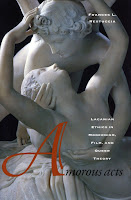
Amorous Acts: Lacanian Ethics in Modernism, Film, and Queer Theory


http://www.amazon.co.uk/gp/product/080475182X/ref=as_li_tl?ie=UTF8&camp=1634&creative=19450&creativeASIN=080475182X&linkCode=as2&tag=freuquot-21
"Amorous Acts" illustrates the value of psychoanalytic theory for comprehending relationships, experiences, art, politics, and all sorts of human interactions. More specifically, it employs psychoanalysis to show how queer theory is operating to effect a non-heterosexist social order. Although the Lacanian subject in Love can only experience his/her self-shattering, Lacan's concept of Love is seen here as politically useful. This study breaks down Lacanian Love into three different forms and tries to unveil the danger, as well as especially the cultural potential, of the most intense of these variations. To arrive at this position, Amorous Acts first works out the meaning of Lacan's "ethics of desire" by analyzing several modern British novels (by E.M. Forster, Virginia Woolf, D.H. Lawrence, and Graham Greene), as well as some contemporary films ("Breaking the Waves," "Seventh Heaven," and "Damage") and then by arguing with Zizek through a reading of Kieslowski's film "White." Finally, queer theory as it has been brought into being by Foucault, Halperin, Bersani, Butler, and Edelman is put into relation with Lacan's notion of the authentic act.Queer theory engages Lacan's conception of self-shattering Love to traverse the pernicious fundamental fantasy of heterosexist reproduction.

The Ethics of Psychoanalysis 1959-1960: The Seminar of Jacques Lacan


http://www.amazon.co.uk/gp/product/0415090547/ref=as_li_tl?ie=UTF8&camp=1634&creative=19450&creativeASIN=0415090547&linkCode=as2&tag=freuquot-21
In his famous seminar on ethics, Jacques Lacan uses this question as his departure point for a re-examination of Freud's work and the experience of psychoanalysis in relation to ethics. Delving into the psychoanalyst's inevitable involvement with ethical questions, Lacan clarifies many of his key concepts. During the seminar he discusses the problem of sublimation, the paradox of jouissance, the essence of tragedy, and the tragic dimension of analytical experience. One of the most influential French intellectuals of this century, Lacan is seen here at the height of his powers.

Introducing Ethics: A Graphic Guide


http://www.amazon.co.uk/gp/product/1848310080/ref=as_li_tl?ie=UTF8&camp=1634&creative=19450&creativeASIN=1848310080&linkCode=as2&tag=freuquot-21&linkId=JFRGK5RAZOLDS36S
What is the place of individual choice and consequence in a post-Holocaust world of continuing genocidal ethnic cleansing? Is “identity” now a last-ditch cultural defence of ethnic nationalisms and competing fundamentalisms? In a climate of instant information, free markets and possible ecological disaster, how do we define “rights”, self-interest and civic duties? What are the acceptable limits of scientific investigation and genetic engineering, the rights and wrongs of animal rights, euthanasia and civil disobedience?”Introducing Ethics” confronts these dilemmas, tracing the arguments of the great moral thinkers, including Socrates, Plato, Aristotle, Hobbes and Kant, and brings us up to date with postmodern critics.


Introducing Graphic Guides - Think for Yourself


Buy Introducing Graphic Guides - Think for Yourself here. - Free delivery worldwide

What can Philosophy do for you?

This box set contains three insightful Introducing Graphic Guides (Ethics, Logic and Philosophy) guaranteed to expand your mind. Using comic-book style illustration combined with accessible but authoritative text, the Introducing Graphic Guide series is a uniquely brilliant way to get your head around some of humankind’s most thrilling ideas.

What is the place of individual choice and consequence in a post-Holocaust world of continuing genocidal ethnic cleansing? Is ‘identity’ now a last-ditch cultural defence of ethnic nationalisms and competing fundamentalisms? In a climate of instant information, free markets and possible ecological disaster, how do we define ‘rights’, self-interest and civic duties? Introducing Ethics confronts these dilemmas, tracing the arguments of the great moral thinkers, including Socrates, Plato, Aristotle, Hobbes and Kant, and brings us up to date with postmodern critics.

Logic is the backbone of Western civilization, holding together its systems of philosophy, science and law. Yet despite logic’s widely acknowledged importance, it remains an unbroken seal for many, due to its heavy use of jargon and mathematical symbolism. Introducing Logic follows the historical development of logic, explains the symbols and methods involved and explores the philosophical issues surrounding the topic. It will take you through the influence of logic on scientific method and the various sciences from physics to psychology, and will show you why computers and digital technology are just another case of logic in action.

Dave Robinson and Judy Groves’ Introducing Philosophy explores the awkward and provocative questions that philosophers have always enjoyed asking, such as: what is the nature of reality? Can we prove that God exists? Does language provide us with a true picture of the world? Comprehensive and enjoyable, it examines the key arguments and ideas off all the significant philosophers of the Western world from Heraclitus to Derrida.


Worldwide Shipping: 🖤 T-Shirts / Hoodies / Mugs / Stickers >>       I WOULD PREFER NOT TO.  
https://www.teepublic.com/t-shirt/1759107-i-would-prefer-not-to-bartleby-zizek
Bartleby, the Scrivener: “I would prefer not to.”
https://www.teepublic.com/t-shirt/1759107-i-would-prefer-not-to-bartleby-zizek
Related Posts Plugin for WordPress, Blogger...