In Bion in Film Theory and Analysis: The retreat in film, Carla Ambrósio Garcia introduces the rich potential of the thinking of British psychoanalyst Wilfred Bion for film theory. By so doing, she rethinks the space of the cinema as a space of retreat, and brings new insights into the representation of retreat in film.
Presented in two parts, the book seeks to deepen our understanding of the film experience and psychical growth. Part I places Bion’s view on the importance of the epistemophilic instinct at the heart of a critique of the pleasure-centred theories of the cinematic apparatus of Jean-Louis Baudry, Christian Metz and Gaylyn Studlar, proposing an idea of cinema as ‘thoughts in search of a thinker’. Garcia then moves from Bion’s epistemological period to his later work, which draws on mysticism, in order to posit an emotional experience in the cinema through which the subject can be or become real (or at one with ‘O’). Part II examines representations of retreat in four European films, directed by Ingmar Bergman, Pier Paolo Pasolini, Georges Perec and Bernard Queysanne, and Manoel de Oliveira, showing them to articulate a gesture of retreat as an emotionally turbulent transitional stage in the development of the psyche – what Bion conceptualizes as caesura.
Through its investigation of the retreat in cinema, the book challenges common understandings of retreat as a regressive movement by presenting it as a gesture and space that can also be future-oriented. Bion in Film Theory and Analysis will be of significant interest to academics and students of psychoanalysis, psychotherapy, and film and media studies, as well as psychoanalysts and psychotherapists.
The premise of this book is that films, like other works of the imagination, may be elucidated by applying methods derived from psychoanalysis, and that doing so will result in a deeper and richer appreciation of the film's meaning. The book explores a number of feature films that lend themselves particularly well to this process. Both in his introduction and throughout the text, the author comments on the method and discusses continuities, similarities and differences among the films.
The book is structured according to the central themes of the films, including time and death, love and lust, secrets, and human identity. Some of the films are relevant to more than one of these thematic elements. The introductory essay explores the themes, their representation in the films, and the ways in which they may be elucidated by a psychoanalytically informed critique. Brief paragraphs between the sections of the book facilitate the transitions.
In an appendix, there are three essays titled 'Mise en Scene,' 'Whatever Flames Upon the Night,' and 'Mad Doctors.' They are relevant to the similarities among movies, dreams and clinical psychoanalysis. From divergent perspectives, they discuss the ways in which acts of representation are fundamentally transgressive and thereby affect alterations in consciousness for those who witness them.
''In the last few days Charlie Chaplin has been in Vienna,'' Freud reported in a letter to a friend written in 1931.
Despite his general lack of interest in cinema and film Freud respects Chaplin as an artist and would have liked to have taken this opportunity to meet him. But no meeting took place.
"Charlie Chaplin has been in Vienna in the last few days, I almost saw him, but it was too cold for him and he left in a hurry. He is without doubt a great artist, though of course he always plays one and the same part, the weak, poor, helpless, clumsy young man for whom things turn out right in the end. Do you think he has to forget his own ego for this role? On the contrary, he only acts himself as he was in his bleak youth. He cannot escape from those impressions and even today he is compensating himself for the deprivations and discouragement of that period. He is, so to speak, a particularly simple and transparent case." [SF-Max Schiller 26.3.1931]
A copy of a 1931 letter from psychoanalyst Sigmund Freud studying the basis of Chaplin’s screen persona as the Little Tramp:
Read Freud’s full analysis of Charlie Chaplin below:
Dear Doctor:
It is such a fascinating experience to have to justify my theories towards Mme. Yvette and Uncle Max. I only wish it were possible otherwise than in writing, in spite of my bad speech and my declining hearing. And I really have not the intention at all to give in to you beyond the confession that we know so little. You know for instance, in the last few days Charlie Chaplin has been in Vienna. Almost I, too, would have seen him, but it was too cold for him here and he left again quickly. He is undoubtedly, a great artist; certainly he always portrays one and the same figure; only the weakly, poor, helpless, clumsy youngster for whom, however, things turn out well in the end. Now do you think that for this role he has to forget his own ego? On the contrary, he always plays only himself as he was in his early dismal youth. He cannot get away from those impressions and to this day he obtains for himself the compensation for the frustrations and humiliations of that past period of his life. He is, so-to-speak, an exceptionally simple and transparent case. The idea that the achievements of artists are intimately bound up with their childhood memories, impressions, repressions and disappointments, has already brought us much enlightenment and has, for that reason, become very precious to us. I once dared to approach analytically one of the greatest of whom we unfortunately know very little: Leonardo da Vinci. I was at least able to make it probable that St. Anne, the Virgin and the Child, which you can visit in the Louvre, cannot be fully understood (comprehensible) without the remarkable childhood history of Leonardo. Nor could, possibly, much else.
But, you will say, Mme. Yvette has not only one role which she repeats. She plays with equal mastery all possible roles: saints and sinners, the coquette, the virtuous, criminals and naives. That is true and it is proof of an immensely rich and adaptable mental life. But I would not despair of tracing back to her experiences and conflicts of her young years the whole repertoire of her art. It would be tempting to continue here, but something holds me back. I know that unwished for analyses arouse misgivings and I do not wish to do anything which might disturb the cordial sympathy which makes up our relationship.
With friendship and greetings for you and Mme. Yvette,
The contents of this book represent a series of experiments in dramatizing Bion’s Memoir of the Future, the primary one being an unfinished film begun in India in the 1980s and directed by Kumar Shahani, 'epic' artfilm maker, most of whose films have been produced in Hindi. The film was inspired and initiated by Bombay psychoanalyst Udayan Patel, and sponsored by the Roland Harris Educational Trust. The cast of actors included Jalal Agha, Tom Alter, Robert Burbage, Nicholas Clay, Neil Cunningham, Carol Drinkwater, Peter Firth, Nigel Hawthorne, Shona Morris, Jonathan Page (as a child), Angela Pleasence, Juliet Reynolds, and Alaknanda Samarth.
The filmscript and a commentary are here included, together with a narrative poem written for Alaknanda Samarth who played the Ayah of Bion’s childhood, and a playscript written for Tom Alter who played the Father. The play is due to be first performed in Bombay and Delhi in February 2016.
An appendix reprints a psychoanalytic study of the Memoir by Donald Meltzer, who was closely involved in the production of the original film.
The book is illustrated by screenshots from the film and the ebook contains video extracts.
Women and men in cinema are imaginary constructs created by filmmakers and their audiences. The film-psychoanalytic approach reveals how movies subliminally influence unconscious reception. On the other hand, the movie is embedded in a cultural tradition: Jean Cocteau‘s film La Belle et la Bête (1946) takes up the classic motif of the animal groom from the story of Cupid and Psyche in Apuleius’ The Golden Ass (originally a tale about the stunning momentum of genuine female desire), liberates it from its baroque educational moral (a girl's virtue and prudence will help her to overcome her sexual fears), and turns it into a boyhood story: inside the ugly rascal there is a good, but relatively boring prince – at least in comparison to the monsters of film history.
In the seventy years since it was made, La Belle et la Bête has inspired numerous interpretations and has been employed by theorists of all genres and interests. In this book, Andreas Hamburger and other contributors consider its background, content, and reception, and explore the impact Cocteau has on our perceptions of beauties and beasts.
Introducing the monster as a suffering person, Cocteau’s film reacts to the disturbing experience of World War II and the Holocaust. It questions hegemonial masculinity, designing a poetic, hallucinatory attempt at healing for a traumatized generation. Moreover, it addresses female and male adolescent development. Its deliberately incredible finale ironically portrays traditional constructs of femininity and masculinity, thus going beyond the scope of a compensatory fairy tale.
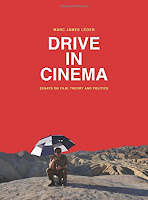
In Drive in Cinema, Marc James Léger presents Žižek-influenced studies of films made by some of the most influential filmmakers of our time, including Jean-Luc Godard, Pier Paolo Pasolini, Werner Herzog, Alexander Kluge, William Klein, Jim Jarmusch, Hal Hartley, Harmony Korine, and more. Working with radical theory and Lacanian ethics, Léger draws surprising connections between art, film, and politics, taking his analysis beyond the academic obsession with cultural representation and filmic technique and instead revealing film’s potential as an emancipatory force.
Loss is an inescapable reality of life, and individuals need to develop a capacity to grieve in order to mature and live life to the full. Yet most western movie audiences live in cultures that do not value this necessary process and filmgoers finding themselves deeply moved by a particular film are often left wondering why. In Cinema as Therapy, John Izod and Joanna Dovalis set out to fill a gap in work on the conjunction of grief, therapy and cinema.
Looking at films including Million Dollar Baby, The Son’s Room, Birth and The Tree of Life, Cinema as Therapy offers an understanding of how deeply emotional life can be stirred at the movies. Izod and Dovalis note that cinema is a medium which engages people in a virtual dialogue with their own and their culture’s unconscious, more deeply than is commonly thought. By analysing the meaning of each film and the root cause of the particular losses featured, the authors demonstrate how our experiences in the movie theatre create an opportunity to prepare psychologically for the inevitable losses we must all eventually face. In recognising that the movie theatre shares symbolic features with both the church and the therapy room, the reader sees how it becomes a sacred space where people can encounter the archetypal and ease personal suffering through laughter or tears, without inhibition or fear, to reach a deeper understanding of themselves.
Cinema as Therapy will be essential reading for therapists, students and academics working in film studies and looking to engage with psychological studies in depth as well as filmgoers who want to explore their relationship with the screen. The book includes a glossary of Jungian and Freudian terms which enhances the clarity of the text and the understanding of the reader.
Christian Metz’s The Imaginary Signifier: Psychoanalysis and the Cinema is--like his Film Language: A Semiotics of the Cinema from seven years earlier--a valuable contribution to semiotic film theory. Yet rather than focusing primarily on the language of cinema itself, Metz turns to Freudian and Lacanian psychoanalysis to deepen his study of the nature of cinematic spectatorship. What we see on screen does not, in essence, exist. The images are imaginary, a play of light and shadow, yet we are still drawn in by an illusion of reality. By way of psychoanalysis, Metz attempts to answer why this is so, including in his scope the cinematic apparatus (the camera and the projector, for example).
The Film Theory in Practice Series fills a gaping hole in the world of film theory. By marrying the explanation of film theory with interpretation of a film, the volumes provide discrete examples of how film theory can serve as the basis for textual analysis. The first book in the series,Psychoanalytic Film Theory and The Rules of the Game, offers a concise introduction to psychoanalytic film theory in jargon-free language and shows how this theory can be deployed to interpret Jean Renoir's classic film. It traces the development of psychoanalytic film theory through its foundation in the thought of Sigmund Freud and Jacques Lacan through its contemporary manifestation in the work of theorists like Slavoj Zizek and Joan Copjec. This history will help students and scholars who are eager to learn more about this important area of film theory and bring the concepts of psychoanalytic film theory into practice through a detailed interpretation of the film.
The awards were inspired by Freud's essay "Delusions and Dreams in Jensen's Gradiva" (1907(1905)), in which he stated, "Creative writers are valuable allies and their evidence is to be prized highly, for they are apt to know a whole host of things between heaven and earth of which our philosophy has not yet let us dream ... they draw upon sources which we have not yet opened up for science."
Reproduction of the Gradiva which hung next to Freud's Couch. Photo by Edmund Engelman, 1938
Recalling Freud's words, National Association for the Advancement of Psychoanalysis (NAAP) established the Gradiva® Awards to honor our "valuable allies," including poets, artists, producers, directors, publishers, etc., who have created works that advance psychoanalysis.
Cleft Tongue: is an attempt to analyse psychic language and its diverse modes of expression, both within psychic structure and in the interpersonal realm.
Shared Realities brings together Jungian analysts and psychoanalysts from across the United States, the United Kingdom, and France.
Student Papers
Michael S. Birnkrant: Should Psychoanalysts Accept Payment via Mental Health Insurance? Ethical Considerations of Third-party Interference in Psychoanalytic Treatment, Boston Graduate School of Psychoanalysis, 2014
Antony Geralis: Listening to One’s Self: An Innovative Approach to Studying the Free Associative Process, New York Graduate School of Psychoanalysis, 2014
Bonnie Irwin: Reaching for the Primitive, Boston Graduate School of Psychoanalysis, 2014
Claude Barbre: Django Unchanged: Identifications with the Oppressor and Intergenerational Cycles of Traumatic Hauntings and Reenactment in Fragments of Trauma and the Social Production of Suffering: Trauma, History, and Memory, in M. O’ Loughlin & M. Charles, eds. Rowman & Littlefield, 2014
Nancy Gerber: Fire and Ice: Poetry & Prose, Arseya Publishing, 2014
Kagayaki Karen Morris:Cataclysm and Other Arrangements, Three Stones Press, 2014
Film
Em Cooper, Filmmaker & Artist: Emergence, 2014
Tommy Lee Jones, Director: The Homesman, 2014
Art
Sandra Indig: Guests of the Sleeping Mind, 60” x 24”, Acrylic on Linen Canvas, Exhibited at the Skirball Gallery, 2014
Janos Marton, Alexandra Plettenberg, & Steven Poser, Curators: Id-Ego-Superego – Art from the Living Museum at Creedmoor Psychiatric Center, Exhibited at CMPS, 2014
Richard Smith, “Star Gazer,” 2008 Acrylic and pen on paper, 8 1/2 ̋ × 12 ̋ Courtesy of the Living Museum at Creedmore.
Considering representations of torture in such television series as 24, Alias, and Homeland; the documentaries Taxi to the Dark Side (2007), Ghosts of Abu Ghraib (2007), and Standard Operating Procedure (2008); and "torture porn" feature films from the Saw and Hostel series, Hilary Neroni unites aesthetic and theoretical analysis to provide a unique portal into theorizing biopower and its relation to the desiring subject.
Her work ultimately showcases film and television studies' singular ability to expose and potentially disable the fantasies that sustain torture and the regimes that deploy it.
Eighth European Psychoanalytic Film Festival 29 October – 1 November 2015, BAFTA London
Films:
Announcements [Annonces]
(Nurith Aviv, 2013, France, 68’)
Synopsis
Announcements (Annonces) is a French documentary that explores words and images in both philosophical and religious contexts. Seven women respond to the theme of ‘announcements,’ taking as their cue the announcements to Hagar, Sarah and Mary in the Old Testament, New Testament, and Koran. In portrait-like interviews, the women reflect not only on universal topics, but also on personal anecdotes and private histories.
Showing at 10.20am on Saturday 31 October
The British Classic: The Browning Version
(Anthony Asquith, 1951, UK, 87’)
Synopsis
We are delighted to announce that our ‘British Classic’ screening for epff8 is Asquith’s 1951 The Browning Version. Based on the successful play by Terence Rattigan, and starring Michael Redgrave and Jean Kent, the picture won best screenplay and best actor at the 1951 Cannes Film Festival. The film tells the story of Andrew Crocker-Harris, a once brilliant scholar reduced to bitterness and pedantry in his role as a Classics teacher at a boys’ school. Loathed by his students and cuckolded by his wife, Andrew is serving his last day at the school due to ill health. However, an encounter with a sympathetic pupil causes him to re-evaluate his actions.
Showing at 8.30pm on Friday 30 October
In the Crosswind [Risttuules]
(Martti Helde, 2014, Estonia, 87’)
Synopsis
In the Crosswind is one of two Estonian films screening at epff8. The film focuses on the Soviets’ deportation of 40,000 Estonians, Lithuanians and Latvians from the Baltic region to Siberia in 1941. Central to the story is Erna, a married philosophy student who is herded onto a train and despatched to the remote area alongside her daughter, Eliide. Over fifteen years, Erna never gives up hope of returning to her home, and the film (beautifully shot in black and white) uses Erna’s experience to both formally and philosophically explore the passage and relativity of time.
Showing at 4.30pm on Saturday 31 October
The Flat
(Arnon Goldfinger, 2011, Israel, 97’)
Synopsis
The second documentary entry in the epff8 programme is the remarkable story of Arnon Goldfinger’s family. The Flat won the Isreali Film Academy Best Documentary in 2011 and begins as a tribute to Goldfinger’s late grandmother, who passed away in Tel Aviv. However, while sorting through her possessions, his family discover evidence of his grandparents’ lasting friendship with Nazi SS officer Leopold von Mildenstein. Repulsed and confused by his findings, Goldfinger undertakes a journey into the past that attempts to make sense of his grandparents’ relationship both to von Mildenstein, and to history.
Showing at 4pm on Friday 30 October
Human Capital [Il capitale umano]
(Paolo Virzì, 2013, Italy 109’)
Synopsis
Adapted from the Stephen Amidon novel and transported from the USA to Italy, Human Capital offers a scathing class critique of contemporary Italian society. Winner of numerous awards, including Best Film at the 2014 Italian Golden Globes, the film opens as a cyclist is run off the road on Christmas Eve. In a series of chapters that take viewers back six months before the incident occurs, Human Capital focuses on three characters whose fates are intertwined by money, consumption and the human capacity for greed.
Showing at 10.50 on Friday 30 October
Ida
(Pawel Pawlikowski, 2013, Poland, 80’)
Synopsis
Ida, nominated for Best Foreign Language Film at the 2015 Academy Awards and BAFTAs, tells the story of Anna, a novice nun in 1960s Poland who is about to take her vows. Before doing so, she discovers that her real name is Anna Lebenstein and that her Jewish parents were killed during World War II. Anna also meets her aunt Wanda, a prosecutor who helped secure support for the communist regime in Poland after the war. The force of history upturns Anna’s ordered, if stark, world. She embarks on a journey to find her parents’ graves alongside Wanda, and in doing so makes a journey of self-discovery that affects both of their futures.
Showing at 4.10pm on Friday 30 October
Leviathan [Leviafan]
(Andrey Zvyagintsev, 2014, Russia, 140’)
Synopsis
Set on the northwest coast of Russia, Academy Award and BAFTA-nominated Leviathan delves into the corruption and injustice that blights the lives of ordinary Russian people. When a corrupt local mayor orders the demolition of Nikolai’s house and business to take control of the land, Nikolai calls on a friend in Moscow to help save his family from ruin. However, their attempts are futile in the face of the ruling elite’s machinations. With its biblical overtones and depictions of class struggle, the Golden Globe winning film paints a bleak picture of life for the inhabitants of Russia’s peripheries.
Showing at 9am on Saturday 31 October
October November [Oktober November]
(Gotz Spielmann, 2013, Austria, 110’)
Synopsis
On learning that her ailing father is dying, successful Berlin-based television and film actress Sonja returns to her family home in small-town Austria. There, she is reunited for the first time in many years with her married sister Verena, who has devoted her life to caring for their sick father. Both sisters must contend not only with the resentment that they feel toward one another, but also with the despair and emptiness that each recognizes in the other.
Showing at 6.10pm on 31 October
Still Life
(Uberto Pasolini, 2013, Italy/UK, 87’)
Synopsis
John is an obsessively organised council worker responsible for locating the next of kin when people die alone. In the rare cases that he cannot find family members, he arranges funerals and often attends as the sole mourner. Immersed in the processes of bereavement and death, John (Eddie Marsan, who won best British actor for the role at the 2013 Edinburgh International Film Festival) is out of step with the modern world. When he learns that his department is being downsized, a complex final case offers him an opportunity to reflect on how he lives his life.
The Eighth Psychoanalytic Film Festival (epff8) will show ten extraordinary feature films that reflect the theme Turning Points: Individuals, Groups, Societies. The programme consists of pictures produced in countries including France, Russia and Estonia and that examine the lives of characters from tangerine farmers in Georgia to wealthy financiers in Italy. The Festival offers guests an excellent opportunity to watch some of the most exciting films in contemporary European cinema, including three nominees for the ‘Best Film in a Foreign Language’ prize at the 2015 Academy Awards.
Using Edward Said's framework - and developments in colonialist and post-colonialist studies - to investigate orientalism in the cinemas of France, England and America, the contributors draw upon feminist analysis, genre criticism, psychoanalytic interpretation and political history. Starting with a demonstration of how colonialist and patriarchal ideologies interrelate in orientalist narrative films, following chapters explore camp and orientalism in selected musicals: the "family romance of orientalism" in "Madame Butterfly" and "Indochine", and Disney's "Aladdin" as a mirror of America's shifting perceptions of the Muslim world. The contributors include Dudley Andrew, Matthew Bernstein, Phebe Chao and Mary Hamer.
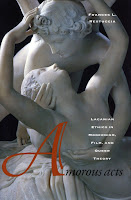
"Amorous Acts" illustrates the value of psychoanalytic theory for comprehending relationships, experiences, art, politics, and all sorts of human interactions. More specifically, it employs psychoanalysis to show how queer theory is operating to effect a non-heterosexist social order. Although the Lacanian subject in Love can only experience his/her self-shattering, Lacan's concept of Love is seen here as politically useful. This study breaks down Lacanian Love into three different forms and tries to unveil the danger, as well as especially the cultural potential, of the most intense of these variations. To arrive at this position, Amorous Acts first works out the meaning of Lacan's "ethics of desire" by analyzing several modern British novels (by E.M. Forster, Virginia Woolf, D.H. Lawrence, and Graham Greene), as well as some contemporary films ("Breaking the Waves," "Seventh Heaven," and "Damage") and then by arguing with Zizek through a reading of Kieslowski's film "White." Finally, queer theory as it has been brought into being by Foucault, Halperin, Bersani, Butler, and Edelman is put into relation with Lacan's notion of the authentic act.Queer theory engages Lacan's conception of self-shattering Love to traverse the pernicious fundamental fantasy of heterosexist reproduction.
Slavoj Žižek is one of the world's most important contemporary public intellectuals. Much of his popularity stems from his constant and recurring references to popular culture and cinema, as well as his own appearances in films such as The Pervert's Guide to Cinema and Examined Life. Although Žižek refers to cinema in order to help explain difficult concepts in his theoretical writing, Matthew Flisfeder argues that Žižek's writing on film radically reorients the scope of contemporary film studies. Returning to questions about ideology and subjectivity, Flisfeder argues that Slavoj Žižek's theories aim to re-politicize film studies and film theory, bringing cinema into the fold of twenty-first century politics.
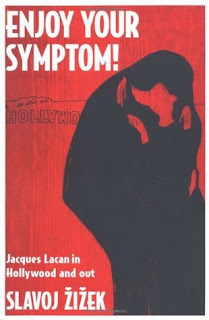
The title is just the first of many startling asides, observations and insights that fill this guide to Hollywood on the Lacanian psychoanalyst’s couch.
Zizek introduces the ideas of Jacques Lacan through the medium of American film, taking his examples from over 100 years of cinema, from Charlie Chaplin to The Matrix and referencing along the way such figures as Lenin and Hegel, Michel Foucault and Jesus Christ. Enjoy Your Symptom! is a thrilling guide to cinema and psychoanalysis from a thinker who is perhaps the last standing giant of cultural theory in the twenty-first century.
Hitchcock gets onto the analyst’s couch in this extraordinary volume of case studies.
The contributors bring to bear an unrivaled enthusiasm and theoretical sweep on the entire Hitchcock oeuvre, analyzing movies such as Rear Window and Psycho. Starting from the premise that ‘everything has meaning,’ the authors examine the films’ ostensible narrative content and formal procedures to discover a rich proliferation of hidden ideological and psychic mechanisms. But Hitchcock is also a bait to lure the reader into a serious Marxist and Lacanian exploration of the construction of meaning.
An extraordinary landmark in Hitchcock studies, this new edition features a brand-new essay by philosopher Slavoj Žižek, presenter of Sophie Fiennes’s three-part documentary The Pervert’s Guide to Cinema.
With contributions by Pascal Bonitzer, Miran Božovič, Michel Chion, Mladen Dolar, Fredric Jameson, Stojan Pelko, Renata Salecl, and Alenka Zupančič