Showing posts with label Film Theory. Show all posts

Critical Flicker Fusion: Psychoanalysis at the Movies


The premise of this book is that films, like other works of the imagination, may be elucidated by applying methods derived from psychoanalysis, and that doing so will result in a deeper and richer appreciation of the film's meaning. The book explores a number of feature films that lend themselves particularly well to this process. Both in his introduction and throughout the text, the author comments on the method and discusses continuities, similarities and differences among the films.

The book is structured according to the central themes of the films, including time and death, love and lust, secrets, and human identity. Some of the films are relevant to more than one of these thematic elements. The introductory essay explores the themes, their representation in the films, and the ways in which they may be elucidated by a psychoanalytically informed critique. Brief paragraphs between the sections of the book facilitate the transitions.

In an appendix, there are three essays titled 'Mise en Scene,' 'Whatever Flames Upon the Night,' and 'Mad Doctors.' They are relevant to the similarities among movies, dreams and clinical psychoanalysis. From divergent perspectives, they discuss the ways in which acts of representation are fundamentally transgressive and thereby affect alterations in consciousness for those who witness them.

Filmed School: Desire, transgression and the filmic fantasy of pedagogy


Filmed School examines the place that teaching holds in the public imaginary through its portrayal in cinema. From early films such as Mädchen in Uniform and La Maternelle to contemporary images of teaching in Notes on a Scandal and The History Boys, teachers’ roles in film have been consistently contradictory, portraying teachers as both seducers and selfless heroes, social outcasts and moral models, contributing to a similarly divided popular understanding of teachers as both salvific and sinister.

In this book, Stillwaggon and Jelinek present these contradictory images of teaching through the concept of transference―the fantastical belief in another’s knowing that founds a teacher’s authority in relation to her students and, to some degree, the public at large. Tracing the place of transference across a century of school films, each chapter demonstrates the persistence of this fantasy in one of the dreams or nightmares of teaching that recurs thematically in school films: the teacher-as-savior, seducer, signifier in a moribund discourse, and sacrificial object. Through these analyses, the authors suggest that something might be missing in our attempts to theorize education when we leave our unthought fantasies of teaching out of the picture.

This book will be of key interest to academics, researchers, and postgraduate students in the fields of educational theory, teacher education, philosophy of education, film and media studies, psychoanalysis, sociology of education, curriculum studies, and cultural studies.

Pixar with Lacan: The Hysteric's Guide to Animation


The films from Pixar Animation Studios belong to the most popular family films today. From Monsters Inc to Toy Story and Wall-E, the animated characters take on human qualities that demand more than just cultural analysis. What animates the human subject according to Pixar? What are the ideological implications?

Pixar with Lacan has the double aim of analyzing the Pixar films and exemplifying important psychoanalytic concepts (the voice, the gaze, partial object, the Other, the object a, the primal father, the name-of-the-father, symbolic castration, the imaginary/ the real/ the symbolic, desire and drive, the four discourses, masculine/feminine), examining the ideological implications of the images of human existence given in the films.

Women and Images of Men in Cinema: Gender Construction in La Belle et la Bête by Jean Cocteau


Women and men in cinema are imaginary constructs created by filmmakers and their audiences. The film-psychoanalytic approach reveals how movies subliminally influence unconscious reception. On the other hand, the movie is embedded in a cultural tradition: Jean Cocteau‘s film La Belle et la Bête (1946) takes up the classic motif of the animal groom from the story of Cupid and Psyche in Apuleius’ The Golden Ass (originally a tale about the stunning momentum of genuine female desire), liberates it from its baroque educational moral (a girl's virtue and prudence will help her to overcome her sexual fears), and turns it into a boyhood story: inside the ugly rascal there is a good, but relatively boring prince – at least in comparison to the monsters of film history.

In the seventy years since it was made, La Belle et la Bête has inspired numerous interpretations and has been employed by theorists of all genres and interests. In this book, Andreas Hamburger and other contributors consider its background, content, and reception, and explore the impact Cocteau has on our perceptions of beauties and beasts.


Introducing the monster as a suffering person, Cocteau’s film reacts to the disturbing experience of World War II and the Holocaust. It questions hegemonial masculinity, designing a poetic, hallucinatory attempt at healing for a traumatized generation. Moreover, it addresses female and male adolescent development. Its deliberately incredible finale ironically portrays traditional constructs of femininity and masculinity, thus going beyond the scope of a compensatory fairy tale.


Drive in Cinema: Essays on Film, Theory and Politics


Buy Drive in Cinema here. - Free delivery worldwide

http://www.amazon.co.uk/gp/product/1783204850/ref=as_li_tl?ie=UTF8&camp=1634&creative=19450&creativeASIN=1783204850&linkCode=as2&tag=freuquot-21
In Drive in Cinema, Marc James Léger presents Žižek-influenced studies of films made by some of the most influential filmmakers of our time, including Jean-Luc Godard, Pier Paolo Pasolini, Werner Herzog, Alexander Kluge, William Klein, Jim Jarmusch, Hal Hartley, Harmony Korine, and more. Working with radical theory and Lacanian ethics, Léger draws surprising connections between art, film, and politics, taking his analysis beyond the academic obsession with cultural representation and filmic technique and instead revealing film’s potential as an emancipatory force.

The Imaginary Signifier: Psychoanalysis and the Cinema


Christian Metz’s The Imaginary Signifier: Psychoanalysis and the Cinema is--like his Film Language: A Semiotics of the Cinema from seven years earlier--a valuable contribution to semiotic film theory. Yet rather than focusing primarily on the language of cinema itself, Metz turns to Freudian and Lacanian psychoanalysis to deepen his study of the nature of cinematic spectatorship. What we see on screen does not, in essence, exist. The images are imaginary, a play of light and shadow, yet we are still drawn in by an illusion of reality. By way of psychoanalysis, Metz attempts to answer why this is so, including in his scope the cinematic apparatus (the camera and the projector, for example).


Psychoanalytic Film Theory and the Rules of the Game


http://www.amazon.co.uk/gp/product/1628920823/ref=as_li_tl?ie=UTF8&camp=1634&creative=19450&creativeASIN=1628920823&linkCode=as2&tag=freuquot-21
The Film Theory in Practice Series fills a gaping hole in the world of film theory. By marrying the explanation of film theory with interpretation of a film, the volumes provide discrete examples of how film theory can serve as the basis for textual analysis. The first book in the series, Psychoanalytic Film Theory and The Rules of the Game, offers a concise introduction to psychoanalytic film theory in jargon-free language and shows how this theory can be deployed to interpret Jean Renoir's classic film. It traces the development of psychoanalytic film theory through its foundation in the thought of Sigmund Freud and Jacques Lacan through its contemporary manifestation in the work of theorists like Slavoj Zizek and Joan Copjec. This history will help students and scholars who are eager to learn more about this important area of film theory and bring the concepts of psychoanalytic film theory into practice through a detailed interpretation of the film.

See also


When Art Imitates Psychoanalysis: Werner Herzog on Klaus Kinski


Werner Herzog on Klaus Kinski during shooting of 'Aguirre'. From "I Am My Films - A Portrait of Werner Herzog" (1978).

The Subject of Torture: Psychoanalysis and Biopolitics in Television and Film


Buy The Subject of Torture here. - Free delivery worldwide

http://www.amazon.co.uk/gp/product/0231170718/ref=as_li_tl?ie=UTF8&camp=1634&creative=19450&creativeASIN=0231170718&linkCode=as2&tag=freuquot-21
Considering representations of torture in such television series as 24, Alias, and Homeland; the documentaries Taxi to the Dark Side (2007), Ghosts of Abu Ghraib (2007), and Standard Operating Procedure (2008); and "torture porn" feature films from the Saw and Hostel series, Hilary Neroni unites aesthetic and theoretical analysis to provide a unique portal into theorizing biopower and its relation to the desiring subject.

Her work ultimately showcases film and television studies' singular ability to expose and potentially disable the fantasies that sustain torture and the regimes that deploy it.

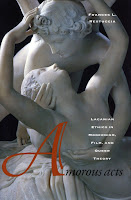
Amorous Acts: Lacanian Ethics in Modernism, Film, and Queer Theory


http://www.amazon.co.uk/gp/product/080475182X/ref=as_li_tl?ie=UTF8&camp=1634&creative=19450&creativeASIN=080475182X&linkCode=as2&tag=freuquot-21
"Amorous Acts" illustrates the value of psychoanalytic theory for comprehending relationships, experiences, art, politics, and all sorts of human interactions. More specifically, it employs psychoanalysis to show how queer theory is operating to effect a non-heterosexist social order. Although the Lacanian subject in Love can only experience his/her self-shattering, Lacan's concept of Love is seen here as politically useful. This study breaks down Lacanian Love into three different forms and tries to unveil the danger, as well as especially the cultural potential, of the most intense of these variations. To arrive at this position, Amorous Acts first works out the meaning of Lacan's "ethics of desire" by analyzing several modern British novels (by E.M. Forster, Virginia Woolf, D.H. Lawrence, and Graham Greene), as well as some contemporary films ("Breaking the Waves," "Seventh Heaven," and "Damage") and then by arguing with Zizek through a reading of Kieslowski's film "White." Finally, queer theory as it has been brought into being by Foucault, Halperin, Bersani, Butler, and Edelman is put into relation with Lacan's notion of the authentic act.Queer theory engages Lacan's conception of self-shattering Love to traverse the pernicious fundamental fantasy of heterosexist reproduction.
Worldwide Shipping: 🖤 T-Shirts / Hoodies / Mugs / Stickers >>       I WOULD PREFER NOT TO.  
https://www.teepublic.com/t-shirt/1759107-i-would-prefer-not-to-bartleby-zizek
Bartleby, the Scrivener: “I would prefer not to.”
https://www.teepublic.com/t-shirt/1759107-i-would-prefer-not-to-bartleby-zizek
Related Posts Plugin for WordPress, Blogger...