Showing posts with label Attachment Theory. Show all posts
Attachment Theory: Working Towards Learned Security
This book covers the groundbreaking concepts in attachment theory, as promulgated by Bowlby himself and during the years post Bowlby. It sets out to develop the seminal concept of 'learned security': the provision of a reparative experience of a secure base by the therapist so that the client can imbibe what he missed out on during his formative years. Rhona M. Fear points out that the idea of learned security has developed from the concept of earned security but is distinctly different.
In Part I, Fear outlines the origins and progress of attachment theory and the concepts of earned and learned security. In Part II, she uses a process of dialectical thinking to put forward an integration of Kohut's self psychology, Bowlby's attachment theory, and Stolorow, Atwood and Brandchaft's intersubjective perspective. The unifying concept that binds these three theories together is that of empathy, but she puts forward a particular intersubjective, collaborative view of empathic attunement. It is through the consistent use of this in the consulting room, combined with the determination to build a coherent sense of narrative of the client's life in a collaborative way, that the author believes a sense of learned security can be achieved.
In Part III, the author introduces us to four case studies of clients whom she believes have achieved a sense of learned security in their work with her in long-term therapy. In the first of these case studies, the client himself presents an account of how he feels that the therapy has impacted upon his life.
This is a definitive account of the development of attachment theory from its very beginnings to the present day that is a must-read for students and experienced analysts alike with its clear explanations, innovative findings, and illustrative case studies.
Attachment-Informed Grief Therapy: The Clinician's Guide to Foundations and Applications
Attachment-Informed Grief Therapy bridges the fields of attachment studies and thanatology, uniting theory, research, and practice to enrich our understanding of how and why people grieve and how we can help the bereaved. In its pages, clinicians and students will gain a new understanding of the etiology of complicated grief and its treatment and will become better equipped to formulate accurate and specific case conceptualization and treatment plans. The authors also illustrate the ways in which the therapeutic relationship is a crucially important―though largely unrecognized―element in grief therapy, and offer guidelines for an attachment informed view of the therapeutic relationship that can serve as the foundation of all grief therapy.
Fifty Years of Attachment Theory: Recollections of Donald Winnicott and John Bowlby
Buy Fifty Years of Attachment Theory here. - Free delivery worldwide
The second volume in the series based on the annual Donald Winnicott Memorial Lecture. Sir Richard Bowlby looks at the personal and professional lives of Donald Winnicott and Dr John Bowlby, to give a fascinating insight into the worlds of these influential analysts.
Selected Books by D.W. Winnicott
Selected Books on D.W. Winnicott
Emotional Development in Psychoanalysis, Attachment Theory and Neuroscience: Creating Connections
Emotional Development in Psychoanalysis, Attachment Theory and Neuroscience is a multi-disciplinary overview of psychological and emotional development, from infancy through to adulthood. Uniquely, it integrates research and concepts from psychology and neurophysiology with psychoanalytic thinking, providing an unusually rich and balanced perspective on the subject. Written by leaders in their field, the chapters cover:
* biological and neurological factors in the unconscious and memory
* the link between genetics and attachment
* the early relationship and the growth of emotional life
* the importance of a developmental framework to inform psychoanalytic work
* clinical work
Drawing on a wide range of detailed case studies with subjects across childhood and adolescence, this book provides a ground-breaking insight into how very different schools of thought can work together to achieve clinical success in work with particularly difficult young patients.
Emotional Development in Psychoanalysis, Attachment Theory and Neuroscience represents the latest knowledge beneficial to child psychiatrists and child psychotherapists, as well as social workers, psychologists, health visitors and specialist teachers.
5 Free Ebooks by John Bowlby ~ (Attachment and Loss 3 volumes, A Secure Base, Maternal Care and Mental Health)
"If a community values its children it must cherish its parents."
― John Bowlby, Maternal Care and Mental Health
A Secure Base: Parent-Child Attachment and Healthy Human Development
As Bowlby himself points out in his introduction to this seminal childcare book, to be a successful parent means a lot of very hard work. Giving time and attention to children means sacrificing other interests and activities, but for many people today these are unwelcome truths. Bowlby’s work showed that the early interactions between infant and caregiver have a profound impact on an infant's social, emotional, and intellectual growth. Controversial yet powerfully influential to this day, this classic collection of Bowlby’s lectures offers important guidelines for child rearing based on the crucial role of early relationships.
•
Attachment and Loss: Attachment (Volume I)
This first volume of John Bowlby’s Attachment and Loss series examines the nature of the child’s ties to the mother. Beginning with a discussion of instinctive behavior, its causation, functioning, and ontogeny, Bowlby proceeds to a theoretical formulation of attachment behavior—how it develops, how it is maintained, what functions it fulfills.In the fifteen years since Attachment was first published, there have been major developments in both theoretical discussion and empirical research on attachment. The second edition, with two wholly new chapters and substantial revisions, incorporates these developments and assesses their importance to attachment theory.
In this classic work of psychology John Bowlby examines the processes that take place in attachment and separation and shows how experimental studies of children provide us with a recognizable behaviour pattern which is confirmed by discoveries in the biological sciences. He makes clear that human attachment is an instinctive response to the need for protection against predators, and one as important for survival as nutrition and reproduction.
•
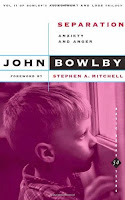
Attachment and Loss: Separation - Anxiety and Anger (Volume II)
Separation, the second volume of Attachment and Loss, continues John Bowlby's influential work on the importance of the parental relationship to mental health.
Here he considers separation and the anxiety that accompanies it: the fear of imminent or anticipated separation, the fear induced by parental threats of separation, and the inversion of the parent-child relationship.
Download Attachment and Loss: Separation - Anxiety and Anger here.
Dr Bowlby re-examines the situations that cause us to feel fear and compares them with evidence from animals. He concludes that fear is initially aroused by certain elemental situations - sudden movement, darkness or separation - which, although intrinsically harmless, are indicative of an increased risk of danger.
•
Free Ebook - Attachment and Loss: Sadness And Depression (Volume III)
In this third and final volume John Bowlby completes the trilogy Attachment and Loss, his much acclaimed work on the importance of the parental relationship to mental health. Here he examines the ways in which young children respond to a temporary or permanent loss of a mother-figure and the expression of anxiety, grief and mourning which accompany such loss. The theories presented differ in many ways from those advanced by Freud and elaborated by his followers, so much so that the frame of reference now offered for understanding personality developement and psychopathology amounts to a new paradigm.
Download Attachment and Loss: Sadness And Depression here.
•
Maternal Care and Mental Health
John Bowlby demonstrates the devastating effects on children of maternal deprivation - effects that ripple through the generations as neglected children often become neglectful parents.
In 1949, Bowlby's earlier work on delinquent and affectionless children and the effects of hospitalised and institutionalised care led to his being commissioned to write the World Health Organization's report on the mental health of homeless children in post-war Europe. The result was Maternal Care and Mental Health published in 1951.
Download Maternal Care and Mental Health here:
Bowlby drew together such limited empirical evidence as existed at the time from across Europe and the USA. His main conclusions, that “the infant and young child should experience a warm, intimate, and continuous relationship with his mother (or permanent mother substitute) in which both find satisfaction and enjoyment” and that not to do so may have significant and irreversible mental health consequences, were both controversial and influential. The 1951 WHO publication was highly influential in causing widespread changes in the practices and prevalence of institutional care for infants and children, and in changing practices relating to the visiting of infants and small children in hospitals by parents. The theoretical basis was controversial in many ways. He broke with psychoanalytic theories which saw infants' internal life as being determined by fantasy rather than real life events. Some critics profoundly disagreed with the necessity for maternal (or equivalent) love to function normally, or that the formation of an ongoing relationship with a child was an important part of parenting. Others questioned the extent to which his hypothesis was supported by the evidence. There was criticism of the confusion of the effects of privation (no primary attachment figure) and deprivation (loss of the primary attachment figure) and in particular, a failure to distinguish between the effects of the lack of a primary attachment figure and the other forms of deprivation and understimulation that may affect children in institutions.
•
The Continuum Concept introduces the idea that in order to achieve optimal physical, mental and emotional development, human beings - especially babies - require the kind of instinctive nurturing as practiced by our ancient relatives. It is a true ‘back to basics’ approach to parenting.
Donald Winnicott and John Bowlby: Personal and Professional Perspectives
Buy Donald Winnicott and John Bowlby: Personal and Professional Perspectives here. - Free delivery worldwide
"Bowlby and Winnicott's students give us new perspectives in a lively, authentic and scholarly picture of these important figures, whose influence and major contributions to many fields is immense. I welcome this informative, entertaining and thought-provoking book and I hope that it will be widely read." --Dr. Mario Marrone
John Bowlby and Donald Winnicott were two of the most notable twentieth century pioneers in the application of psychoanalysis to child development and family studies. A series of essays, written by former students of both men, provides insight into the way they approached their work, in addition to novel and clarifying commentaries on their ideas.
The book covers such subjects as the problems of antisocial children, separation, loss, and grief. It pays attention to the social context and dimension of Bowlby and Winnicott's work and includes a novel examination of their contributions to the 1945 Curtis Committee’s deliberations leading to the landmark 1948 Children’s Act in Great Britain. Their different personalities and scientific attitudes are brought out in a lively and anecdotal way. The book ends with an extensive bibliography that links their own individual work not only to each other, but also to the many and varied strands of research and reflection that owe their origin to D.W. Winnicott and John Bowlby.
Free Ebook - A Secure Base: Parent-Child Attachment and Healthy Human Development by John Bowlby
As Bowlby himself points out in his introduction to this seminal childcare book, to be a successful parent means a lot of very hard work. Giving time and attention to children means sacrificing other interests and activities, but for many people today these are unwelcome truths. Bowlby’s work showed that the early interactions between infant and caregiver have a profound impact on an infant's social, emotional, and intellectual growth. Controversial yet powerfully influential to this day, this classic collection of Bowlby’s lectures offers important guidelines for child rearing based on the crucial role of early relationships.
•
Free Ebook - Attachment and Loss: Sadness And Depression (Volume III) by John Bowlby
In this third and final volume John Bowlby completes the trilogy Attachment and Loss, his much acclaimed work on the importance of the parental relationship to mental health. Here he examines the ways in which young children respond to a temporary or permanent loss of a mother-figure and the expression of anxiety, grief and mourning which accompany such loss. The theories presented differ in many ways from those advanced by Freud and elaborated by his followers, so much so that the frame of reference now offered for understanding personality developement and psychopathology amounts to a new paradigm.
Download Attachment and Loss: Sadness And Depression here.
•
Free Ebook - Attachment and Loss: Separation - Anxiety and Anger (Volume II) by John Bowlby
Separation, the second volume of Attachment and Loss, continues John Bowlby's influential work on the importance of the parental relationship to mental health.
Here he considers separation and the anxiety that accompanies it: the fear of imminent or anticipated separation, the fear induced by parental threats of separation, and the inversion of the parent-child relationship.
Download Attachment and Loss: Separation - Anxiety and Anger here.
Dr Bowlby re-examines the situations that cause us to feel fear and compares them with evidence from animals. He concludes that fear is initially aroused by certain elemental situations - sudden movement, darkness or separation - which, although intrinsically harmless, are indicative of an increased risk of danger.
•
Free Ebook - Attachment and Loss: Attachment (Volume I) by John Bowlby
This first volume of John Bowlby’s Attachment and Loss series examines the nature of the child’s ties to the mother. Beginning with a discussion of instinctive behavior, its causation, functioning, and ontogeny, Bowlby proceeds to a theoretical formulation of attachment behavior—how it develops, how it is maintained, what functions it fulfills.In the fifteen years since Attachment was first published, there have been major developments in both theoretical discussion and empirical research on attachment. The second edition, with two wholly new chapters and substantial revisions, incorporates these developments and assesses their importance to attachment theory.
In this classic work of psychology John Bowlby examines the processes that take place in attachment and separation and shows how experimental studies of children provide us with a recognizable behaviour pattern which is confirmed by discoveries in the biological sciences. He makes clear that human attachment is an instinctive response to the need for protection against predators, and one as important for survival as nutrition and reproduction.
•
The Making and Breaking of Affectional Bonds
Helping both parents and psychologists to arrive at a better understanding of the inner emotional world of the infant, this selection of key lectures by Bowlby includes the seminal one that gives the volume its title. Informed by wide clinical experience, and written with the author's well-known humanity and lucidity, the lectures provide an invaluable introduction to John Bowlby’s thought and work, as well as much practical guidance of use both to parents and to members of the mental health professions.
•
The Milan Seminar: Clinical Applications of Attachment Theory
This edited book contains a hitherto unpublished seminar held by John Bowlby in Milan, Italy in 1985. The seminar is preceded by a foreword by Kate White, of the Bowlby Centre, and by an introduction by the editor, Marco Bacciagaluppi. The introduction contains excerpts from unpublished correspondence between Bowlby and the editor, carried out over a span of eight years, between 1982 and 1990. After the seminar there are the follow-ups of the three cases presented by Leopolda Pelizzaro, Ferruccio Osimo and Emilia Fumagalli, and a report by Germana Agnetti and Angelo Barbato, who gave hospitality to Bowlby and his wife. This is followed by a contribution by Ferruccio Osimo on experiential dynamic psychotherapy, an application of attachment theory, with a long case study. At the end there are some concluding remarks by the editor.
•
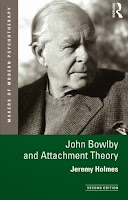
John Bowlby and Attachment Theory
John Bowlby is one of the outstanding psychological theorists of the twentieth century. This new edition of John Bowlby and Attachment Theory is both a biographical account of Bowlby and his ideas and an up-to-date introduction to contemporary attachment theory and research, now a dominant force in psychology, counselling, psychotherapy and child development.
Jeremy Holmes traces the evolution of Bowlby’s work from a focus on delinquency, material deprivation and his dissatisfaction with psychoanalysis's imperviousness to empirical science to the emergence of attachment theory as a psychological model in its own right. This new edition traces the explosion of interest, research and new theories generated by Bowlby’s followers, including Mary Main’s discovery of Disorganised Attachment and development of the Adult Attachment Interview, Mikulincer and Shaver’s explorations of attachment in adults and the key contributions of Fonagy, Bateman and Target. The book also examines advances in the biology and neuroscience of attachment.
Thoroughly accessible yet academically rigorous, and written by a leading figure in the field, John Bowlby and Attachment Theory is still the perfect introduction to attachment for students of psychology, psychiatry, counselling, social work and nursing.
•
John Bowlby - From Psychoanalysis to Ethology: Unravelling the Roots of Attachment Theory
This accessible book draws on unique evidence from oral histories and little–known archive material to shed new light on the working relationships which led to John Bowlby s shift from psychoanalysis to ethology as a frame of reference and ultimately to the development of attachment theory.
- A unique exploration of the origins of Bowlby s ideas and the critical transformation in his thinking offers an alternative to standard accounts of the origin of attachment theory
- Explores the significance of Bowlby s influential working relationships with Robert Hinde, Harry Harlow, James Robertson and Mary Ainsworth
- Provides students, academics, and practitioners with clear insights into the development of attachment theory
- Accessible to general readers interested in psychology and psychoanalysis
•
Love in the Age of the Internet: Attachment in the Digital Era
Buy Love in the Age of the Internet here. - Free delivery worldwide
This highly topical book explores the new technological environment we have created, and our adaptation to it, twenty-five years after the death of John Bowlby. In the space of just a couple of decades, the world has changed radically, and we are changing too: personal computers and smartphones mediate our lives, work, play, and love. Relationships of all kinds are now conducted through mobile phones, email, Skype and social network sites. Attachment theory is concerned with the impact of the external world on internal reality, where twenty-first century experiences encounter the powerful, primitive, and ancient instinct for attachment and survival.
This book is written by psychotherapists whose practice, with individual adults and couples, is informed by attachment theory. It contains theoretical, observational, and clinical material, and will be relevant to all psychotherapists, psychoanalysts, counsellors, and psychologists interested in the profound impact of digital and communication technologies on human relationships: the bond between children and parents in which the child's sense of self develops, attachment between adult couples and within friendship groups and communities, and our relationships with ourselves. The particular kind of 'love' between the practitioner and patient, increasingly influenced by new ways of communicating, is also examined. The implicit question posed is this: does digital technology enhance secure attachment or fuel insecurity, alienation, and psychopathology?
The Continuum Concept: In Search Of Happiness Lost by Jean Liedloff
The Continuum Concept introduces the idea that in order to achieve optimal physical, mental and emotional development, human beings - especially babies - require the kind of instinctive nurturing as practiced by our ancient relatives. It is a true ‘back to basics’ approach to parenting.
Author Jean Liedloff spent two and-a-half years in the jungle deep in the heart of South America living with indigenous tribes and was astounded at how differently children are raised outside the Western world. She came to the realisation that essential child-rearing techniques such as touch, trust and community have been undermined in modern times, and in this book suggests practical ways to regain our natural well-being, for our children and ourselves.
According to Jean Liedloff, the continuum concept is the idea that in order to achieve optimal physical, mental and emotional development, human beings — especially babies — require the kind of experience to which our species adapted during the long process of our evolution. For an infant, these include such experiences as...
Here are some excerpts from the book which define the continuum concept:
Author Jean Liedloff spent two and-a-half years in the jungle deep in the heart of South America living with indigenous tribes and was astounded at how differently children are raised outside the Western world. She came to the realisation that essential child-rearing techniques such as touch, trust and community have been undermined in modern times, and in this book suggests practical ways to regain our natural well-being, for our children and ourselves.
Understanding The Continuum Concept
According to Jean Liedloff, the continuum concept is the idea that in order to achieve optimal physical, mental and emotional development, human beings — especially babies — require the kind of experience to which our species adapted during the long process of our evolution. For an infant, these include such experiences as...
- constant physical contact with his mother (or another familiar caregiver as needed) from birth;
- sleeping in his parents' bed, in constant physical contact, until he leaves of his own volition;
- breastfeeding "on cue" — nursing in response to his own body's signals;
- being constantly carried in arms or otherwise in contact with someone, usually his mother, and allowed to observe (or nurse, or sleep) while the person carrying him goes about his or her business — until the infant begins creeping, then crawling on his own impulse, usually at six to eight months;
- having caregivers immediately respond to his signals (squirming, crying, etc.), without judgment, displeasure, or invalidation of his needs, yet showing no undue concern nor making him the constant center of attention;
- sensing (and fulfilling) his elders' expectations that he is innately social and cooperative and has strong self-preservation instincts, and that he is welcome and worthy.
- traumatic separation from his mother at birth due to medical intervention and placement in maternity wards, in physical isolation except for the sound of other crying newborns, with the majority of male babies further traumatized by medically unnecessary circumcision surgery;
- at home, sleeping alone and isolated, often after "crying himself to sleep";
- scheduled feeding, with his natural nursing impulses often ignored or "pacified";
- being excluded and separated from normal adult activities, relegated for hours on end to a nursery, crib or playpen where he is inadequately stimulated by toys and other inanimate objects;
- caregivers often ignoring, discouraging, belittling or even punishing him when he cries or otherwise signals his needs; or else responding with excessive concern and anxiety, making him the center of attention;
- sensing (and conforming to) his caregivers' expectations that he is incapable of self-preservation, is innately antisocial, and cannot learn correct behavior without strict controls, threats and a variety of manipulative "parenting techniques" that undermine his exquisitely evolved learning process.
Here are some excerpts from the book which define the continuum concept:
...It is no secret that the "experts" have not discovered how to live satisfactorily, but the more they fail, the more they attempt to bring the problems under the sole influence of reason and disallow what reason cannot understand or control.
We are now fairly brought to heel by the intellect; our inherent sense of what is good for us has been undermined to the point where we are barely aware of its working and cannot tell an original impulse from a distorted one.
...[Determining what is good for us] has for many millions of years been managed by the infinitely more refined and knowledgeable areas of the mind called instinct. ... [The] unconscious can make any number of observations, calculations, syntheses, and executions simultaneously and correctly.
...What is meant here by "correct" is that which is appropriate to the ancient continuum of our species inasmuch as it is suited to the tendencies and expectations with which we have evolved. Expectation, in this sense, is founded as deeply in man as his very design. His lungs not only have, but can be said to be, an expectation of air, his eyes are an expectation of light... [etc.]
...The human continuum can also be defined as the sequence of experience which corresponds to the expectations and tendencies of the human species in an environment consistent with that in which those expectations and tendencies were formed. It includes appropriate behavior in, and treatment by, other people as part of that environment.
The continuum of an individual is whole, yet forms part of the continuum of his family, which in turn is part of his clan's, community's, and species' continua, just as the continuum of the human species forms part of that of all life.
...Resistance to change, no way in conflict with the tendency to evolve, is an indispensable force in keeping any system stable.
What interrupted our own innate resistance to change a few thousand years ago we can only guess. The important thing is to understand the significance of evolution versus (unevolved) change. ... [The latter] replaces what is complex and adapted with what is simpler and less adapted.
There is no essential difference between purely instinctive behavior, with its expectations and tendencies, and our equally instinctive expectation of a suitable culture, one in which we can develop our tendencies and fulfill our expectations, first, of precise treatment in infancy, and gradually of a (more flexible) kind of treatment and circumstance, and a range of requirements to which adaptation is ready, eager, and able to be made.
pp. 22-27, The Continuum Concept, Revised edition ©1977, 1985 by Jean Liedloff, published by Addison-Wesley, paperback, 20th printing.
Articles by Jean Liedloff
- The Importance of the In-Arms Phase
- Allowing Human Nature To Work Successfully: A very candid interview with Jean Liedloff, by Michael Mendizza
- Who's In Control? The Unhappy Consequences of Being Child-Centered
- Normal Neurotics Like Us / How does one heal a broken continuum?
- Adopt an Adult Orphan / Another look at Yequana culture
- Questions and Answers: Jean Liedloff Answers Readers' Questions
- Back from Bali: A conversation with Jean Liedloff
- An Interview with Jean Liedloff by Chris Mercogliano of the Albany Freeschool
- Why a Newsletter? / This website replaced the original newsletter, but the article is still relevant.
Additional Helpful Articles
- The Consequences of "Consequences" / by Teresa Pitman. This discipline "technique" is popular, but does it work?
- Finding Your Tribe / by Teresa Pitman. Teresa shares how she created TCC-inspired support relationships with other families.
- Restoring Harmony: A Mother's Story / by Abigail Warren.
- Other Voices / Reviews of TCC and quotes from various authors and visionaries.
- A Review of Baby Carriers
- Infant Carriers and Spinal Stress / A chiropractor (and mother) recommends slings.
- Natural Infant Hygiene: A Gentle Alternative to Long-term Diapering / by Ingrid Bauer, based on her book, Diaper Free!, which is recommended by Jean Liedloff.
- Neurosis / by Dr. Arthur Janov. The originator of Primal Therapy describes how a broken continuum leads to a broken self.
- Images of Yequana Baby-Carrying / A few photos from Jean Liedloff's collection
- Homosexuality and The Continuum Concept / Jean Liedloff comments
Free Ebook - Maternal Care and Mental Health by John Bowlby
John Bowlby demonstrates the devastating effects on children of maternal deprivation - effects that ripple through the generations as neglected children often become neglectful parents.
In 1949, Bowlby's earlier work on delinquent and affectionless children and the effects of hospitalised and institutionalised care led to his being commissioned to write the World Health Organization's report on the mental health of homeless children in post-war Europe. The result was Maternal Care and Mental Health published in 1951.
Bowlby drew together such limited empirical evidence as existed at the time from across Europe and the USA. His main conclusions, that “the infant and young child should experience a warm, intimate, and continuous relationship with his mother (or permanent mother substitute) in which both find satisfaction and enjoyment” and that not to do so may have significant and irreversible mental health consequences, were both controversial and influential. The 1951 WHO publication was highly influential in causing widespread changes in the practices and prevalence of institutional care for infants and children, and in changing practices relating to the visiting of infants and small children in hospitals by parents. The theoretical basis was controversial in many ways. He broke with psychoanalytic theories which saw infants' internal life as being determined by fantasy rather than real life events. Some critics profoundly disagreed with the necessity for maternal (or equivalent) love to function normally, or that the formation of an ongoing relationship with a child was an important part of parenting. Others questioned the extent to which his hypothesis was supported by the evidence. There was criticism of the confusion of the effects of privation (no primary attachment figure) and deprivation (loss of the primary attachment figure) and in particular, a failure to distinguish between the effects of the lack of a primary attachment figure and the other forms of deprivation and understimulation that may affect children in institutions.
In 1949, Bowlby's earlier work on delinquent and affectionless children and the effects of hospitalised and institutionalised care led to his being commissioned to write the World Health Organization's report on the mental health of homeless children in post-war Europe. The result was Maternal Care and Mental Health published in 1951.
Download Maternal Care and Mental Health here:
Bowlby drew together such limited empirical evidence as existed at the time from across Europe and the USA. His main conclusions, that “the infant and young child should experience a warm, intimate, and continuous relationship with his mother (or permanent mother substitute) in which both find satisfaction and enjoyment” and that not to do so may have significant and irreversible mental health consequences, were both controversial and influential. The 1951 WHO publication was highly influential in causing widespread changes in the practices and prevalence of institutional care for infants and children, and in changing practices relating to the visiting of infants and small children in hospitals by parents. The theoretical basis was controversial in many ways. He broke with psychoanalytic theories which saw infants' internal life as being determined by fantasy rather than real life events. Some critics profoundly disagreed with the necessity for maternal (or equivalent) love to function normally, or that the formation of an ongoing relationship with a child was an important part of parenting. Others questioned the extent to which his hypothesis was supported by the evidence. There was criticism of the confusion of the effects of privation (no primary attachment figure) and deprivation (loss of the primary attachment figure) and in particular, a failure to distinguish between the effects of the lack of a primary attachment figure and the other forms of deprivation and understimulation that may affect children in institutions.
•
The Continuum Concept
introduces the idea that in order to achieve optimal physical, mental
and emotional development, human beings - especially babies - require
the kind of instinctive nurturing as practiced by our ancient relatives.
It is a true ‘back to basics’ approach to parenting.
•
Subscribe to:
Posts (Atom)
![]() |
| Bartleby, the Scrivener: “I would prefer not to.” |