Showing posts with label Death. Show all posts

Death and the City: On Loss, Mourning, and Melancholia at Work


Buy Death and the City here. - Free delivery worldwide

Organisational collapse is part of our vernacular. Enron, Woolworths, Lehman’s, Bank of America, Rover, BOAC, Northern Rock – these failures are part of our cultural experience of work. At a time when working lives are often vulnerable and organisational mortality is under threat from technology and the economy the consequences of organizational death are worthy of attention.

Organisations can face many different endings – sharp and brutal, premature, or carefully planned and premeditated – all these endings have emotional collateral damage. We are working in an environment where crises, failure, and demise are everyday features. Closure, merger, downsizing, redundancy, liquidation, insolvency, administration – this is the dialect of organizational life in a recession driven economy. Such vulnerability at work creates challenges for decision making, operational and communication delivery, as well as the loss and suffering of individuals involved.

Death and the City provides an in-depth portrait of an organisation in a palliative state. It transports the analytic concepts of mourning and melancholia and of the death drive into the workplace, and brings this important, but under explored, stream of psychoanalytic thought to the fore as a means of interrogating and further understanding organisational life.

The reader will gain an understanding of the experience and catastrophe of loss in the context of the global financial crisis. The pain of a slow corporate death and the acceptance of failure will be illuminated using psychoanalytic theory helpful to consultants and academics dealing with endings. This book offers an original and in-depth understanding of organisational closure, the inner world of the organisation seen through the inner world of the researcher.

Death deserves contemplation at a time when organisations are experiencing more exposure to endings than at any time in the last century. The book applies insights from psychoanalysis to provide a deeper awareness and understanding of the experience of these endings.

Buy Death and the City here. - Free delivery worldwide

Death and Fallibility in the Psychoanalytic Encounter : Mortal Gifts


Death and Fallibility in the Psychoanalytic Encounter considers psychoanalysis from a fresh perspective: the therapist’s mortality—in at least two senses of the word. That the therapist can die, and is also fallible, can be seen as necessary or even defining components of the therapeutic process. At every moment, the analyst's vulnerability and human limitations underlie the work, something rarely openly acknowledged.

Freud’s central insights continue to guide the range of all talking therapies, but they do so somewhat in the manner of a smudged ancestral map. That blur, or degree of confusion, invites new ways of reading. Ellen Pinsky reexamines fundamental principles underlying by-now-dusty terms such as "neutrality," "abstinence," "working through," and the peculiar expression "termination." Pinsky reconsiders—in some measure, hopes to restore—the most essential, humane, and useful components of the original psychoanalytic perspective, guided by the most productive threads in the discipline's still-evolving theory. Freud's most important contribution was arguably to discover (or invent) the psychoanalytic situation itself. This book reflects on central questions pertaining to that extraordinary discovery: What is the psychoanalytic situation? How does it work (and fail to work)? Why does it work? 

This book aims to articulate what is fundamental and what we can't do without—the psychoanalytic essence—while neither idealizing Freud nor devaluing his achievement. Historically, Freud has been misread, distorted, maligned or, at times, even dismissed. Pinsky reappraises his significance with respect to psychoanalytic writers who have extended, and amended, his thinking. Of particular interest are those psychoanalytic thinkers who, like Freud, are not only original thinkers but also great writers—including D. W. Winnicott and Hans Loewald. 

Covering a broad range of psychoanalytic paradigms, Death and Fallibility in the Psychoanalytic Encounter will bring a fresh understanding of the nature, benefits and pitfalls of psychoanalysis. It will appeal to psychoanalysts and psychoanalytic psychotherapists and provide superb background and inspiration for anyone working across the entire range of talking therapies.


“In mourning it is the world which has become poor and empty; in melancholia it is the ego itself.”


“In mourning it is the world which has become poor and empty; in melancholia it is the ego itself.”

― Sigmund Freud, "Mourning and Melancholia"


In this essay, Freud argues that mourning and melancholia are similar but different responses to loss. In mourning, a person deals with the grief of losing of a specific love object, and this process takes place in the conscious mind. In melancholia, a person grieves for a loss he is unable to fully comprehend or identify, and thus this process takes place in the unconscious mind. Mourning is considered a healthy and natural process of grieving a loss, while melancholia is considered pathological.


See also:


“It is indeed impossible to imagine our own death,”

“It is indeed impossible to imagine our own death,” Sigmund Freud wrote in 1915, “and whenever we attempt to do so, we can perceive that we are in fact still present as spectators. Hence the psychoanalytic school could venture on the assertion that, at bottom, no one believes in his own death, or to put the same thing another way, that, in the unconscious, every one of us is convinced of his own immortality.”

― Sigmund Freud, Thoughts for the Times on War and Death (free online)


Freud and War


Buy Freud and War here. - Free delivery worldwide

During the rise of fascism and anti-Semitism in Germany, Albert Einstein wrote to Sigmund Freud asking the fundamental question: What can be done to liberate humanity from the menace of war? The psychoanalyst replied at length and their exchange of letters (reproduced here) was published in March 1933 under the title Why War?. The book would be included in the book burnings in Berlin on 10th of May that year.

Why War? is important in Freud’s work because in it he develops a fundamental idea that leads him to conclude that the life and death drives are linked – a thought that he had already entertained in works such as Death and Us (1915), which is also included here. In a terrible irony, Freud dedicated a copy of Why War? to Mussolini, who nonetheless instituted a police investigation of its author. The contributors to this volume explore the reasons underlying the dedication, as well as giving their own reflections on the genesis of war.

Contributors include François Ansermet, Marlène Belilos, Philippe De Georges, Eugénie Lemoine-Luccioni, Laura Sokolowsky, Mark Solms, and Jean Ziegler.

Buy Freud and War here. - Free delivery worldwide
 

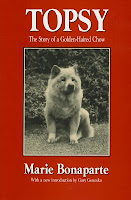
Topsy: The Story of a Golden-haired Chow by Marie Bonaparte


http://www.amazon.co.uk/gp/product/1560001275/ref=as_li_tl?ie=UTF8&camp=1634&creative=19450&creativeASIN=1560001275&linkCode=as2&tag=freuquot-21&linkId=2ISW75KSUL4KGU2D
Topsy is a psychoanalytic tale of the effects of a dog on its owner; the analyst is the great Marie Bonaparte. Only after being told that her dog had cancer did she realize the attachment she developed to Topsy. She describes the emotions she experienced during the time of Topsy's illness and subsequent healing.

Written in France and Greece at the onset of World War II, the story of Topsy's cancer clearly is intended to convey the ills of Europe at that time. Bonaparte's relationship with her dog reveals her own fears about aging, dying, being alone, as well as the uncertainty of the political situation. As she tells her story, Bonaparte is reminded of the experience of her father, who also suffered from cancer.


Topsy, while not written as a scientific study, provides insight into the psychoanalytical effects of relationships between humans and animals. It tells us much about one of psychotherapy's founding personages as well as the members of her professional circle in a critical period of European history. In the new introduction, Gary Genosko reflects on Sigmund Freud's own affection for, and use of, dogs in his analyses. He goes on to describe the relationship between Freud and Bonaparte and how dogs played a significant part in that companionship. Topsy will be of interest to psychologists, psychiatrists, and those who love, and have been loved by dogs.

Princess Marie Bonaparte astride Oscar Nemon’s Topsy, Paris, 1961

Marie Bonaparte —Freud’s friend, confidante, and benefactress, who provided vital help in the dangerous days after the Anschluss.

Staring At The Sun: Being at peace with your own mortality: Overcoming the Terror of Death


http://www.amazon.co.uk/gp/product/0749928786/ref=as_li_tl?ie=UTF8&camp=1634&creative=19450&creativeASIN=0749928786&linkCode=as2&tag=freuquot-21&linkId=MK54LE2G2RTE3264
Over the past quarter century Irvin Yalom has established himself as the world's leading group psychotherapist. In STARING AT THE SUN, he explores how the knowledge of our own mortality affects the unconscious mind of every human being. Tackling the effect of mankind's fear of death - both conscious and unconscious - on life and how we might live it, Yalom explains how we find ourselves in need of the comfort of therapy.

At age 70 and facing his own fear of death, which he discusses in a special afterword, Dr Yalom tackles his toughest subject yet and finds it to be the root cause of patients' fears, stresses and depression. If therapists are to deliver 'the gift of therapy', they must confront the realities of life for themselves and their practice, as must we all.


http://freudquotes.blogspot.co.uk/2015/06/irvin-d-yalom-quotes_8.html
Worldwide Shipping: 🖤 T-Shirts / Hoodies / Mugs / Stickers >>       I WOULD PREFER NOT TO.  
https://www.teepublic.com/t-shirt/1759107-i-would-prefer-not-to-bartleby-zizek
Bartleby, the Scrivener: “I would prefer not to.”
https://www.teepublic.com/t-shirt/1759107-i-would-prefer-not-to-bartleby-zizek
Related Posts Plugin for WordPress, Blogger...