Showing posts with label Peter Gay. Show all posts
Freud: A Life for Our Time
Freud: A Life for Our Time is a 1988 biography of Sigmund Freud, the founder of psychoanalysis, by historian Peter Gay. The work is based partly on new material that has become available since the publication of Ernest Jones' The Life and Work of Sigmund Freud (1953). The book has been praised, but has also been criticized by several authors skeptical of psychoanalysis.
A magisterial contribution to the history of ideas (J. Anthony Lukas), this remarkable biography . . . briskly traces the story of Freud's life and education, deftly weaving the familiar narrative with a style that makes it seem fresh and lively (Chicago Tribune).
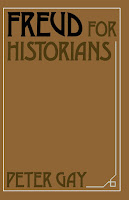
Freud for Historians by Peter Gay
Is psychoanalysis a legitimate tool for helping us understand the past? Many traditional historians have answered with an emphatic no, greeting the introduction of Freud into historical study with responses ranging from condescending skepticism to outrage. Now Peter Gay, one of America's leading historians, builds an eloquent case for "history informed by psychoanalysis" and offers an impressive rebuttal to the charges of the profession's anti-Freudians.
In this book, Gay takes on the opposition's arguments, defending psychoanalysis as a discipline that can enhance social, economic, and literary studies. No mere polemic, Freud for Historians is a thoughtful and detailed contribution to a major intellectual debate.
Freud’s Last War
It was 78 years ago today (September 23, 1939) that Sigmund Freud passed away at the age of 83.
By mid-September 1939, Freud's cancer of the jaw was causing him increasingly severe pain and had been declared to be inoperable. The last book he read, Balzac's La Peau de chagrin, prompted reflections on his own increasing frailty and a few days later he turned to his doctor, friend and fellow refugee, Max Schur, reminding him that they had previously discussed the terminal stages of his illness: "Schur, you remember our 'contract' not to leave me in the lurch when the time had come. Now it is nothing but torture and makes no sense." When Schur replied that he had not forgotten, Freud said, "I thank you," and then "Talk it over with Anna, and if she thinks it's right, then make an end of it." Anna Freud wanted to postpone her father's death, but Schur convinced her it was pointless to keep him alive and on 21 and 22 September administered doses of morphine that resulted in Freud's death on 23 September 1939.
Three days after his death Freud's body was cremated at the Golders Green Crematorium in North London, with Harrods of Knightsbridge acting as funeral directors, on the instructions of his son, Ernst. Funeral orations were given by Ernest Jones and the Austrian author Stefan Zweig. Freud's ashes were later placed in the crematorium's Ernest George Columbarium. They rest on a plinth designed by his son, Ernst, in a sealed ancient Greek urn that Freud had received as a gift from Princess Bonaparte and which he had kept in his study in Vienna for many years. After his wife, Martha, died in 1951, her ashes were also placed in the urn.
By mid-September 1939, Freud's cancer of the jaw was causing him increasingly severe pain and had been declared to be inoperable. The last book he read, Balzac's La Peau de chagrin, prompted reflections on his own increasing frailty and a few days later he turned to his doctor, friend and fellow refugee, Max Schur, reminding him that they had previously discussed the terminal stages of his illness: "Schur, you remember our 'contract' not to leave me in the lurch when the time had come. Now it is nothing but torture and makes no sense." When Schur replied that he had not forgotten, Freud said, "I thank you," and then "Talk it over with Anna, and if she thinks it's right, then make an end of it." Anna Freud wanted to postpone her father's death, but Schur convinced her it was pointless to keep him alive and on 21 and 22 September administered doses of morphine that resulted in Freud's death on 23 September 1939.
![]() |
| Freud at work at his desk in London, in the summer of 1938. He is dressed complete with tie, the faultless bourgeois to the end. (Mary Evans/Sigmund Freud Copyrights, Wivenhoe) |
Three days after his death Freud's body was cremated at the Golders Green Crematorium in North London, with Harrods of Knightsbridge acting as funeral directors, on the instructions of his son, Ernst. Funeral orations were given by Ernest Jones and the Austrian author Stefan Zweig. Freud's ashes were later placed in the crematorium's Ernest George Columbarium. They rest on a plinth designed by his son, Ernst, in a sealed ancient Greek urn that Freud had received as a gift from Princess Bonaparte and which he had kept in his study in Vienna for many years. After his wife, Martha, died in 1951, her ashes were also placed in the urn.
"He is being buried today in the atmosphere he would have wished, one of stark truth and realism; in sheer simplicity, without a note of pomp or ceremony." Ernest Jones, funeral oration 26 Sept. 1939.
"For his discoveries were not, as is so often the case, divorced from the everyday affairs. They were concerned with the very mind of Everyman, with his happiness and more important, his miseries." Edward Glover, The Listener 28 Sept. 1939.
"Freud's work will, when duly appreciated, prove to be of importance, not simply to the student, but to every thinking man. If ever one may venture to acclaim a contemporary as immortal one can do so of Freud....With his death we lose a revered teacher, a wise and inspiring companion, and a man of enduring friendship." Ernest Jones, The Spectator 29 Sept. 1939.
![]() |
| Freud's last home, now dedicated to his life and work as the Freud Museum, 20 Maresfield Gardens, Hampstead, London NW3, England. |
'At bottom, no one believes in his own death, or, to put it another way, in the unconscious every one of us is convinced of his own immortality. [...] Towards the actual person who has died we adopt a special attitude - something almost like admiration for someone who has accomplished a very difficult task.'
- Sigmund Freud, 'Thoughts for the Times on War and Death'
Death of a Stoic
"The war came to Maresfield Gardens early in September, with an air raid alarm. Just to be sure, Freud's bed was moved to the "safe" part of the house, an operation, Schur records, that Freud observed "with a certain interest." He was already "far away", Schur adds. "The distance he had established" a year before, at the time of Munich, "was still more pronounced." But there were still flashes of his wit: when the two men heard a broadcast proclaiming this to be the last war, Schur asked Freud whether he believed it, and Freud replied dryly, "My last war." His bourgeois habits, too, continued to claim him. Schur notes that Freud had a wind-up watch and a seven-day clock, and to his death he wound them up as he had done all his life. "He commented to me, "Schur remembers, "how fortunate he was, that he has found so many valuable friends." Anna had just left the room, which gave Freud the opportunity to tell Schur, "Fate has been good to me, that it should still have granted me the relationship to such a woman - I mean Anna, of course." The comment, Schur adds was utterly tender, even Freud had never been demonstrative with his daughter. She was always at hand, on duty round the clock. So were Schur and Josefine Stross, affectionately known in the Freud family as "Fiffi, " the young pediatrician who had accompanied the Freuds to England and remained close to them.
Freud was very tired now, and it was hard to feed him. But while he suffered greatly and the nights especially were hard, he did not get, and did not want, any sedation. He could still read, and his last book was Balzac's mysterious tale of the magical shrinking skin, La Peau de chagrin. When he had finished the book he told Schur, casually, that this had been the right book for him to read, dealing as it did with shrinking and starvation. It was the shrinking, Anna Freud thought, that seemed to speak particularly to his condition: his time was running out. He spent the last days in his study downstairs, looking out at the garden. Ernest Jones, hastily summoned by Anna Freud, who thought her father was dying, stopped by on September 19. Freud, Jones remembered, was dozing, as he did so much these days, but when Jones called out "Herr Professor, "Freud opened an eye, recognized his visitor, "and waved his hand, then dropped it with a highly expressive gesture that conveyed a wealth of meaning: greetings, farewell, resignation." He then relapsed into his doze.
Jones read Freud's gesture aright. Freud was saluting his old ally for the last time. He had resigned from life. Schur as agonized by his inability to relieve Freud's suffering, but two days after Jones's visit, on September 21, as Schur was sitting by Freud's bedside, Freud took his hand and said to him, "Schur, you remember our 'contract' not to leave me in the lurch when the time had come. Now it is nothing but torture and makes no sense." Schur indicated that he had not forgotten. Freud gave a sigh of relief, kept his hand for a moment, and said, "I thank you." Then, after a slight hesitation, he added, "Talk it over with Anna, and if she thinks it's right, then make an end of it." As she had been for years, so at this juncture, Freud's Antigone was first in his thoughts. Anna Freud wanted to postpone the fatal moment, but Schur insisted that to keep Freud going was pointless, and she submitted to the inevitable, as had her father. The time had come; he knew and acted. This was Freud's interpretation of his saying that he had come to England to die in freedom.
Schur was on the point of tears as he witnessed Freud facing death with dignity and without self-pity. He had never seen anyone die like that. On September 21, Schur injected Freud with three centigrams of morphine - the normal dose for sedation was two centigrams - and Freud sank into a peaceful sleep. Schur repeated the injection, when he became restless, and administered a final one the next day, September 22. Freud lapsed into a coma from which he did not awake. He died at three in the morning, September 23, 1939. Nearly four decades earlier, Freud had written to Oskar Pfister wondering what one would do some day, "when thoughts fail or words will not come? "He could not suppress a "tremor before this possibility. That is why, with all the resignation before destiny that suits an honest man, I have one wholly secret entreaty: only no invalidism, no paralysis of one's powers through bodily misery. Let us die in harness, as King Macbeth says." He had seen to it that his secret entreaty would be fulfilled. The old stoic had kept control of his life to the end."
Excerpt from Freud: A Life for Our Time by Peter Gay
Subscribe to:
Posts (Atom)
![]() |
| Bartleby, the Scrivener: “I would prefer not to.” |