Showing posts with label Melanie Klein. Show all posts

Melanie Klein Revisited: Pioneer and Revolutionary in the Psychoanalysis of Young Children


Buy Melanie Klein Revisited here. - Free delivery worldwide

While much writing has been devoted, predominantly by contemporary Kleinian adult psychoanalysts, to the Kleinian and post Kleinian development of Klein’s work, comparatively little has recently been written about the ongoing importance and character of Klein’s clinical work for contemporary psychoanalytic psychotherapy or analysis with very small children (2 – 6 year olds). Little attention now seems to be paid to the revolutionary character of her work from the start (in the early 1920s) with this age group and its challenges, still relevant today, or to her recognition of the importance of mother-infant relations in the period long before World War II brought investigation into and understanding of problems of attachment, separation and loss. This book addresses these issues and re-explores Klein’s work in these (and other) areas.

This book is concerned primarily with Klein’s work with pre-latency children and aims to give these small children more of the voice today that Melanie Klein herself discovered. Among important new sources are the treatment notes published in Claudia Frank’s seminal book Melanie Klein in Berlin (trans. 2009, Routledge), a rare exception to the current trend of publication for those interested in Klein’s child work.

This book is relevant to professionals working in a wide range of contexts from a range of professional bases, as well as child psychoanalytic psychotherapists and analysts. It will also be of interest to those concerned with the history and development of child psychoanalysis and especially those interested in Melanie Klein’s work in the UK and abroad.

Buy Melanie Klein Revisited here. - Free delivery worldwide

History of Countertransference: From Freud to the British Object Relations School


Buy History of Countertransference here. - Free delivery worldwide

The constant and polymorphous development of the field of psychoanalysis since its inception has led to the evolution of a wide variety of psychoanalytic ‘schools’. In seeking to find common ground between them, Alberto Stefana examines the history of countertransference, a concept which has developed from its origins as an apparent obstacle, to become an essential tool for analysis, and which has undergone profound changes in definition and in clinical use.

In History of Countertransference, Stefana follows the development of this concept over time, exploring a very precise trend which begins with the original notion put forward by Sigmund Freud and leads to the ideas of Melanie Klein and the British object relations school. The book explores the studies of specific psychoanalytic theorists and endeavours to bring to light how the input from each one may have been influenced by previous theories, by the personal history of the analyst, and by their historical-cultural context. By shedding light on how different psychoanalytic groups work with countertransference, Stefana helps the reader to understand the divergences that exist between them.

This unique study of a key psychoanalytical concept will be essential reading for psychoanalysts in practice and in training, and academics and students of psychoanalytic studies and the history of psychology.

Buy History of Countertransference here. - Free delivery worldwide

The Collected Works of Melanie Klein


A cloth-bound four-volume set including Melanie Klein's best-known works.

This is a facsimile edition of the 1975 Hogarth Press four-volume set with a limited print-run of 300.


Volume I - “Love, Guilt and Reparation” and Other Works 1921-1945

1. The Development of a Child (1921)

2. Inhibitions and Difficulties at Puberty (1922)

3. The Role of the School in the Libidinal Development of the Child (1923)

4. Early Analysis (1923)

5. A Contribution to the Psychogenesis of Tics (1925)

6. The Psychological Principles of Early Analysis (1926)

7. Symposium on Child-Analysis (1927)

8. Criminal Tendencies in Normal Children (1927)

9. Early Stages of the Oedipus Conflict (1928)

10. Personification in the Play of Children (1929)

11. Infantile Anxiety Situations Reflected in a Work of Art and in the Creative Impulse (1929)

12. The Importance ofSymbol-Formation in the Development of the Ego (1930)

13. The Psychotherapy of the Psychoses (1930)

14. A Contribution to the Theory of Intellectual Inhibition (I931)

15. The Early Development of Conscience in the Child (1933)

16. On Criminality (I934)

17. A Contribution to the Psychogenesis of Manic-Depressive States (1935)

18. Weaning (1936)

19. Love, Guilt and Reparation (I937)

20. Mourning and its Relation to Manic-Depressive States (1940)

21. The Oedipus Complex in the Light of Early Anxieties (1945)

Volume II - The Psycho-Analysis of Children

Part I

THE TECHNIQUE OF CHILD ANALYSIS

1. The Psychological Foundations of Child Analysis

2. The Technique of Early Analysis

3· An Obsessional Neurosis in a Six-Year-Old Girl

4· The Technique of Analysis in the Latency Period

5· The Technique of Analysis in Puberty

6. Neurosis in Children

7. The Sexual Activities of Children

Part II

EARLY ANXIETY-SITUATIONS AND THEIR EFFECT ON THE DEVELOPMENT OF THE CHILD

8. Early Stages of the Oedipus Conflict and of Super-Ego Formation

9. The Relations Between Obsessional Neurosis and the Early Stages of the Super-Ego

10. The Significance of Early Anxiety-Situations in the Development of the Ego

11. The Effects of Early Anxiety-Situations on the Sexual Development of the Girl

12. The Effects of Early Anxiety-Situations on the Sexual Development of the Boy

Volume III - “Envy and Gratitude” and Other Works 1946-1963

1. Notes on Some Schizoid Mechanisms (1946)

2. On the Theory of Anxiety and Guilt (1948)

3. On the Criteria for the Termination of a Psycho-Analysis (1950)

4· The Origins of Transference (1952)

5· The Mutual Influences in the Development of Ego and Id (1952)

6. Some Theoretical Conclusions Regarding the Emotional Life of the Infant (1952)

7. On Observing the Behaviour ofYoung Infants (1952)

8. The Psycho-Analytic Play Technique: Its History and Significance (1955)

9. On Identification (1955)

10. Envy and Gratitude (1957)

11. On the Development of Mental Functioning (1958)

12. Our Adult World and its Roots in Infancy (1959)

13. A Note on Depression in the Schizophrenic (1960o)

14. On Mental Health (1960)

15. Some Reflections on The Oresteia (1963)

16. On the Sense of Loneliness (1963)

Short Contributions

The Importance of Words in Early Analysis (1927)

Note on 'A Dream of Forensic Interest' (1928)

Theoretical Deductions from an Analysis of Dementia Praecox in Early Infancy (1929)

Review of Woman's Periodicity by Mary Chadwick (1933)

Some Psychological Considerations: A comment (1942)

Volume IV - Narrative of a Child Analysis

Sessions 1-93.

Developments in Object Relations: Controversies, Conflicts, and Common Ground


Developments in Object Relations provides a highly accessible account of how British Object Relations developed in the second half of the twentieth century, focusing on the generation who took up where Klein and Winnicott left off. Complementing and building on its predecessor, An Introduction to Object Relations, it gives an overview of the development of Object Relations with special reference to the Independent and Kleinian traditions.

An introductory chapter defines the key features of Object Relations. The emergence of Object Relations is is then described theoretically from some of Freud’s papers and clinically from the controversial work of Sandor Ferenczi. Similarities and divergences between Kleinian and Independent approaches are considered in detail through the close examination of the work of a key practitioner from each approach, and other significant contributions. Gomez brings clarity to a complex field, discussing what is powerful and problematic about the two main strands in British psychoanalysis. Kleinian and Independent approaches are consistently compared and contrasted, so that readers can develop a clear idea of each. Rather than preferring one to the other, they are presented as different approaches to what is fundamental in psychoanalysis. Chapters on Bion and Masud Khan bring the work of each tradition to life in a fascinating and informative way. Gomez concludes by summarising the claim of psychoanalysis to offer a new way of understanding human reality, particularly useful for readers interested in her second book, The Freud Wars.

Developments in Object Relations will be of great help to psychoanalysts and psychotherapists who work psychoanalytically, particularly those in the process of training, those who have recently qualified and those who are rethinking their position on the different, strongly-held views they encounter. This book is particularly timely when psychoanalytic approaches are under attack from treatments claiming to offer quicker and easier solutions.

Reading Klein


Buy Reading Klein here. - Free delivery worldwide

Reading Klein provides an introduction to the work of one of the twentieth century’s greatest psychoanalysts, known in particular for her contribution in developing child analysis and for her vivid depiction of the inner world. This book makes Melanie Klein’s works highly accessible, providing both substantial extracts from her writings, and material by the authors exploring their significance.

Each chapter corresponds to a major field of Klein’s work outlining its development over almost 40 years. The first part is concerned with her theoretical and clinical contributions. It shows Klein to be a sensitive clinician deeply concerned for her patients, and with a remarkable capacity to understand their unconscious anxieties and to revise our understanding of the mind. The second part sets out the contribution of her ideas to morality, to aesthetics, and to the understanding of society, introducing writing by her associates as well as herself.

The book provides a lucid account of Klein’s published writing, presented by two distinguished writers who know her work well and have made creative use of it in their own clinical and extra-clinical writing. Its aim is to show how substantial her contribution to psychoanalytic thinking and clinical practice was, and how indispensable it remains to understanding the field of psychoanalysis.

Reading Klein will be a highly valuable resource for students, trainees in psychoanalysis, psychoanalytic practitioners, and all who are interested in Melanie Klein and her legacy.

Melanie Klein's works are collected in four volumes:


Selected books on Melanie Klein:

Enjoyment is always bound up with gratitude

“Enjoyment is always bound up with gratitude; if this gratitude is deeply felt it includes the wish to return goodness received and is thus the basis of generosity. There is always a close connection between being able to accept and to give, and both are part of the relation to the good object and therefore counteract loneliness. Furthermore, the feeling of generosity underlies creativeness, and this applies to the infant's most primitive constructive activities as well as to the creativeness of the adult.

The capacity for enjoyment is also the precondition  for a measure of resignation which allows for pleasure in what is available without too much greed for inaccessible gratifications and without excessive resentment about frustration. Such adaptation can already be observed in some young infants. Resignation is bound up with tolerance and with the feeling that destructive impulses will not overwhelm love, and that therefore goodness and life may be preserved.”


― Melanie Klein, Envy And Gratitude And Other Works 1946-1963


The Klein-Winnicott Dialectic: Transformative New Metapsychology and Interactive Clinical Theory


Buy The Klein-Winnicott Dialectic here. - Free delivery worldwide

'The Klein-Winnicott Dialectic: Transformative New Metapsychology and Interactive Clinical Theory' brings together the theories of Melanie Klein and Donald W. Winnicott, two giants and geniuses of the British school of object relations clinical and developmental theory and psychoanalytic technique. In this book, Dr Kavaler-Adler attempts to integrate the theories of Klein and Winnicott, rather than polarising them, as has been done often in the past. This book takes the best of Klein and Winnicott for use by clinicians on an everyday basis, without having the disputes between their followers interfere with the full and rich platter of theoretical offerings they each of them provided. In addition, this book looks at the biographies of Klein and Winnicott, to show how their theories were inspired by their contrasting lives and contrasting parenting and developmental dynamics. By examining their theories in relation to their biographies, one can see why their dialectical theoretical focuses emerged, highly contrasted in their major emphasis, and yet highly complementary when applied together to clinical work. This is a very new perspective. In demonstrating this approach, rich and vivid clinical case illustrations are provided for the reader.


Dr. Susan Kavaler-Adler discusses so-called Klein-Winnicott dialectic, which enriched the object relations clinical theory and technique, as Melanie Klein and Donald Winnicott complemented each other, although they were perceived to be rather polarized.


Melanie Klein's works are collected in four volumes:


Selected books on Melanie Klein:

Melanie Klein, one of the founding figures of psychoanalysis and the "mother" of child psychology

Melanie Klein (30 March 1882 – 22 September 1960) is one of the founding figures of psychoanalysis. Building on the discoveries of Sigmund Freud, she recognised the centrality of the infant’s first relationships with its primary caregivers and, most significantly, she elucidated the early mental processes that build up a person’s inner emotional world.


A pioneering child analyst from Central Europe, she was a controversial and powerful member of the British Psychoanalytical Society for 30 years and her influence is now worldwide.


Through the development of her own distinctive approach to psychoanalysis Klein inaugurated the school of psychoanalysis known as object relations theory, which places the mother-infant relationship at the center of personality development, and influenced the work of prominent psychologists like John Bowlby and Donald Winnicott. Her impact on developmental psychology has thus been indirect but profound.

A drawing by Melanie Klein's 10-year-old patient, 'Richard', of his 'internal family'. Klein wrote a detailed account of Richard's psychoanalytic treatment, undertaken in 1941, in Narrative of a Child Analysis (Karnac, 1961).

Toys used by Melanie Klein in child analysis.

In The Psychoanalytic Play Technique (1955, p122), Klein states that:

“….my work with both children and adults, and my contributions to psycho-analytic theory as a whole, derive ultimately from the play technique evolved with young children. I do not mean by this that my later work was a direct application of the play technique; but the insight that I gained into early development, into unconscious processes, and into the nature of the interpretations by which the unconscious can be approached, has been of far-reaching influence on the work I have done with older children and adults.”


A dinner to celebrate Melanie Klein's 70th birthday

Ernest Jones organises a dinner at Kettner’s (29 Romilly St, Soho) to celebrate Klein’s 70th birthday.

A dinner to celebrate Melanie Klein's 70th birthday, at Kettner's, London. W.1, 1952.

In photograph, clockwise from left: [sitting] Marion Milner, Sylvia Payne, Eric Klein, Roger Money-Kyrle, Clifford Scott, Paula Heimann, James Strachey, Gwen Evans, [unknown], Michael Balint, Judy Klein (wife of Eric Klein), [standing] Melanie Klein, Enest Jones, Herbert Rosenfeld, Joan Riviere, Donald Winnicott


Rare, silent cine footage shows Melanie Klein walking in the garden of her home in Clifton Hill around 1950:


The identity of the filmmaker, and of the gentleman who appears with Klein, are unknown.


Download a transcript of a 1983 BBC Radio 3 documentary about Klein's life and ideas. Made by Professor Richard Wollheim, the documentary featured a range of contributors including Betty Joseph, Elliott Jaques, Katharina Jones (Mrs Ernest Jones), Hanna Segal, Marion Milner and Jo Sandler.


Melanie Klein's works are collected in four volumes:


Selected books on Melanie Klein:


“Although psychology and pedagogy have always maintained the belief that a child is a happy being without any conflicts..

“Although psychology and pedagogy have always maintained the belief that a child is a happy being without any conflicts, and have assumed that the sufferings of adults are the results of the burdens and hardships of reality, it must be asserted that just the opposite is true. What we learn about the child and the adult through psychoanalysis shows that all the sufferings of later life are for the most part repetitions of these earlier ones, and that every child in the first years of life goes through and immeasurable degree of suffering.”

― Melanie Klein, Love, Guilt and Reparation: And Other Works 1921-1945, p. 173


A drawing by Melanie Klein's 10-year-old patient, 'Richard', of his 'internal family'. Klein wrote a detailed account of Richard's psychoanalytic treatment, undertaken in 1941, in Narrative of a Child Analysis (Karnac, 1961)

Winnicott, Klein, Bowlby, Lacan, Anna & Sigmund Freud: 6 Psychoanalytic Theorists Introduced in Animated Videos

Sigmund Freud


Sigmund Freud, the inventor of psychoanalysis, appreciated the many ways in which our minds are troubled and anxious.

Selected Works:


Anna Freud


It's to Anna Freud we owe the genius term 'defensiveness' to describe how most of us get some of the time.

Selected Works:


Melanie Klein


Melanie Klein was a great psychotherapist who teaches us how to stop either idealising or denigrating others.

Selected Works:


John Bowlby


The English psychoanalyst John Bowlby teaches us about Attachment Theory, which is quite simply the best way to understand how and why relationships are tricky.

Selected Works:


Donald Winnicott


Donald Winnicott has lots to teach us about how to look after children - but also about how not to aim for perfection. Being a 'good enough' parent is good enough...

Selected Works:


Jacques Lacan


Jacques Lacan was France’s most famous psychoanalyst, who came up with the intriguing concept of the ‘mirror phase.’

Introductory Books on Lacan:

See also

'What is Psychoanalysis?' is a 4-part educational film series by Freud Museum London​ for students and teachers.

On Being a Patient: A short animation about the experience of psychoanalysis

Melanie Klein walking in the garden (1950)


Some rare, silent cine footage shows Melanie Klein walking in the garden of her home in Clifton Hill at about this time. The identity of the filmmaker, and of the gentleman who appears with Klein, are unknown.

+ complementary dark garden music:


A Casebook of Psychotherapy Practice with Challenging Patients: A Modern Kleinian Approach


Most contemporary psychoanalysts and psychotherapists see each patient once or twice a week at most. As many patients have reached a marked state of distress before seeking treatment, this gives the analyst a difficult task to accomplish in what is a limited amount of time. A Casebook of Psychotherapy Practice with Challenging Patients: A modern Kleinian approach sets out a model for working with quite significantly disturbed, distressed, or resistant patients in a very limited time, which Robert Waska has termed "Modern Kleinian Therapy."

Each chapter provides a vivid look into the moment-to-moment workings of a contemporary Kleinian focus on understanding projective identification, enactment, and acting out as well as the careful and thoughtful interpretive work necessary in these complex clinical situations. Individual psychotherapeutic work is represented throughout the book alongside instructive reports of psychoanalytic work with disturbed couples, and the more challenging patient is illustrated with several comprehensive reviews of films that follow such hard-to-reach individuals.

A Casebook of Psychotherapy Practice with Challenging Patients: A modern Kleinian approach is filled with a combination of contemporary theory building, a wealth of clinical vignettes, and practical advice. It is a hands-on guide for psychoanalysts and therapists who need to get to grips with complex psychoanalytic concepts in a short time and shows the therapeutic power the Modern Kleinian Therapy approach can have and how it can enable them to work most effectively with difficult patients.

Robert Waska LPCC, MFT, PhD is an analytic member at the San Francisco Center for Psychoanalysis and conducts a full-time private psychoanalytic practice for individuals and couples in San Francisco and Marin County, California. He is the author of thirteen published textbooks on Kleinian psychoanalytic theory and technique, is a contributing author for three psychology texts, and has published over a hundred articles in professional journals.

Melanie Klein's works are collected in four volumes:


Selected books on Melanie Klein:

The New Klein-Lacan Dialogues


Buy The New Klein-Lacan Dialogues here. - Free delivery worldwide

http://www.amazon.co.uk/gp/product/1780491182/ref=as_li_tl?ie=UTF8&camp=1634&creative=19450&creativeASIN=1780491182&linkCode=as2&tag=freuquot-21
This book provides a timely exploration and comparison of key concepts in the theories of Melanie Klein and Jacques Lacan, two thinkers and clinicians whose influence over the development of psychoanalysis in the wake of Freud has been profound and far-reaching. Whilst the centrality of the unconscious is a strong conviction shared by both Klein and Lacan, there are also many differences between the two schools of thought and the clinical work that is produced in each. The purpose of this collection is to take seriously these similarities and differences.

Deeply relevant to both theoretical reflection and clinical work, the New Klein-Lacan Dialogues should make interesting reading for psychoanalysts, psychotherapists, mental health professionals, scholars and all those who wish to know more about these two leading figures in the field of psychoanalysis.

The collection centres around key concepts such as: 'symbolic function', the 'ego', the 'object', the 'body', 'trauma', 'autism', 'affect' and 'history and archives'. The authors are internationally renowned writers and clinicians and include: Eva Bahovec, Lionel Bailly, Rachel Blass, Ronald Britton, Catalina Bronstein, Bernard Burgoyne, Robert Hinshelwood, Roberto Ileyassoff, Marie-Christine Laznik, Elias Mallet da Rocha Barros, Catherine Mathelin-Vanier, Maria Rhode, Elisabeth Roudinesco, Richard Rusbridger, Michael Rustin , Paul Verhaeghe and Marcus Vieria.

Re-opening a dialogue first attempted with great success in 1995 ('The Klein-Lacan Dialogues', organised by Catalina Bronstein and Bernard Burgoyne), this book is based on a new international seminar series collaboratively organised by colleagues at UCL, Middlesex University, and the Royal College of Art and held in 2011 under the auspices of the UCL Psychoanalysis Unit.


Melanie Klein's works are collected in four volumes:


Selected books on Melanie Klein:


The Klein-Lacan Dialogues


Buy The Klein-Lacan Dialogues here. - Free delivery worldwide

http://www.amazon.co.uk/gp/product/1782200231/ref=as_li_tl?ie=UTF8&camp=1634&creative=19450&creativeASIN=1782200231&linkCode=as2&tag=freuquot-21
This book records a series of groundbreaking discussions that took place in 1994-95 between a number of prominent Kleinian and Lacanian psychoanalysts. The aim of the presentations and the debates that followed was to allow for dialogue, as well as controversy, to take place. Respecting the convictions of the other and allowing their expression in their own terms became a prerequisite in the dialogue. Topics discussed included phantasy, sexuality, counter-transference, the unconscious, interpretation and technique, and child analysis. The meetings provided an opportunity for reflection upon the implications for respective positions and an appreciation of the sensitivities of both schools.

Among the speakers were Margaret Rustin, Bice Benvenuto, Catalina Bronstein, Bernard Burgoyne, Robert M. Young, Darian Leader, Jane Temperley, Dany Nobus, Robert Hinshelwood, Vicente Palomera, Robin Anderson, Filip Geerardyn, and Marc du Ry. The book is rounded off by contributions from two of the giants of psychoanalysis - Eric Laurent for Lacan and Donald Meltzer for Klein.


Melanie Klein's works are collected in four volumes:


Selected books on Melanie Klein:

Anna Freud, Melanie Klein, and the Psychoanalysis of Children and Adolescents


The central theme of this book is concerned with the controversies on technique between Anna Freud and Melanie Klein in the 1920s and 1930s, and with a clear differentiation between child analysis proper and analytical child psychotherapy. Alex Holder takes into account the historic background in which child psychoanalysis developed, especially World War II and the Nazi regime in Germany. The author also looks at the way child psychoanalysis developed in specific institutions, such as the Hampstead Child Therapy Course in London, and in specific areas, such as the spread of child analysis in the US. The concluding chapter is on the importance of knowledge of child analysis among psychoanalysts working with adults. The differences in the theories of the two "greats" in child analysis, Anna Freud and Melanie Klein, are examined one by one, including such concepts as the role of transference, the Oedipus complex and the superego.

Melanie Klein's works are collected in four volumes:


Selected books on Melanie Klein:

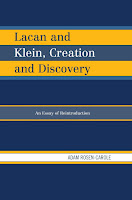
Lacan and Klein, Creation and Discovery: An Essay of Reintroduction


http://www.amazon.co.uk/gp/product/0739164562/ref=as_li_tl?ie=UTF8&camp=1634&creative=19450&creativeASIN=0739164562&linkCode=as2&tag=freuquot-21
On the one hand, Creation and Discovery, Lacan and Klein: An Essay of Reintroduction seeks to disclose the often suppressed or unacknowledged proximity, even intimacy, between Lacan and Klein, and thereby to facilitate a re-introduction between Lacan and Klein such that their works can read anew, both independently and together. On the other hand, by reconstructing the highly divergent metapsychological theories and clinical orientations of Jacques Lacan and Melanie Klein from their discussions of the same case material, the text seeks to demonstrate the irreducible plurality of psychoanalysis and the ethico-political significance of this plurality. Siding with neither Lacan nor Klein's perspective, Adam Rosen-Carole argues that within and between these exaggerated positions, a dialectic of creation and discovery emerges that affords the reader unique insights into the nature and status of psychoanalytic knowing and its particular objects. Special attention is paid to the indelible exaggerations and distortions, the guiding sensitivities and urgencies, and the concomitant structures of blindness and insight organizing various psychoanalytic perspectives.

Written for clinicians as well as for students and scholars interested in psychoanalysis and philosophy, this book serves not only as a comprehensive introduction to Lacan, but also a reassessment of psychoanalytic method.

Lacan and Klein, Creation and Discovery: An Essay of Reintroduction


http://www.amazon.co.uk/gp/product/B009D13VLC/ref=as_li_tl?ie=UTF8&camp=1634&creative=19450&creativeASIN=B009D13VLC&linkCode=as2&tag=freuquot-21
On the one hand, Creation and Discovery, Lacan and Klein seeks to disclose the often suppressed or unacknowledged proximity, even intimacy, between Lacan and Klein, and thereby to facilitate a re-introduction between Lacan and Klein such that their works can read anew, both independently and together. On the other hand, by reconstructing the highly divergent metapsychological theories and clinical orientations of Jacques Lacan and Melanie Klein from their discussions of the same case material, the text seeks to demonstrate the irreducible plurality of psychoanalysis and the ethico-political significance of this plurality.

Siding with neither Lacan nor Klein's perspective, Adam Rosen-Carole argues that within and between these exaggerated positions, a dialectic of creation and discovery emerges that affords the reader unique insights into the nature and status of psychoanalytic knowing and its particular objects. Special attention is paid to the indelible exaggerations and distortions, the guiding sensitivities and urgencies, and the concomitant structures of blindness and insight organizing various psychoanalytic perspectives. Written for clinicians as well as for students and scholars interested in psychoanalysis and philosophy, this book serves not only as a comprehensive introduction to Lacan, but also a reassessment of psychoanalytic method.

Mothers of Psychoanalysis: Helene Deutsch, Karen Horney, Anna Freud, Melanie Klein

This book tells the story of that revolution through biographical portraits of four pioneering figures in the early institutions of psychoanalysis: Helene Deutsch, Karen Horney, Anna Freud, and Melanie Klein.

http://www.amazon.co.uk/gp/product/0393309428/ref=as_li_tl?ie=UTF8&camp=1634&creative=19450&creativeASIN=0393309428&linkCode=as2&tag=freuquot-21

“In lucid, uncluttered prose, Janet Sayers presents the reader with a fresh viewing of the lives and times of four extraordinary women pioneer analysts. Sayers recounts how they were able to shift the theoretic balance of the day to include the creative evolution of their thinking. This book is of value not only for the novice, but certainly for many others who can learn from these excellent, abridged biographies.” —Dr. Helene DeRosis


Love, Guilt And Reparation by Melanie Klein


Love, Guilt and Reparation shows the growth of Melanie Klein`s work and ideas between 1921 and 1945.

http://www.amazon.co.uk/gp/product/0099752816/ref=as_li_tl?ie=UTF8&camp=1634&creative=19450&creativeASIN=0099752816&linkCode=as2&tag=freuquot-21&linkId=UXHBI726WD4C3LFI
The earlier papers reveal her intense proccupation with the impact of infant anxieties upon child development. She traces these influences on criminality and childhood psychosis, symbol formation and intellectual inhibition and the early development of conscience. In the final paper on the Oedipus complex, Klein develops her theories of the earliest infant stages of development, extending Freud`s analysis of the Oedipus complex and laying a basis for her own subsequent conceptualising of the paranoid-schizoid position in the first six months of life.

The volume also contains a foreward by Dr Hanna Segal and explanatory notes by the Editorial Board of the Melanie Klein Trust.


Melanie Klein's works are collected in four volumes:


Selected books on Melanie Klein:

The Psycho-Analysis Of Children by Melanie Klein


http://www.amazon.co.uk/gp/product/0099752913/ref=as_li_tl?ie=UTF8&camp=1634&creative=19450&creativeASIN=0099752913&linkCode=as2&tag=freuquot-21&linkId=FQW7YU76A7RBGFVW
The Psycho-Analysis of Children, first published in 1932, is a classic in its subject, and revolutionised child analysis. Melanie Klein had already proved, by the special technique she devised, that she was a pioneer in that branch of analysis. She made possible the extension of psycho-analysis to the field of early childhood, and in this way not only made the treatment of young children possible but also threw new light on psychological development in childhood and on the roots of adult neuroses and psychoses.


Melanie Klein's works are collected in four volumes:


Selected books on Melanie Klein:


 http://freudquotes.blogspot.co.uk/2014/05/introducing-melanie-klein-graphic-guide.html
Worldwide Shipping: 🖤 T-Shirts / Hoodies / Mugs / Stickers >>       I WOULD PREFER NOT TO.  
https://www.teepublic.com/t-shirt/1759107-i-would-prefer-not-to-bartleby-zizek
Bartleby, the Scrivener: “I would prefer not to.”
https://www.teepublic.com/t-shirt/1759107-i-would-prefer-not-to-bartleby-zizek
Related Posts Plugin for WordPress, Blogger...